The Volkswagen Polo, a name synonymous with compact practicality and German engineering, entered its third generation, internally designated 6N/6KV, in 1994. This iteration marked a significant evolution for the supermini, building upon the success of its predecessors by offering improved refinement, safety, and a broader range of powertrains. Among these, the Volkswagen Polo III (6N/6KV) 1.7 SDI (60 Hp) variant, produced between 1997 and 2000, stood out as a particularly pragmatic choice for European consumers. While never officially imported to the United States, this model played a crucial role in its primary markets, offering exceptional fuel economy and robust reliability in a compact, versatile package. It embodied the Volkswagen philosophy of delivering solid, dependable transportation without unnecessary frills, catering to a demographic that valued running costs and longevity above all else.
The Polo III (6N/6KV) itself was a critical success for Volkswagen, selling millions of units and cementing its position as a segment leader in Europe. The 1.7 SDI, specifically, represented a no-nonsense approach to diesel motoring, foregoing turbocharging for a naturally aspirated direct injection system designed for maximum efficiency and durability. This focus made it an ideal vehicle for urban commuting, long-distance economical travel, and as a reliable daily driver across the continent. Its modest power output was offset by its impressive fuel economy and the inherent torque delivery of a diesel engine, making it feel surprisingly tractable in everyday driving scenarios.
Engine & Performance of the Volkswagen Polo III (6N/6KV) 1.7 SDI (60 Hp)
At the heart of the Volkswagen Polo III (6N/6KV) 1.7 SDI (60 Hp) was its 1.7-liter (1716 cm3 or 104.72 cu. in.) naturally aspirated diesel engine, identified by the engine code AKU. This inline four-cylinder unit, positioned transversely at the front, was engineered for longevity and exceptional fuel efficiency rather than outright speed. It delivered a modest 60 horsepower at 4200 rpm, translating to a power-per-liter figure of 35 Hp/l. While these numbers might seem low by modern standards, they were entirely adequate for the vehicle’s intended purpose within the European supermini segment.
The engine’s torque characteristics were more impressive for its class, producing 115 Nm (84.82 lb.-ft.) at a low 2200 rpm. This early torque delivery was a key feature of the SDI engine, providing a responsive feel in city driving and making the car surprisingly capable of maintaining momentum. The direct injection fuel system, a relatively advanced feature for a naturally aspirated diesel of its time, contributed significantly to both its efficiency and its relatively smooth operation. With a high compression ratio of 19.5:1 and two valves per cylinder, the engine was designed to maximize every drop of diesel fuel.
Performance figures for the Volkswagen Polo III (6N/6KV) 1.7 SDI (60 Hp) reflected its economic focus. Acceleration from 0 to 60 mph was achieved in a leisurely 16.5 seconds, with a top speed of 97.56 mph (157 km/h). These figures were competitive for non-turbo diesel superminis of the era and perfectly acceptable for navigating European roads, where speed limits are often lower and fuel economy is a paramount concern for many drivers. Power was sent to the front wheels via a robust 5-speed manual transmission, a common and reliable setup that further enhanced driver engagement and fuel efficiency.
Where the 1.7 SDI truly shone was in its fuel consumption. The combined cycle consumption was an astounding 4.4 l/100 km, equating to approximately 53.5 US mpg. On the extra-urban cycle, this figure dropped to an incredible 3.6 l/100 km (65.3 US mpg), making it one of the most economical vehicles on the market at the time. With a 45-liter (11.89 US gallon) fuel tank, the Polo 1.7 SDI offered an impressive cruising range, a major selling point for budget-conscious consumers and those needing a dependable commuter.
Design & Features of the Volkswagen Polo III (6N/6KV)
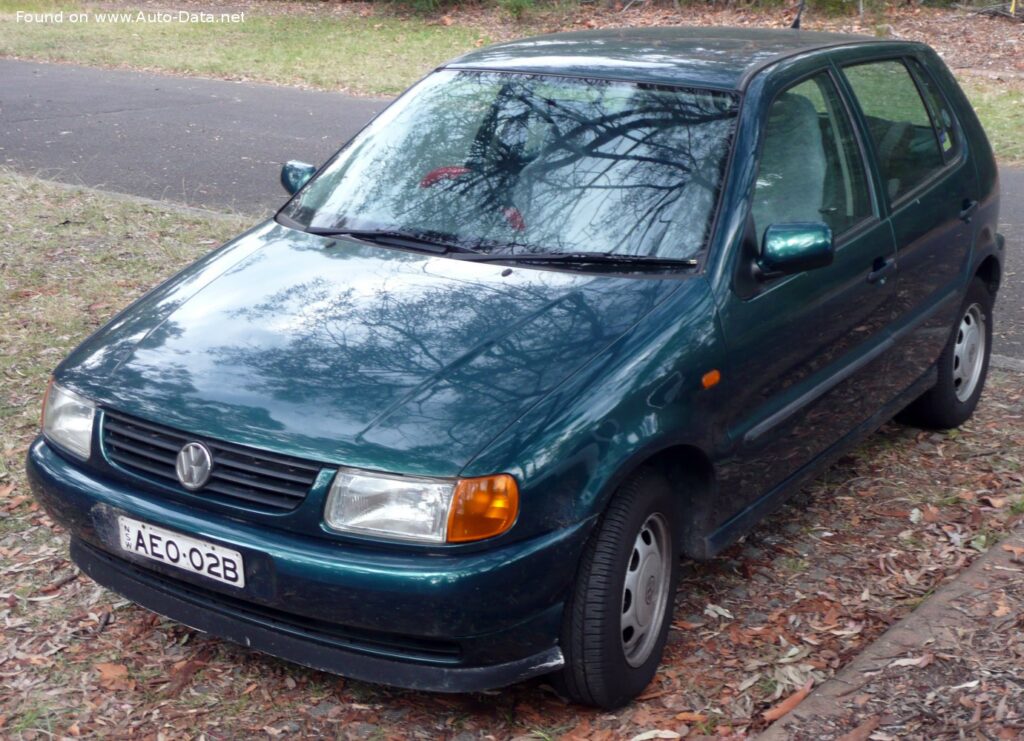
The Volkswagen Polo III (6N/6KV) represented a significant design departure from its boxier predecessor, adopting the more rounded, cohesive aesthetic that characterized Volkswagen models of the mid-to-late 1990s. Available in both 3-door and 5-door hatchback configurations, the Volkswagen Polo III (6N/6KV) 1.7 SDI (60 Hp) offered practical flexibility for various lifestyles. Its dimensions were compact, measuring 146.26 inches in length, 65.16 inches in width, and 55.91 inches in height, with a wheelbase of 94.49 inches, making it agile and easy to maneuver in congested urban environments.
Inside, the Polo III prioritized functionality and ergonomics. The cabin was designed to comfortably accommodate five occupants, though the rear bench was more suited for two adults on longer journeys. Material quality, while not luxurious, was typical Volkswagen: durable, well-assembled, and designed to withstand years of daily use. The trunk space was practical for its class, offering a minimum of 8.65 cu. ft. (245 liters) of cargo volume, which could be expanded to a generous 34.43 cu. ft. (975 liters) by folding down the rear seats, enhancing its versatility for carrying larger items.
In terms of chassis and safety, the Polo III (6N/6KV) featured a conventional but effective setup. The suspension system utilized coil springs at both the front and rear, providing a comfortable ride quality balanced with predictable handling characteristics. The front brakes were ventilated discs, offering good stopping power, while the rear wheels were equipped with drum brakes, a common and cost-effective solution for vehicles in this segment. An important safety feature for the era was the inclusion of ABS (Anti-lock Braking System) as an assisting system, enhancing control during emergency braking maneuvers. The steering system was a hydraulic rack and pinion setup, offering direct feedback to the driver, a hallmark of German automotive engineering.
The vehicle’s curb weight of 2127.46 lbs (965 kg) contributed significantly to its nimble feel and excellent fuel economy. Fitted with 175/65 R13 T tires on 13-inch wheel rims, the Polo III maintained a comfortable and stable stance on the road, perfectly suited for its intended use as an urban and suburban commuter.
Technical Specifications
| Category | Specification |
| Brand | Volkswagen |
| Model | Polo III (6N/6KV) |
| Variant | 1.7 SDI (60 Hp) |
| Production Years | 1997 – 2000 |
| Body Type | Hatchback (3-5 Doors) |
| Seats | 5 |
| Performance | |
| Fuel Type | Diesel |
| Acceleration 0-60 mph | 16.5 sec |
| Acceleration 0-100 km/h | 17.4 sec |
| Maximum Speed | 97.56 mph (157 km/h) |
| Fuel Consumption (Urban) | 39.9 US mpg (5.9 l/100 km) |
| Fuel Consumption (Extra Urban) | 65.3 US mpg (3.6 l/100 km) |
| Fuel Consumption (Combined) | 53.5 US mpg (4.4 l/100 km) |
| Weight-to-Power Ratio | 16.1 kg/Hp |
| Weight-to-Torque Ratio | 8.4 kg/Nm |
| Engine | |
| Power | 60 Hp @ 4200 rpm |
| Torque | 84.82 lb.-ft. (115 Nm) @ 2200 rpm |
| Engine Layout | Front, Transverse |
| Engine Model/Code | AKU |
| Engine Displacement | 1.7 Liters (1716 cm3 / 104.72 cu. in.) |
| Number of Cylinders | 4, Inline |
| Cylinder Bore | 3.13 in. (79.5 mm) |
| Piston Stroke | 3.4 in. (86.4 mm) |
| Compression Ratio | 19.5:1 |
| Valves per Cylinder | 2 |
| Fuel Injection System | Direct injection |
| Engine Aspiration | Naturally aspirated |
| Engine Oil Capacity | 4.97 US qt (4.7 l) |
| Coolant Capacity | 6.87 US qt (6.5 l) |
| Dimensions & Weight | |
| Length | 146.26 in. (3715 mm) |
| Width | 65.16 in. (1655 mm) |
| Height | 55.91 in. (1420 mm) |
| Wheelbase | 94.49 in. (2400 mm) |
| Front Track | 53.19 in. (1351 mm) |
| Rear Track | 54.49 in. (1384 mm) |
| Kerb Weight | 2127.46 lbs (965 kg) |
| Max. Weight | 3163.63 lbs (1435 kg) |
| Max Load | 1036.17 lbs (470 kg) |
| Trunk Space (Min) | 8.65 cu. ft. (245 l) |
| Trunk Space (Max) | 34.43 cu. ft. (975 l) |
| Fuel Tank Capacity | 11.89 US gal (45 l) |
| Drivetrain, Brakes & Suspension | |
| Drivetrain Architecture | Internal Combustion engine drives front wheels |
| Drive Wheel | Front-wheel drive |
| Gearbox Type | 5-speed manual transmission |
| Front Suspension | Coil spring |
| Rear Suspension | Coil spring |
| Front Brakes | Ventilated discs |
| Rear Brakes | Drum |
| Assisting Systems | ABS (Anti-lock braking system) |
| Steering Type | Steering rack and pinion |
| Power Steering | Hydraulic Steering |
| Tires Size | 175/65 R13 T |
| Wheel Rims Size | 13 inches |
The Volkswagen Polo III (6N/6KV) left an indelible mark on the European automotive landscape, and its 1.7 SDI (60 Hp) variant was a significant contributor to its success. This particular model, with its emphasis on economy and durability, carved out a strong niche in a highly competitive segment. Its reputation was built on Volkswagen’s core values: solid build quality, reliability, and excellent running costs. Owners often lauded the 1.7 SDI for its unwavering dependability and its ability to cover vast distances on minimal fuel, making it a favorite among commuters, small businesses, and families seeking an affordable and efficient secondary vehicle.
In its primary markets, the Volkswagen Polo III (6N/6KV) competed fiercely with other popular European superminis. Key rivals included the Ford Fiesta, Opel Corsa (known as Vauxhall Corsa in the UK), Renault Clio, Peugeot 206, and the Fiat Punto. While some competitors might have offered more stylish designs or punchier turbocharged engines, the Polo consistently stood out for its more “grown-up” feel, a perception of higher quality, and its robust engineering. The SDI engine specifically differentiated itself from the burgeoning trend of turbodiesels by offering a simpler, arguably more reliable, and ultimately more economical proposition for those who prioritized efficiency above all else.
The historical significance of the Polo III (6N/6KV) extends beyond its sales figures. It further solidified the Polo’s role as a premium offering in the supermini class, often seen as a smaller, more accessible version of the venerable Golf. The 1.7 SDI engine, in particular, showcased Volkswagen’s early commitment to direct injection diesel technology, even in naturally aspirated form. This laid groundwork for the widespread adoption of TDI (Turbocharged Direct Injection) engines that would come to dominate the European market in subsequent years, demonstrating the potential for diesel to be both efficient and refined, even if the SDI was at the more utilitarian end of the spectrum.
Although the Volkswagen Polo III (6N/6KV) 1.7 SDI (60 Hp) was never marketed in the United States, its influence was felt globally as part of Volkswagen’s broader strategy to offer well-engineered, segment-leading vehicles. It represented a benchmark for what a compact, economical diesel car could be in the late 1990s, setting standards for fuel efficiency and reliability that many competitors aspired to match. Today, these models are remembered fondly in Europe as resilient workhorses, testaments to an era when simplicity, robustness, and outstanding fuel economy were paramount design considerations for the everyday driver.