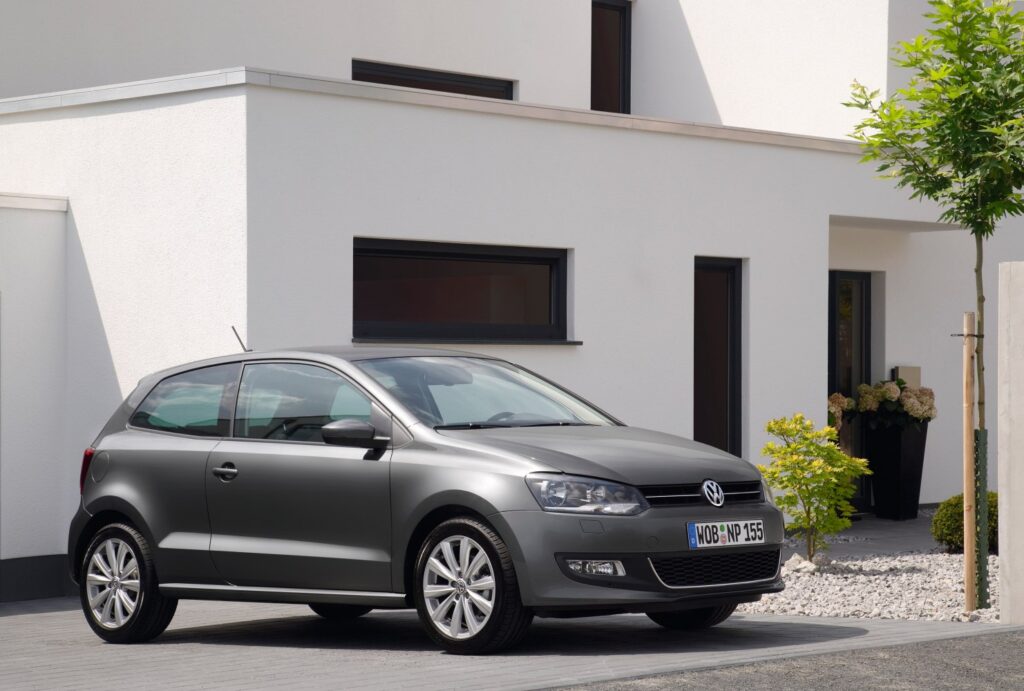
The Volkswagen Polo V (3-door) 1.4 BiFuel, produced for a limited run in 2010, represents a unique offering within the fifth generation of Volkswagen’s popular supermini. This model, primarily aimed at European markets where bi-fuel vehicles were more common due to tax incentives and fuel cost considerations, combined petrol and Liquefied Petroleum Gas (LPG) capabilities. The Polo V, launched in 2009, succeeded the Polo IV and brought with it a more refined design, improved safety features, and a wider range of engine options. The 3-door configuration catered to buyers seeking a sportier aesthetic and often a lower price point compared to the 5-door variant. While not officially sold in the United States, understanding the Polo V BiFuel provides insight into Volkswagen’s broader strategy of offering alternative fuel vehicles and adapting to diverse market demands.
Volkswagen Polo V (3-door) 1.4 BiFuel: A Detailed Overview
The Polo V marked a significant step forward for Volkswagen’s small car lineup. It built upon the success of its predecessors, offering a more sophisticated and modern package. The introduction of the BiFuel variant, specifically the 1.4-liter engine, allowed drivers to switch between petrol and LPG, providing flexibility and potential cost savings. This model was particularly popular in countries with well-developed LPG infrastructure and favorable government policies. The 3-door body style, while less practical than the 5-door, appealed to a younger demographic and those prioritizing a more dynamic appearance.
Engine & Performance
At the heart of the Polo V 1.4 BiFuel lies a 1.390-liter inline four-cylinder engine. This engine is capable of running on either petrol or LPG, with a switchover mechanism allowing seamless transition between the two fuels. When running on petrol, the engine produces 85 horsepower (Hp) at 5000 rpm and 132 Newton-meters (Nm) of torque at 3800 rpm. Switching to LPG slightly reduces the power output to 82 Hp at the same 5000 rpm, with torque dropping to 126 Nm at 3800 rpm. Despite the slight power reduction on LPG, the system offered a viable alternative fuel option. The engine utilizes multi-port fuel injection and a double overhead camshaft (DOHC) valvetrain. Performance figures reflect the engine’s modest output; acceleration from 0 to 100 km/h (0-62 mph) takes 12.7 seconds on petrol and 13.4 seconds on LPG. Top speed is 177 km/h (109.98 mph) on petrol and 174 km/h on LPG. The engine’s power-to-weight ratio is 13.1 kg/Hp, and its torque-to-weight ratio is 8.4 kg/Nm.
Design & Features
The Polo V (3-door) features a contemporary hatchback design typical of early 21st-century Volkswagen styling. The 3-door configuration lends a sportier profile, with a sloping roofline and a relatively compact footprint. The interior is designed to comfortably accommodate five passengers, although rear space is somewhat limited, typical for a supermini. Key features included standard safety equipment for the time, such as Anti-lock Braking System (ABS). The interior trim levels varied, but generally offered a functional and well-built environment. The trunk space is a practical 280 liters (9.89 cubic feet) with the rear seats up, expanding to 952 liters (33.62 cubic feet) when the rear seats are folded down. The car’s drag coefficient of 0.32 contributes to reasonable fuel efficiency. The Polo V prioritized practicality and build quality, aligning with Volkswagen’s reputation for producing reliable and well-engineered vehicles.
Technical Specifications
| Brand | Volkswagen |
| Model | Polo |
| Generation | Polo V (3-door) |
| Type (Engine) | 1.4 BiFuel (85/82 Hp) LPG |
| Start of production | 2010 |
| End of production | 2010 |
| Powertrain Architecture | Internal Combustion engine |
| Body type | Hatchback |
| Seats | 5 |
| Doors | 3 |
| Fuel consumption (economy) – urban (NEDC) | 8.3 l/100 km (28.3 US mpg, 34 UK mpg, 12 km/l) |
| Fuel consumption (economy) – urban (LPG) (NEDC) | 10.9 l/100 km |
| Fuel consumption (economy) – extra urban (NEDC) | 4.9 l/100 km (48 US mpg, 57.6 UK mpg, 20.4 km/l) |
| Fuel consumption (economy) – extra urban (LPG) (NEDC) | 6.5 l/100 km |
| Fuel consumption (economy) – combined (NEDC) | 6.1 l/100 km (38.6 US mpg, 46.3 UK mpg, 16.4 km/l) |
| Fuel consumption (economy) – combined (LPG) (NEDC) | 8.1 l/100 km |
| CO2 emissions (NEDC) | 146 g/km |
| CO2 emissions (LPG) (NEDC) | 132 g/km |
| Fuel Type | Petrol / LPG |
| Acceleration 0 – 100 km/h | 12.7 sec |
| Acceleration 0 – 62 mph | 12.7 sec |
| Acceleration 0 – 100 km/h (LPG) | 13.4 sec |
| Acceleration 0 – 60 mph (Calculated by Auto-Data.net) | 12.1 sec |
| Maximum speed | 177 km/h (109.98 mph) |
| Maximum speed (LPG) | 174 km/h |
| Emission standard | Euro 5 |
| Weight-to-power ratio | 13.1 kg/Hp |
| Weight-to-torque ratio | 8.4 kg/Nm |
| Power | 85 Hp @ 5000 rpm |
| Power per litre | 61.2 Hp/l |
| Power (LPG) | 82 Hp @ 5000 rpm |
| Power per litre (LPG) | 59 Hp/l |
| Torque | 132 Nm @ 3800 rpm (97.36 lb.-ft. @ 3800 rpm) |
| Torque (LPG) | 126 Nm @ 3800 rpm |
| Engine layout | Front, Transverse |
| Engine Model/Code | EA111 / CMAA |
| Engine displacement | 1390 cm3 (84.82 cu. in.) |
| Number of cylinders | 4 |
| Engine configuration | Inline |
| Cylinder Bore | 76.5 mm (3.01 in.) |
| Piston Stroke | 75.6 mm (2.98 in.) |
| Compression ratio | 10.5:1 |
| Number of valves per cylinder | 4 |
| Fuel injection system | Multi-port manifold injection |
| Engine aspiration | Naturally aspirated engine |
| Valvetrain | DOHC |
| Engine oil capacity | 3.2 l (3.38 US qt | 2.82 UK qt) |
| Coolant | 5.6 l (5.92 US qt | 4.93 UK qt) |
| Kerb Weight | 1113 kg (2453.74 lbs.) |
| Max. weight | 1570 kg (3461.26 lbs.) |
| Max load | 457 kg (1007.51 lbs.) |
| Trunk (boot) space – minimum | 280 l (9.89 cu. ft.) |
| Trunk (boot) space – maximum | 952 l (33.62 cu. ft.) |
| Fuel tank capacity | 45 l (11.89 US gal | 9.9 UK gal) |
| Fuel tank capacity (LPG) | 52 l |
| Max. roof load | 75 kg (165.35 lbs.) |
| Permitted trailer load with brakes (8%) | 1200 kg (2645.55 lbs.) |
| Permitted trailer load with brakes (12%) | 1000 kg (2204.62 lbs.) |
| Permitted trailer load without brakes | 560 kg (1234.59 lbs.) |
| Permitted towbar download | 50 kg (110.23 lbs.) |
| Length | 3970 mm (156.3 in.) |
| Width | 1682 mm (66.22 in.) |
| Width including mirrors | 1901 mm (74.84 in.) |
| Height | 1462 mm (57.56 in.) |
| Wheelbase | 2470 mm (97.24 in.) |
| Front track | 1463 mm (57.6 in.) |
| Rear (Back) track | 1456 mm (57.32 in.) |
| Front overhang | 839 mm (33.03 in.) |
| Rear overhang | 661 mm (26.02 in.) |
| Ride height (ground clearance) | 153 mm (6.02 in.) |
| Drag coefficient (Cd) | 0.32 |
| Minimum turning circle (turning diameter) | 10.6 m (34.78 ft.) |
| Approach angle | 13.3° |
| Departure angle | 19.5° |
| Ramp-over (brakeover) angle | 11.1° |
| Drivetrain Architecture | The Internal combustion engine (ICE) drives the front wheels of the vehicle. |
| Drive wheel | Front wheel drive |
| Number of gears and type of gearbox | 5 gears, manual transmission |
| Front suspension | Independent, type McPherson with coil spring and anti-roll bar |
| Rear suspension | Coil spring, Torsion |
| Front brakes | Ventilated discs, 256×22 mm |
| Rear brakes | Disc, 232×9 mm |
| Assisting systems | ABS (Anti-lock braking system) |
| Steering type | Steering rack and pinion |
| Power steering | Electric Steering |
| Tires size | 175/70 R14; 185/60 R15 |
| Wheel rims size | 5J x 14; 6J x 15 |