
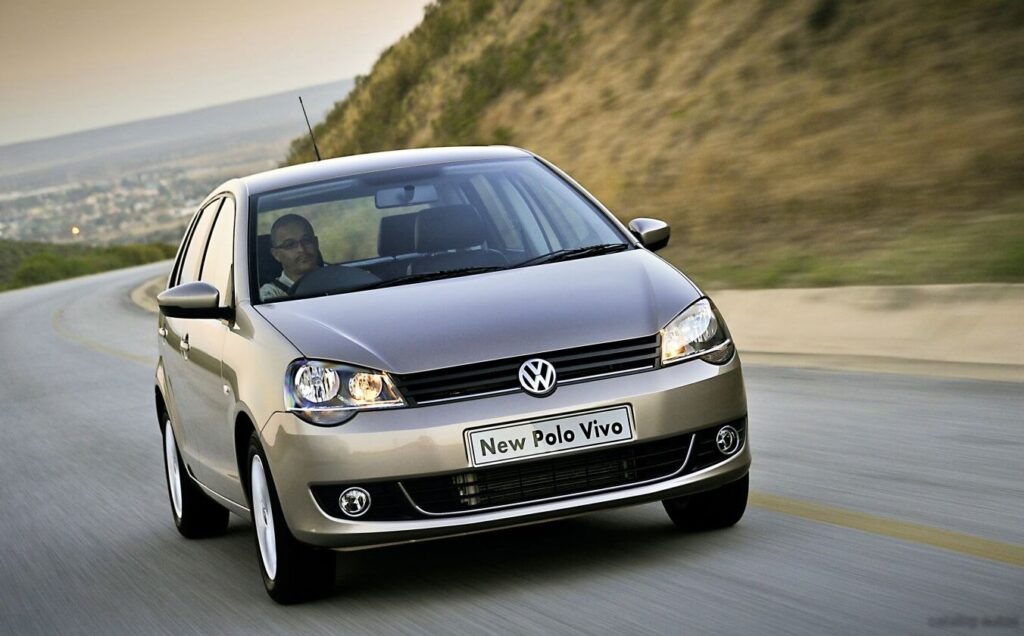
The Volkswagen Polo Vivo I 1.6, producing 105 horsepower, was a key variant in the South African market from 2010 to 2017. Positioned as a practical and affordable entry point into the Polo range, the Vivo represented a continuation of the Polo Mk5 platform specifically tailored for the needs of buyers in that region. It served as a replacement for the Citi Golf, offering a more modern vehicle while maintaining a similar price point. This model occupied a mid-range position within the Vivo lineup, offering a balance between performance and fuel efficiency compared to lower-powered options and the more expensive, higher-specification trims.
Technical Specifications
| Brand | Volkswagen |
| Model | Polo Vivo |
| Generation | Polo Vivo I |
| Type (Engine) | 1.6 (105 Hp) |
| Start of production | 2010 |
| End of production | 2017 |
| Powertrain Architecture | Internal Combustion engine |
| Body type | Hatchback |
| Seats | 5 |
| Doors | 5 |
| Fuel consumption (urban) | 9 l/100 km (26.1 US mpg, 31.4 UK mpg, 11.1 km/l) |
| Fuel consumption (extra urban) | 5.2 l/100 km (45.2 US mpg, 54.3 UK mpg, 19.2 km/l) |
| Fuel consumption (combined) | 6.6 l/100 km (35.6 US mpg, 42.8 UK mpg, 15.2 km/l) |
| CO2 emissions | 156 g/km |
| Fuel Type | Petrol (Gasoline) |
| Acceleration 0 – 100 km/h | 10.6 sec |
| Acceleration 0 – 62 mph | 10.6 sec |
| Acceleration 0 – 60 mph | 10.1 sec |
| Maximum speed | 187 km/h (116.2 mph) |
| Weight-to-power ratio | 10.4 kg/Hp, 96.4 Hp/tonne |
| Weight-to-torque ratio | 7 kg/Nm, 142.3 Nm/tonne |
| Power | 105 Hp @ 5250 rpm |
| Power per litre | 65.7 Hp/l |
| Torque | 155 Nm @ 3500 rpm (114.32 lb.-ft. @ 3500 rpm) |
| Engine layout | Front, Transverse |
| Engine Model/Code | CLSA |
| Engine displacement | 1598 cm3 (97.52 cu. in.) |
| Number of cylinders | 4 |
| Engine configuration | Inline |
| Cylinder Bore | 76.5 mm (3.01 in.) |
| Piston Stroke | 86.9 mm (3.42 in.) |
| Compression ratio | 10.5:1 |
| Number of valves per cylinder | 4 |
| Fuel injection system | Multi-port manifold injection |
| Engine aspiration | Naturally aspirated engine |
| Valvetrain | DOHC |
| Engine oil capacity | 3.6 l (3.8 US qt | 3.17 UK qt) |
| Kerb Weight | 1089 kg (2400.83 lbs.) |
| Trunk (boot) space – minimum | 270 l (9.53 cu. ft.) |
| Trunk (boot) space – maximum | 635 l (22.42 cu. ft.) |
| Fuel tank capacity | 45 l (11.89 US gal | 9.9 UK gal) |
| Length | 3916 mm (154.17 in.) |
| Width | 1650 mm (64.96 in.) |
| Height | 1467 mm (57.76 in.) |
| Wheelbase | 2462 mm (96.93 in.) |
| Front track | 1434 mm (56.46 in.) |
| Rear (Back) track | 1426 mm (56.14 in.) |
| Ride height (ground clearance) | 115 mm (4.53 in.) |
| Minimum turning circle | 10.6 m (34.78 ft.) |
| Drivetrain Architecture | Front wheel drive |
| Number of gears and type of gearbox | 5 gears, manual transmission |
| Front suspension | Spring Strut, Wishbone |
| Rear suspension | Spring Strut, Trailing arm, Torsion |
| Front brakes | Disc |
| Rear brakes | Drum |
| Assisting systems | ABS (Anti-lock braking system) |
| Steering type | Steering rack and pinion |
| Power steering | Hydraulic Steering |
| Tires size | 185/60 R15 |
| Wheel rims size | 6J x 15 |
INTRODUCTION
The Volkswagen Polo Vivo I 1.6, launched in 2010, was a crucial model for Volkswagen South Africa. Designed to replace the long-running Citi Golf, the Vivo offered a more contemporary vehicle while remaining accessible to a broad range of buyers. Built on the Polo Mk5 platform (specifically the 6Y series), the Vivo was adapted for local manufacturing and market conditions. The 1.6-liter, 105 hp variant was a popular choice, offering a good balance of performance, fuel economy, and affordability. It represented a step up from the base models, providing a more refined driving experience without the higher price tag of the more powerful trims.
Powertrain & Engine Architecture
The heart of the Polo Vivo I 1.6 is the CLSA engine code, a 1.6-liter inline-four cylinder petrol engine. This engine is a naturally aspirated unit utilizing a multi-port fuel injection system. The engine features a double overhead camshaft (DOHC) valvetrain with four valves per cylinder, contributing to its relatively efficient power output. The 105 horsepower peak is achieved at 5250 rpm, while the 155 Nm (114.32 lb.-ft.) of torque is available at 3500 rpm. The engine’s 10.5:1 compression ratio is typical for a naturally aspirated petrol engine of this era. The engine is transversely mounted, driving the front wheels. The transmission paired with this engine is a five-speed manual gearbox, chosen for its simplicity and cost-effectiveness. While an automatic transmission was offered on other Vivo models, it wasn’t available with the 1.6-liter 105 hp engine.
Driving Characteristics
The Polo Vivo I 1.6 with the five-speed manual transmission delivers a practical and predictable driving experience. Acceleration from 0-100 km/h takes approximately 10.6 seconds, which is adequate for everyday driving but doesn’t offer particularly sporty performance. The gear ratios are well-suited for urban and highway use, providing sufficient torque for overtaking maneuvers. Compared to the higher-output Polo Vivo models (like those with the 1.9 TDI diesel engine), the 1.6 feels less powerful, especially when fully loaded. However, it offers a smoother and more linear power delivery than the smaller-displacement engines in the range. The manual transmission allows for greater driver control and contributes to better fuel economy compared to an automatic.
Equipment & Trim Levels
The Polo Vivo I 1.6 typically came equipped with a reasonable level of standard features. These included power steering, central locking, an immobilizer, and basic audio system. Interior upholstery was typically cloth, with a functional and durable design. Air conditioning was often an optional extra, as were power windows and alloy wheels. The dashboard layout was straightforward and easy to use, prioritizing practicality over luxury. Higher trim levels within the Vivo range offered features like upgraded audio systems, more sophisticated interior trim, and additional safety equipment, but the 1.6 model focused on providing essential features at an affordable price.
Chassis & Braking
The Polo Vivo I 1.6 utilizes a MacPherson strut front suspension and a torsion beam rear suspension. This setup provides a comfortable ride quality, suitable for the often-challenging road conditions found in South Africa. The front brakes are ventilated discs, while the rear brakes are drums. ABS (Anti-lock Braking System) was standard, enhancing safety during emergency braking situations. The chassis is relatively lightweight, contributing to the car’s decent fuel economy and handling. Stabilizer bars were fitted to both the front and rear axles to reduce body roll during cornering.
Market Reception & Comparison
The Polo Vivo I 1.6 was well-received in the South African market, largely due to its affordability and practicality. Critics praised its robust build quality and relatively low running costs. Compared to the base-model Vivos with smaller engines, the 1.6 offered a noticeable improvement in performance. However, it was often seen as a compromise compared to the more powerful and refined Polo models available in other markets. The 1.9 TDI diesel variant offered superior fuel economy and torque, but at a higher purchase price. The 1.6’s simplicity and reliability made it a popular choice for first-time car buyers and those seeking a dependable daily driver.
Legacy
The Polo Vivo I 1.6 has proven to be a reliable and durable vehicle, with many examples still on the road today. The CLSA engine is known for its robustness and relatively straightforward maintenance requirements. Used examples are readily available and typically offer good value for money. While not a particularly exciting or technologically advanced vehicle, the Vivo I 1.6 represents a significant chapter in Volkswagen South Africa’s history, providing affordable and dependable transportation to a wide range of customers. Its continued presence in the used car market is a testament to its enduring quality and practicality.

