
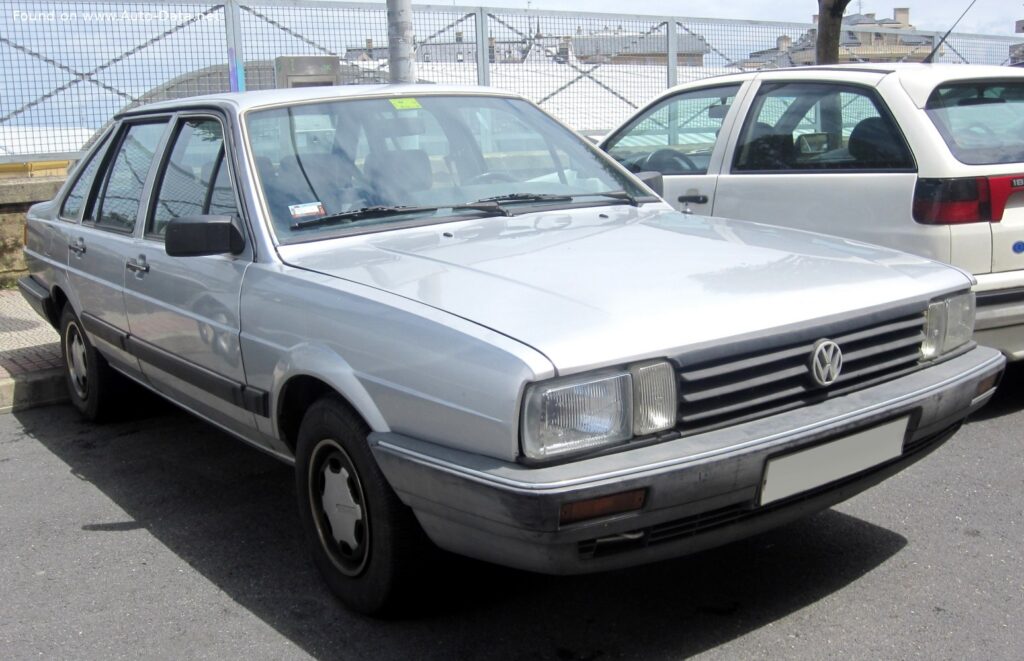
The Volkswagen Santana (32B) represents a pivotal moment in the company’s history, marking a departure from the long-running Beetle and a move towards more modern, globally-oriented designs. Produced from 1981 to 1983, the 1.3-liter version, delivering 60 horsepower, was a key variant in establishing the Santana’s presence, particularly in the Brazilian market where it became a hugely successful and long-lived model. While not initially a major seller in North America, understanding the Santana’s development and impact requires recognizing its significance as Volkswagen’s first truly global mid-size car, designed to appeal to a broader range of customers than its predecessors.
Volkswagen Santana (32B): A Global Strategy
The Santana project arose from the need to replace the aging Type 4, and more importantly, to create a vehicle that could be manufactured and sold in multiple markets with minimal adaptation. Volkswagen aimed to establish a manufacturing base in Brazil and Mexico, and the Santana was designed with these locations in mind. The 32B designation refers to the internal project code and generation of the Santana. The car was based on the Volkswagen Passat (B2) platform, but significantly adapted for local production and market demands. The 1.3-liter engine variant was particularly important for price sensitivity in developing markets, offering a more affordable entry point into the Santana range.
Origins and Market Positioning
Unlike many Volkswagen models that were initially developed for the European market and then exported, the Santana was conceived as a global car from the outset. Brazil was the primary target, and the car was heavily influenced by Brazilian automotive regulations and consumer preferences. The Santana filled a gap in Volkswagen’s lineup, offering a more spacious and comfortable alternative to the Beetle and the smaller Gol. It competed with other mid-size sedans available in Brazil at the time, such as the Chevrolet Opala and the Ford Corcel.
Engine & Performance
The 1.3-liter engine powering the Santana (32B) was a naturally aspirated, inline-four cylinder gasoline engine. While 60 horsepower might seem modest by modern standards, it was considered adequate for the vehicle’s weight and intended use in its target markets. Engine codes varied depending on the production location and year, with FZ, EP, and EU being common designations. The engine featured a simple, robust design prioritizing reliability and ease of maintenance – crucial factors in regions with less developed automotive infrastructure.
The Santana 1.3 wasn’t designed for outright performance. Acceleration was moderate, and top speed was limited. However, the engine provided sufficient power for everyday driving and highway cruising. The engine’s relatively small displacement contributed to reasonable fuel economy for the time, making it an attractive option for cost-conscious buyers. The drivetrain was a rear-wheel drive configuration, a characteristic inherited from earlier Volkswagen models like the Beetle and Type 4. This layout provided good handling balance, although it wasn’t as space-efficient as front-wheel drive. Transmission options typically included a four-speed manual gearbox, with a three-speed automatic available as an option in some markets.
Design & Features
The Santana (32B) featured a traditional, conservative sedan body style. The design was clean and functional, prioritizing practicality and durability over flamboyant aesthetics. The car’s exterior was characterized by its rectangular shape, prominent headlights, and relatively simple trim. The interior was spacious for its class, offering comfortable seating for five passengers.
Features were relatively basic in the 1.3-liter variant, reflecting its position as an affordable model. Standard equipment typically included cloth upholstery, basic instrumentation, and manual windows and locks. Safety features were limited by the standards of the early 1980s, with seatbelts being the primary safety device. However, the Santana’s robust construction and solid build quality provided a degree of inherent safety. The car’s suspension system was designed to provide a comfortable ride, even on rough roads. The Santana’s trunk offered a generous amount of cargo space, making it a practical choice for families and those needing to transport luggage or goods. The car’s overall design emphasized practicality, reliability, and affordability, making it a popular choice in its target markets.
Long-Term Impact and Evolution
The Santana’s success in Brazil led to its continued production there for over three decades, undergoing numerous updates and revisions. It became a cultural icon in Brazil, representing a significant part of the country’s automotive history. The Santana also served as a platform for various special editions and performance variants. The car’s enduring popularity demonstrated Volkswagen’s ability to adapt to local market conditions and create vehicles that resonated with consumers.
Technical Specifications
| Brand | Volkswagen |
| Model | Santana |
| Generation | Santana (32B) |
| Type (Engine) | 1.3 (60 Hp) |
| Start of production | 1981 |
| End of production | 1983 |
| Powertrain Architecture | Internal Combustion engine |
| Body type | Sedan |
| Fuel Type | Petrol (Gasoline) |
| Power | 60 Hp |
| Engine Model/Code | FZ, EP, EU |
| Engine aspiration | Naturally aspirated engine |
| Engine oil capacity | 3 l |
| Engine oil capacity (US qt) | 3.17 US qt |
| Engine oil capacity (UK qt) | 2.64 UK qt |
| Coolant capacity | 6 l |
| Coolant capacity (US qt) | 6.34 US qt |
| Coolant capacity (UK qt) | 5.28 UK qt |
