
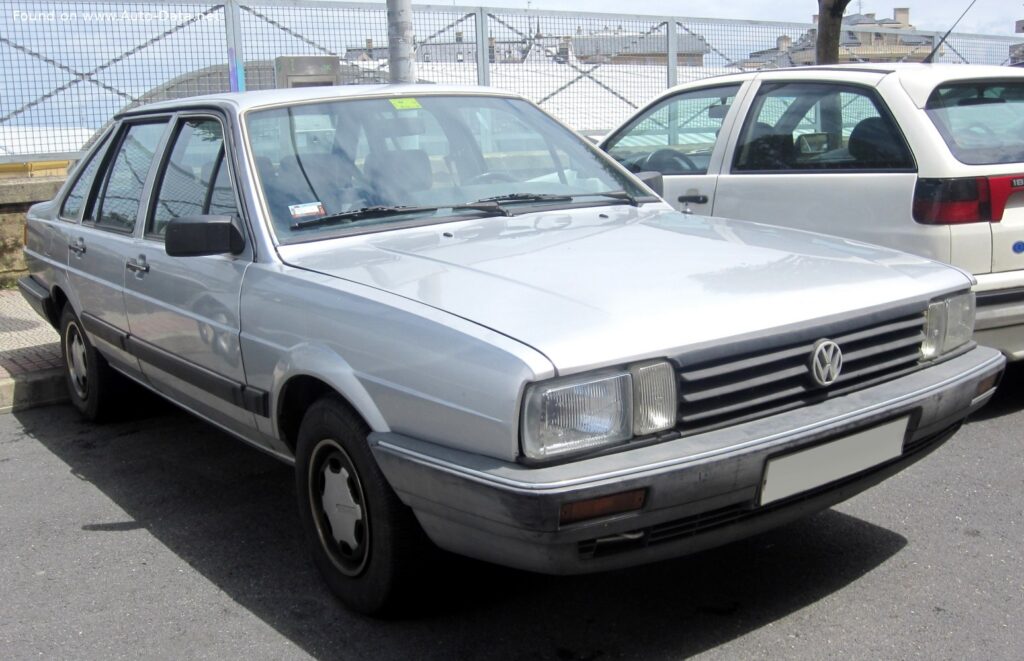
The Volkswagen Santana (32B) represents a pivotal moment in the company’s history, marking a departure from the rear-engined, air-cooled designs that had defined Volkswagen for decades. Introduced in August 1982 and produced through December 1984, the Santana was Volkswagen’s first globally-marketed, front-engined, water-cooled sedan. While not initially sold in the United States, the Santana was hugely significant in Europe, Latin America, and Asia, particularly in China where it became a symbol of the country’s burgeoning automotive industry. The 32B designation refers to the internal project code for this generation, and the 1.6-liter engine variant, producing 75 horsepower, was a common configuration.
Volkswagen Santana (32B): A New Direction
The Santana was conceived as a modern, internationally competitive sedan. It was designed to appeal to a broader market than the Beetle, offering more space, comfort, and contemporary features. The development of the Santana was heavily influenced by Volkswagen’s partnership with Audi, sharing many components with the Audi 80. This collaboration allowed Volkswagen to rapidly develop a modern vehicle without incurring the full cost of a completely new platform. The Santana’s success lay in its blend of German engineering, practicality, and affordability, making it a popular choice for families and businesses alike.
Engine & Performance
The Santana 1.6 was powered by a 1.6-liter, inline four-cylinder gasoline engine. This engine, designated DT or JU depending on the specific market, produced 75 horsepower at 5600 rpm and 121 Nm (89.25 lb-ft) of torque at 3200 rpm. While not a performance car, the engine provided adequate power for everyday driving. The engine featured a single overhead camshaft (SOHC) valvetrain and utilized a carburetor for fuel delivery – a common technology for the era. Acceleration from 0 to 100 km/h (0-62 mph) took approximately 14 seconds, and the car had a top speed of 160 km/h (99.42 mph). The engine’s longitudinal front-engine layout, coupled with front-wheel drive, contributed to reasonable handling characteristics. Fuel economy was rated at 10.8 l/100 km (21.8 US mpg) in urban conditions and 7.7 l/100 km (30.5 US mpg) on the open road.
Design & Features
The Volkswagen Santana (32B) was a traditional three-box sedan with a clean, understated design. Its styling was conservative, reflecting the prevailing automotive trends of the early 1980s. The car offered seating for five passengers and featured four doors for easy access. The interior was functional and well-built, prioritizing practicality over extravagance. Safety features, while limited by the standards of today, included disc brakes on the front wheels and drum brakes on the rear. The McPherson strut front suspension and trailing arm rear suspension provided a comfortable ride. The Santana’s trunk offered a generous 535 liters (18.89 cubic feet) of storage space. The car’s relatively simple construction and robust engineering contributed to its reliability and longevity.
Technical Specifications
| Brand | Volkswagen |
| Model | Santana |
| Generation | Santana (32B) |
| Type (Engine) | 1.6 (75 Hp) |
| Start of production | August, 1982 |
| End of production | December, 1984 |
| Powertrain Architecture | Internal Combustion engine |
| Body type | Sedan |
| Seats | 5 |
| Doors | 4 |
| Fuel consumption (urban) | 10.8 l/100 km (21.8 US mpg, 26.2 UK mpg, 9.3 km/l) |
| Fuel consumption (extra urban) | 7.7 l/100 km (30.5 US mpg, 36.7 UK mpg, 13 km/l) |
| Fuel Type | Petrol (Gasoline) |
| Acceleration 0 – 100 km/h | 14 sec |
| Acceleration 0 – 62 mph | 14 sec |
| Acceleration 0 – 60 mph | 13.3 sec |
| Maximum speed | 160 km/h (99.42 mph) |
| Weight-to-power ratio | 12.4 kg/Hp, 80.6 Hp/tonne |
| Weight-to-torque ratio | 7.7 kg/Nm, 130 Nm/tonne |
| Power | 75 Hp @ 5600 rpm |
| Power per litre | 47.2 Hp/l |
| Torque | 121 Nm @ 3200 rpm (89.25 lb.-ft. @ 3200 rpm) |
| Engine layout | Front, Longitudinal |
| Engine Model/Code | DT, JU |
| Engine displacement | 1588 cm3 (96.91 cu. in.) |
| Number of cylinders | 4 |
| Engine configuration | Inline |
| Cylinder Bore | 79.5 mm (3.13 in.) |
| Piston Stroke | 80 mm (3.15 in.) |
| Compression ratio | 8.2:1 |
| Number of valves per cylinder | 2 |
| Fuel injection system | Carburettor |
| Engine aspiration | Naturally aspirated engine |
| Valvetrain | SOHC |
| Engine oil capacity | 3 l (3.17 US qt | 2.64 UK qt) |
| Coolant | 6 l (6.34 US qt | 5.28 UK qt) |
| Kerb Weight | 931 kg (2052.5 lbs.) |
| Max. weight | 1440 kg (3174.66 lbs.) |
| Max load | 509 kg (1122.15 lbs.) |
| Trunk (boot) space – minimum | 535 l (18.89 cu. ft.) |
| Max. roof load | 75 kg (165.35 lbs.) |
| Permitted trailer load with brakes (12%) | 1200 kg (2645.55 lbs.) |
| Permitted trailer load without brakes | 465 kg (1025.15 lbs.) |
| Length | 4545 mm (178.94 in.) |
| Width | 1695 mm (66.73 in.) |
| Height | 1400 mm (55.12 in.) |
| Wheelbase | 2550 mm (100.39 in.) |
| Front track | 1400 mm (55.12 in.) |
| Rear (Back) track | 1408 mm (55.43 in.) |
| Minimum turning circle (turning diameter) | 10.7 m (35.1 ft.) |
| Drivetrain Architecture | The Internal combustion engine (ICE) drives the front wheels of the vehicle. |
| Drive wheel | Front wheel drive |
| Number of gears and type of gearbox | 4 gears, manual transmission |
| Front suspension | Independent, type McPherson with coil spring and anti-roll bar |
| Rear suspension | Trailing arm |
| Front brakes | Disc |
| Rear brakes | Drum |
| Steering type | Steering rack and pinion |
| Wheel rims size | 5.5J x 13 |
The Volkswagen Santana (32B) was a significant vehicle for Volkswagen, representing a crucial step in the company’s transition to modern, front-engined designs. Its success in international markets, particularly its long-running production in China, cemented its place in automotive history. While not a high-performance vehicle, the Santana offered a compelling combination of practicality, reliability, and affordability, making it a popular choice for a wide range of buyers.
