
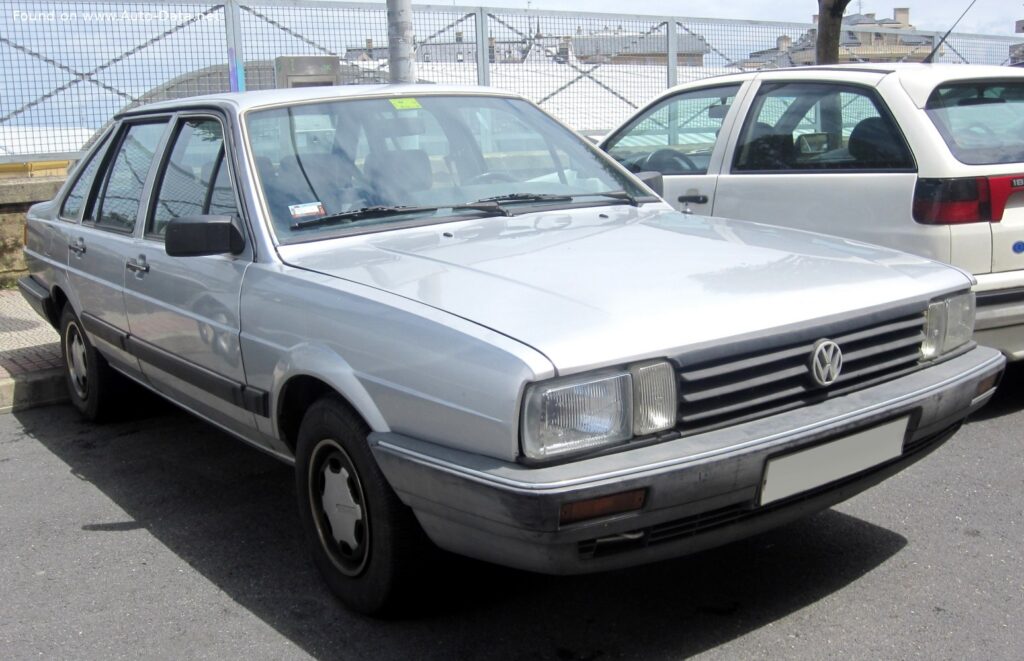
The Volkswagen Santana (32B) represents a pivotal moment in the company’s history, marking a departure from the long-running Beetle and a strategic move towards more modern, globally-marketed vehicles. Introduced in 1981 and produced through 1982 in this initial configuration, the Santana was Volkswagen’s first entirely new mid-size car since the K70 in the 1970s. Crucially, it wasn’t intended as a direct replacement for the Beetle, but rather as a vehicle to appeal to a broader customer base seeking more space, comfort, and contemporary styling. While not initially sold in the United States, the Santana became immensely popular in Europe, Latin America, and Asia, serving as a cornerstone of Volkswagen’s international expansion. The 32B designation refers to the internal project code and the first generation of the Santana line.
Volkswagen Santana (32B): A New Direction
The Santana’s development stemmed from the need to modernize Volkswagen’s lineup and offer a vehicle competitive with offerings from Ford, Opel (Vauxhall), and other European manufacturers. The Beetle, while iconic, was increasingly seen as outdated and unable to meet the demands of a changing automotive landscape. The Santana aimed to address this by providing a practical, reliable, and relatively affordable family sedan. Its design incorporated elements of contemporary styling trends, while retaining the Volkswagen hallmarks of engineering integrity and build quality. The initial 1.6-liter engine, producing 85 horsepower, was chosen to balance performance with fuel economy, a key consideration in the early 1980s.
Origins and Market Positioning
The Santana was primarily designed for the European market, with a particular focus on West Germany and other key European nations. However, its production was quickly expanded to other regions, including Mexico and Brazil, where it became a hugely successful model. In these markets, the Santana filled a gap for a locally-produced, reliable, and reasonably priced mid-size sedan. It competed directly with vehicles like the Ford Sierra, Opel Ascona, and Fiat 131. The Santana’s success in these regions was instrumental in establishing Volkswagen as a major player in the global automotive industry. The decision to not initially offer the Santana in the US market was largely due to existing emissions regulations and the presence of the Dasher/Quantum models.
Engine & Performance
The heart of the early Volkswagen Santana (32B) was the 1.6-liter, naturally aspirated YP engine. This inline-four cylinder powerplant delivered 85 horsepower, providing adequate performance for everyday driving. While not a performance-oriented engine, it was known for its reliability and relatively good fuel economy for its time. The engine featured a single overhead camshaft and a two-barrel carburetor, a common configuration for engines of this era. Power was delivered to the front wheels via a four-speed manual transmission, although an optional three-speed automatic transmission was also available. The Santana’s suspension system consisted of independent front suspension with MacPherson struts and a torsion beam rear suspension, offering a comfortable ride and predictable handling. The engine’s simplicity contributed to its longevity and ease of maintenance, making it a popular choice for fleet operators and private owners alike. The 1.6-liter engine was a workhorse, designed for durability rather than outright speed.
Design & Features
The Santana’s exterior design was a clear departure from the rounded lines of the Beetle. It adopted a more angular and modern aesthetic, reflecting the styling trends of the early 1980s. The sedan body style offered a spacious interior for passengers and a reasonably sized trunk for luggage. The car’s interior was functional and well-built, with a focus on practicality rather than luxury. Features included cloth upholstery, basic instrumentation, and a simple audio system. Safety features were relatively limited by today’s standards, but included seat belts and a collapsible steering column. The Santana’s design prioritized functionality and durability, making it a practical and reliable family car. The car’s relatively simple construction also made it easier to repair and maintain, contributing to its long-term appeal. The overall aesthetic was conservative, aiming for broad appeal rather than radical styling.
Compared to its predecessor, the Beetle, the Santana offered significantly improved comfort and refinement. The larger cabin provided more legroom and headroom for passengers, while the independent front suspension delivered a smoother ride. The Santana also benefited from features such as power-assisted brakes and a more modern heating and ventilation system. While not a luxury car, the Santana offered a level of comfort and convenience that was previously unavailable in Volkswagen’s lineup.
Technical Specifications
| Brand | Volkswagen |
| Model | Santana |
| Generation | Santana (32B) |
| Type (Engine) | 1.6 (85 Hp) |
| Start of production | 1981 |
| End of production | 1982 |
| Powertrain Architecture | Internal Combustion engine |
| Body type | Sedan |
| Fuel Type | Petrol (Gasoline) |
| Power | 85 Hp |
| Engine Model/Code | YP |
| Engine aspiration | Naturally aspirated engine |
| Engine oil capacity | 3 l |
| Engine oil capacity (US qt) | 3.17 US qt |
| Engine oil capacity (UK qt) | 2.64 UK qt |
| Coolant capacity | 6 l |
| Coolant capacity (US qt) | 6.34 US qt |
| Coolant capacity (UK qt) | 5.28 UK qt |
The Volkswagen Santana (32B) 1.6, despite its relatively short production run in its initial form, laid the groundwork for a highly successful and long-lived model line. It represented a significant step forward for Volkswagen, demonstrating the company’s ability to adapt to changing market demands and compete effectively in the global automotive arena. The Santana’s blend of practicality, reliability, and affordability made it a popular choice for drivers around the world, and its legacy continues to this day in various iterations produced in different regions.
