
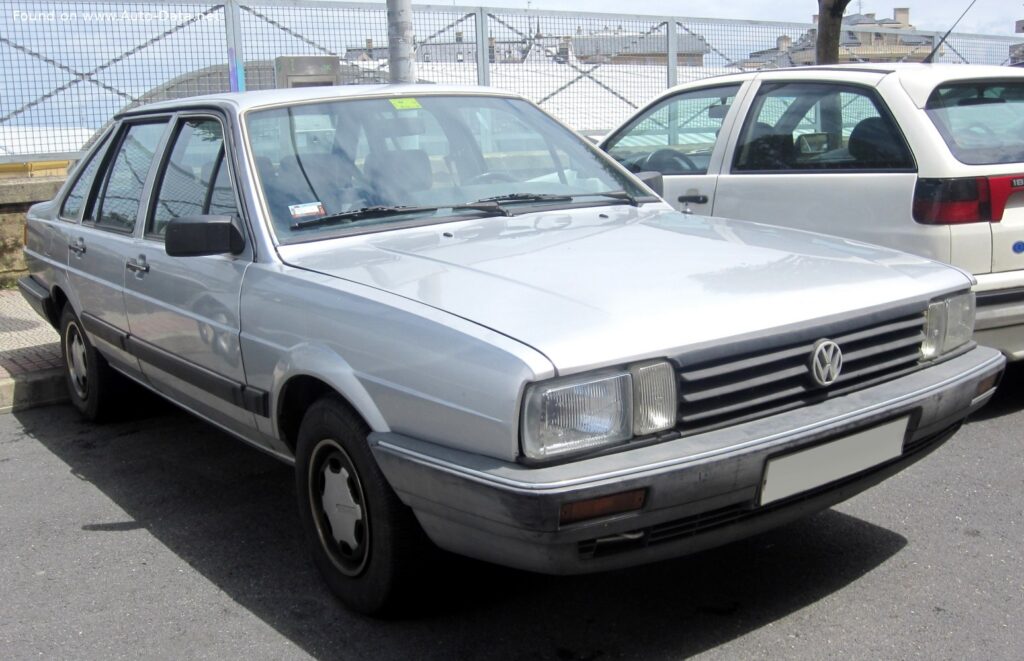
The Volkswagen Santana (32B) 1.6 D is a compact executive car produced by Volkswagen between 1982 and 1984. While not officially sold in the United States, the Santana holds a significant place in Volkswagen’s history as a globally-marketed vehicle, particularly successful in Europe and Latin America. It represented a move towards modernizing Volkswagen’s lineup and offered a more contemporary alternative to the aging Passat. The 1.6 D variant, powered by a diesel engine, was a popular choice for its fuel efficiency and durability, catering to a market increasingly conscious of running costs.
Volkswagen Santana (32B) 1.6 D: A Detailed Overview
The Santana (32B) was conceived as a modern replacement for the Volkswagen Passat, initially intended to be a globally unified platform. However, regional variations emerged, with the Santana becoming particularly prominent in markets like Brazil, Argentina, Mexico, and Germany. The 1.6 D model specifically targeted buyers seeking economical transportation without sacrificing the practicality and build quality associated with the Volkswagen brand. It was positioned as a family sedan, offering a comfortable ride and reasonable space for passengers and luggage.
Engine & Performance
The heart of the Santana 1.6 D is a 1.6-liter inline-four cylinder diesel engine. This engine produced 54 horsepower at 4800 rpm and 104 Nm (76.71 lb.-ft.) of torque at 2000 rpm. While the power output might seem modest by modern standards, the diesel engine’s torque characteristics provided adequate performance for everyday driving. The engine utilized a precombustion chamber injection system, a common technology for diesel engines of the era, to improve combustion efficiency. The engine’s longitudinal front-engine layout contributed to a balanced weight distribution. Acceleration from 0 to 100 km/h (0-62 mph) took approximately 20.5 seconds, and 0 to 60 mph was achieved in around 19.5 seconds. The weight-to-power ratio stood at 17.9 kg/Hp, and the weight-to-torque ratio was 9.3 kg/Nm. Fuel economy was a key selling point, with urban consumption rated at 7.1 l/100 km (33.1 US mpg), and extra-urban consumption at 4.6 l/100 km (51.1 US mpg).
Design & Features
The Santana (32B) featured a traditional sedan body style with four doors and seating for five passengers. Its design was relatively conservative, reflecting the automotive aesthetics of the early 1980s. The car’s exterior was characterized by clean lines, a rectangular grille, and relatively large windows. Inside, the Santana offered a functional and practical interior. While not luxurious, the cabin was well-built and offered a reasonable level of comfort. Safety features were limited by the standards of the time, but typically included seatbelts and a robust body structure. The Santana’s trunk offered a generous 535 liters (18.89 cu. ft.) of storage space. The McPherson strut front suspension and trailing arm rear suspension provided a comfortable, if not particularly sporty, ride. The car’s 60-liter (15.85 US gal) fuel tank provided a good driving range, further enhancing its practicality.
Technical Specifications
| Brand | Volkswagen |
| Model | Santana |
| Generation | Santana (32B) |
| Type (Engine) | 1.6 D (54 Hp) |
| Start of production | August, 1982 |
| End of production | December, 1984 |
| Powertrain Architecture | Internal Combustion engine |
| Body type | Sedan |
| Seats | 5 |
| Doors | 4 |
| Fuel consumption (urban) | 7.1 l/100 km (33.1 US mpg) |
| Fuel consumption (extra urban) | 4.6 l/100 km (51.1 US mpg) |
| Fuel Type | Diesel |
| Acceleration 0 – 100 km/h | 20.5 sec |
| Acceleration 0 – 62 mph | 20.5 sec |
| Acceleration 0 – 60 mph | 19.5 sec |
| Weight-to-power ratio | 17.9 kg/Hp |
| Weight-to-torque ratio | 9.3 kg/Nm |
| Power | 54 Hp @ 4800 rpm |
| Power per litre | 34 Hp/l |
| Torque | 104 Nm @ 2000 rpm (76.71 lb.-ft. @ 2000 rpm) |
| Engine layout | Front, Longitudinal |
| Engine displacement | 1588 cm3 (96.91 cu. in.) |
| Number of cylinders | 4 |
| Engine configuration | Inline |
| Cylinder Bore | 76.5 mm (3.01 in.) |
| Piston Stroke | 86.4 mm (3.4 in.) |
| Compression ratio | 23:1 |
| Number of valves per cylinder | 2 |
| Fuel injection system | Precombustion chamber injection |
| Engine aspiration | Naturally aspirated |
| Valvetrain | SOHC |
| Engine oil capacity | 3.5 l (3.7 US qt | 3.08 UK qt) |
| Kerb Weight | 964 kg (2125.26 lbs.) |
| Max. weight | 1460 kg (3218.75 lbs.) |
| Max load | 496 kg (1093.49 lbs.) |
| Trunk (boot) space | 535 l (18.89 cu. ft.) |
| Fuel tank capacity | 60 l (15.85 US gal | 13.2 UK gal) |
| Max. roof load | 75 kg (165.35 lbs.) |
| Permitted trailer load (braked) | 1000 kg (2204.62 lbs.) |
| Permitted trailer load (unbraked) | 482 kg (1062.63 lbs.) |
| Length | 4545 mm (178.94 in.) |
| Width | 1695 mm (66.73 in.) |
| Height | 1400 mm (55.12 in.) |
| Wheelbase | 2550 mm (100.39 in.) |
| Front track | 1400 mm (55.12 in.) |
| Rear track | 1408 mm (55.43 in.) |
| Turning circle | 10.7 m (35.1 ft.) |
| Drivetrain | Front wheel drive |
| Gearbox | 4 gears, manual |
| Front suspension | Independent, McPherson with coil spring and anti-roll bar |
| Rear suspension | Trailing arm |
| Front brakes | Disc |
| Rear brakes | Drum |
| Steering | Steering rack and pinion |
| Wheel rims size | 5.5J x 13 |
The Volkswagen Santana (32B) 1.6 D, while not a performance car, offered a compelling package of practicality, fuel efficiency, and Volkswagen build quality. Its success in various international markets demonstrates its adaptability and appeal to a broad range of buyers. It remains a notable example of Volkswagen’s engineering prowess during the early 1980s and a testament to the enduring popularity of the Santana nameplate.
