
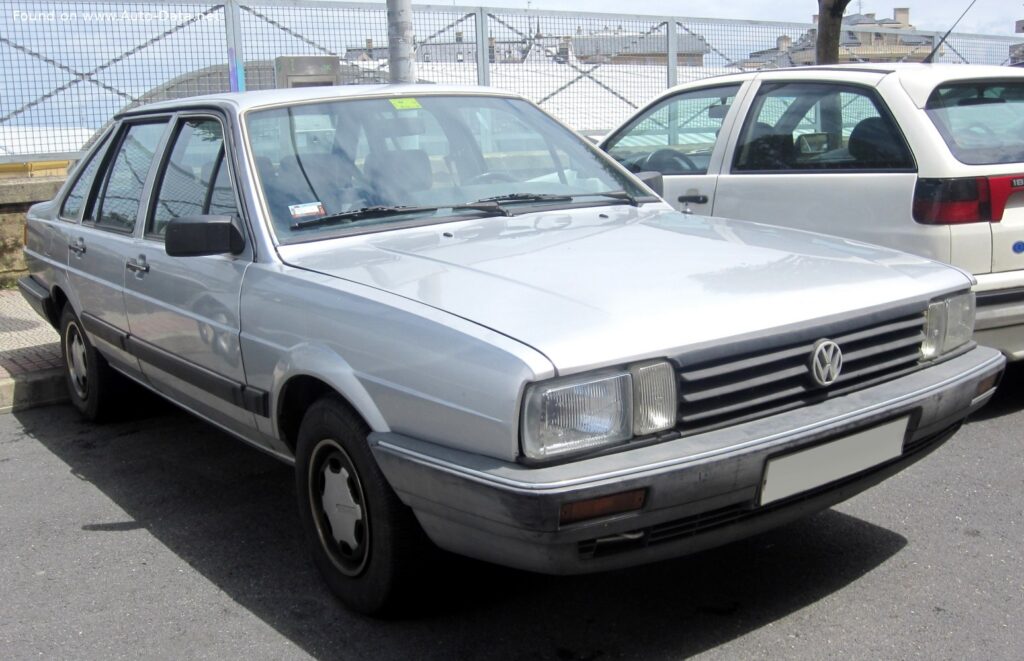
The Volkswagen Santana (32B) represents a pivotal moment in the company’s history, marking a departure from the rear-engined, air-cooled designs that had defined Volkswagen for decades. Produced from 1981 to 1984, the Santana was Volkswagen’s first globally-marketed, front-engined, water-cooled sedan. While not initially sold in the United States, the Santana was hugely significant in Europe, Latin America, and Asia, particularly in China where it became a symbol of the country’s burgeoning automotive industry. The 1.8-liter version, producing 90 horsepower, was a common variant, offering a balance of affordability and practicality for a wide range of buyers.
Volkswagen Santana (32B): A New Direction
The Santana (32B) was developed as a modern replacement for the aging Type 4, and crucially, it was designed to be adaptable for production in multiple locations. This strategy proved successful, with assembly lines established in Mexico, Brazil, Argentina, and most notably, China, where it was produced by the Shanghai Volkswagen joint venture. The Santana filled a gap in Volkswagen’s lineup, providing a conventional, family-sized sedan that appealed to a broader audience than the Beetle or Golf. It was a deliberate move to compete with established rivals like the Ford Sierra and Opel Ascona in the European market, and to establish a foothold in emerging markets.
Engine & Performance
The 1.8-liter inline-four engine powering the Santana (32B) was a significant step forward for Volkswagen. Designated with engine codes DS, JN, or JV, this naturally aspirated engine produced 90 horsepower at 5200 rpm and 145 Nm (106.95 lb-ft) of torque at 3300 rpm. While not a performance powerhouse, the engine provided adequate power for everyday driving. Acceleration from 0 to 60 mph took approximately 10.9 seconds, and the car had a top speed of 169 km/h (105.01 mph). Fuel economy was respectable for the era, achieving around 9.4 l/100 km (25 US mpg) in urban conditions and 5.6 l/100 km (42 US mpg) on the open road. The engine featured a single overhead camshaft (SOHC) valvetrain and utilized a carburetor fuel injection system, typical for vehicles of this period. The longitudinal engine layout and front-wheel drive configuration contributed to the car’s balanced handling.
Design & Features
The Santana (32B) featured a conservative, yet functional design. Its sedan body style offered seating for five passengers and a generous 535-liter (18.89 cu. ft.) trunk. The car’s dimensions – 4545 mm (178.94 in) in length, 1695 mm (66.73 in) in width, and 1400 mm (55.12 in) in height – positioned it squarely within the mid-size sedan segment. The interior was practical and focused on durability rather than luxury. Safety features were relatively basic by modern standards, but included disc brakes on the front wheels and drum brakes on the rear. The McPherson strut front suspension and trailing arm rear suspension provided a comfortable ride. The Santana’s design prioritized practicality and reliability, making it a popular choice for families and fleet operators. The 5.5J x 13 wheel rims were standard.
Technical Specifications
| Brand | Volkswagen |
| Model | Santana |
| Generation | Santana (32B) |
| Type (Engine) | 1.8 (90 Hp) |
| Start of production | March, 1983 |
| End of production | December, 1984 |
| Powertrain Architecture | Internal Combustion engine |
| Body type | Sedan |
| Seats | 5 |
| Doors | 4 |
| Fuel consumption (urban) | 9.4 l/100 km (25 US mpg) |
| Fuel consumption (extra urban) | 5.6 l/100 km (42 US mpg) |
| Fuel Type | Petrol (Gasoline) |
| Acceleration 0 – 100 km/h | 11.5 sec |
| Acceleration 0 – 62 mph | 11.5 sec |
| Acceleration 0 – 60 mph | 10.9 sec |
| Maximum speed | 169 km/h (105.01 mph) |
| Weight-to-power ratio | 10.5 kg/Hp |
| Weight-to-torque ratio | 6.5 kg/Nm |
| Power | 90 Hp @ 5200 rpm |
| Torque | 145 Nm @ 3300 rpm (106.95 lb.-ft. @ 3300 rpm) |
| Engine layout | Front, Longitudinal |
| Engine Model/Code | DS, JN, JV |
| Engine displacement | 1781 cm3 (108.68 cu. in.) |
| Number of cylinders | 4 |
| Engine configuration | Inline |
| Cylinder Bore | 81 mm (3.19 in.) |
| Piston Stroke | 86.4 mm (3.4 in.) |
| Compression ratio | 10:1 |
| Number of valves per cylinder | 2 |
| Fuel injection system | Carburettor |
| Engine aspiration | Naturally aspirated |
| Valvetrain | SOHC |
| Engine oil capacity | 3 l (3.17 US qt | 2.64 UK qt) |
| Coolant capacity | 6 l (6.34 US qt | 5.28 UK qt) |
| Kerb Weight | 946 kg (2085.57 lbs.) |
| Max. weight | 1440 kg (3174.66 lbs.) |
| Max load | 494 kg (1089.08 lbs.) |
| Trunk (boot) space – minimum | 535 l (18.89 cu. ft.) |
| Fuel tank capacity | 60 l (15.85 US gal | 13.2 UK gal) |
| Max. roof load | 75 kg (165.35 lbs.) |
| Permitted trailer load with brakes (12%) | 1200 kg (2645.55 lbs.) |
| Permitted trailer load without brakes | 463 kg (1020.74 lbs.) |
| Length | 4545 mm (178.94 in.) |
| Width | 1695 mm (66.73 in.) |
| Height | 1400 mm (55.12 in.) |
| Wheelbase | 2550 mm (100.39 in.) |
| Front track | 1400 mm (55.12 in.) |
| Rear track | 1408 mm (55.43 in.) |
| Minimum turning circle | 10.7 m (35.1 ft.) |
| Drivetrain Architecture | Front wheel drive |
| Number of gears | 4 |
| Gearbox type | Manual transmission |
The Volkswagen Santana (32B) 1.8 represents a crucial turning point for the company. It signaled a move away from its traditional roots and towards a more modern, globally-competitive product range. While it may not have achieved widespread recognition in the United States, its success in other markets cemented its place as an important model in Volkswagen’s history, and laid the groundwork for the company’s future expansion.
