
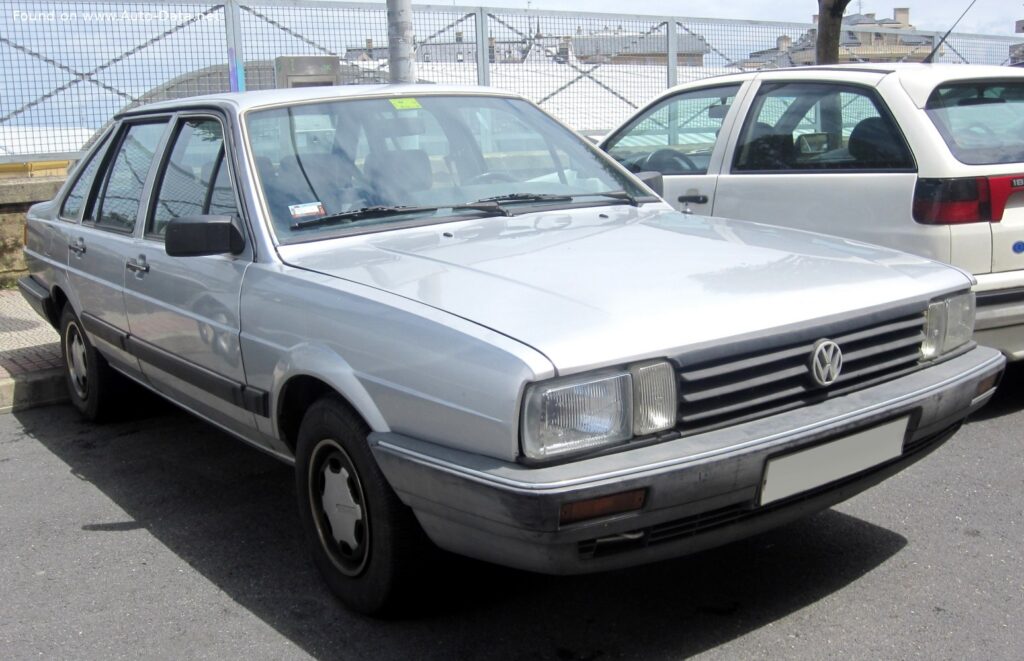
The Volkswagen Santana (32B) represents a pivotal moment in the company’s history, marking a departure from the long-running Beetle and a move towards more modern, globally-focused designs. Produced between 1981 and 1983, the Santana was initially developed for the Brazilian market, where it was known as the Quantum, and later adapted for European and other international sales. This model, specifically the 1.9-liter version producing 115 horsepower, aimed to provide a comfortable, reliable, and relatively affordable family sedan, bridging the gap between the aging Beetle and the more expensive offerings from other European manufacturers. The Santana was significant as Volkswagen’s first entirely new model developed under the leadership of Ferdinand Piëch, and it laid the groundwork for many subsequent Volkswagen models.
Volkswagen Santana (32B) 1.9: A New Direction
The Santana (32B) was a direct response to changing market demands and the need for Volkswagen to modernize its lineup. While the Beetle remained popular in some regions, its rear-engine, air-cooled design was becoming increasingly outdated. The Santana offered a conventional front-engine, water-cooled layout, providing improved handling, comfort, and packaging. It was designed to be a world car, adaptable to various markets and production facilities. The 1.9-liter engine variant, while not the most powerful in the Santana range, provided a good balance of performance and fuel economy for everyday driving. The car’s relatively simple mechanicals and robust construction contributed to its reputation for reliability, making it a popular choice for families and fleet operators.
Engine & Performance
The heart of the Santana (32B) 1.9 is a 1.9-liter, naturally aspirated inline-five cylinder gasoline engine. This engine produced 115 horsepower at 5000 rpm and 152 Nm (112.11 lb.-ft.) of torque. While the five-cylinder configuration was somewhat unusual for the time, it offered a smoother and more refined driving experience compared to traditional four-cylinder engines. Power is delivered to the front wheels through a four or five-speed manual transmission, or an optional three-speed automatic transmission. The Santana 1.9’s performance figures were respectable for its era. Acceleration from 0 to 60 mph was achieved in approximately 9.7 seconds, and it had a top speed of 180 km/h (111.85 mph). The engine utilized a carburetor fuel injection system, which was typical for cars of this period. The power-to-liter ratio was 59.9 horsepower per liter, indicating a reasonably efficient engine design for the early 1980s.
Design & Features
The Volkswagen Santana (32B) featured a classic, conservative sedan design. Its body style was a four-door, five-seater configuration, offering ample space for passengers and luggage. The exterior styling was clean and understated, reflecting the prevailing design trends of the early 1980s. The Santana’s interior was functional and well-built, with a focus on practicality and durability. Features included comfortable seating, a straightforward dashboard layout, and adequate storage space. Safety features, while limited by the standards of today, included seatbelts and a robust body structure. The Santana’s suspension system consisted of an independent McPherson strut setup at the front and an independent torsion beam suspension at the rear, providing a comfortable ride and decent handling characteristics. The car rode on 13-inch wheels with 185/70 R13 tires. The Santana was designed to be a practical and reliable family car, and its features reflected this focus.
Technical Specifications
| Brand | Volkswagen |
| Model | Santana |
| Generation | Santana (32B) |
| Type (Engine) | 1.9 (115 Hp) |
| Start of production | 1981 |
| End of production | 1983 |
| Powertrain Architecture | Internal Combustion engine |
| Body type | Sedan |
| Seats | 5 |
| Doors | 4 |
| Fuel Type | Petrol (Gasoline) |
| Acceleration 0 – 100 km/h | 10.2 sec |
| Acceleration 0 – 62 mph | 10.2 sec |
| Acceleration 0 – 60 mph | 9.7 sec |
| Maximum speed | 180 km/h (111.85 mph) |
| Power | 115 Hp @ 5000 rpm |
| Power per litre | 59.9 Hp/l |
| Torque | 152 Nm (112.11 lb.-ft.) |
| Engine displacement | 1921 cm3 (117.23 cu. in.) |
| Number of cylinders | 5 |
| Fuel injection system | Carburettor |
| Engine aspiration | Naturally aspirated engine |
| Engine oil capacity | 3 l (3.17 US qt | 2.64 UK qt) |
| Coolant | 6 l (6.34 US qt | 5.28 UK qt) |
| Front suspension | Independent type McPherson |
| Rear suspension | independent torsion suspension |
| Front brakes | Disc |
| Rear brakes | Drum |
| Tires size | 185/70 R13 |
| Wheel rims size | 13 |
The Volkswagen Santana (32B) 1.9, while not a groundbreaking vehicle in terms of innovation, was a crucial step in Volkswagen’s evolution. It represented a move away from the company’s past and towards a more modern, globally competitive future. The Santana’s success in various markets, particularly in Brazil and Europe, demonstrated its versatility and appeal. It served as a foundation for subsequent Volkswagen models and helped establish the company as a major player in the global automotive industry. The Santana’s blend of practicality, reliability, and affordability ensured its place as a significant vehicle in automotive history.
