
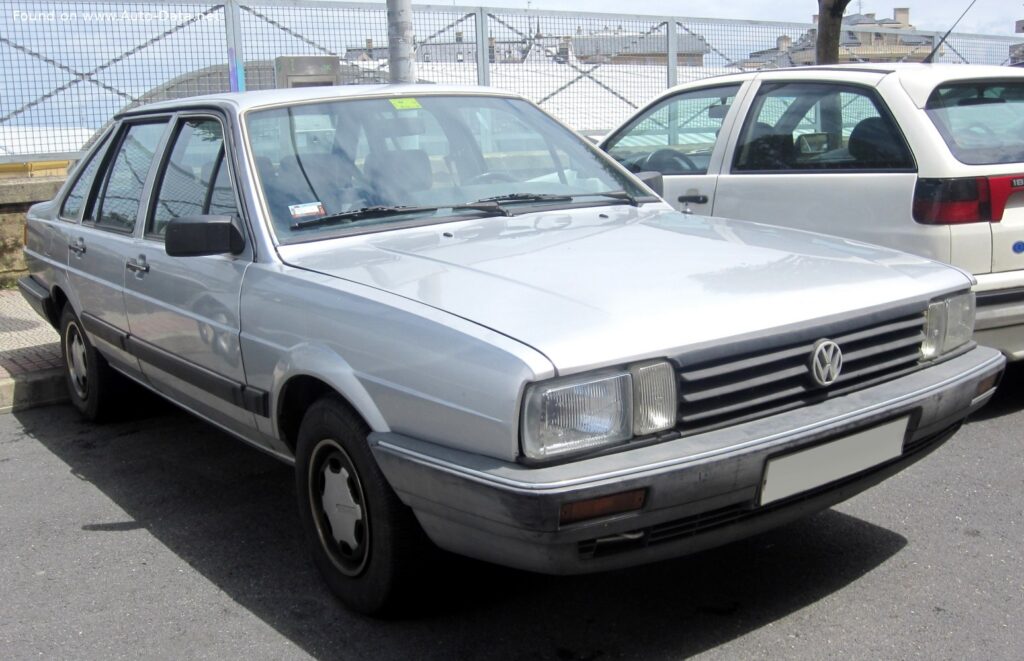
The Volkswagen Santana (32B), produced from 1983 to 1988, represents a pivotal moment in Volkswagen’s history, marking a significant departure from the rear-engined, air-cooled designs that had defined the brand for decades. Designed primarily for markets outside of Western Europe, particularly Latin America and China, the Santana was Volkswagen’s first globally unified mid-size car. It was intended to replace the aging Passat and Dasher models in many regions, offering a more modern, front-engine, water-cooled platform. While not initially a major success in North America, the Santana’s robust construction, relative affordability, and adaptability made it a popular choice in developing economies, establishing a strong foothold for Volkswagen in those markets. The 2.0-liter version, producing 115 horsepower, was a common configuration, balancing performance with fuel economy for the era.
Volkswagen Santana (32B): A Global Strategy
The development of the Santana stemmed from Volkswagen’s need for a modern, globally marketable vehicle. The existing Passat, while successful in Europe, was considered too expensive and complex for many emerging markets. Volkswagen sought a simpler, more robust design that could be manufactured efficiently in various locations. The Santana, based on the stretched platform of the Golf, fulfilled this requirement. The “32B” designation refers to the internal project code during its development. Unlike its predecessors, the Santana embraced front-wheel drive and a water-cooled engine, aligning it with contemporary automotive engineering trends. Its design was intentionally conservative, aiming for broad appeal and avoiding the polarizing styling of some competitors. The Santana’s success wasn’t about groundbreaking innovation, but about providing a reliable and affordable transportation solution tailored to specific regional needs.
Engine & Performance
The Santana 2.0 was powered by a 1,984 cc (120.7 cubic inches) inline-four cylinder, naturally aspirated gasoline engine. This engine, designated HP or JS depending on the specific production year and market, produced 115 horsepower (86 kW) at approximately 5,200 rpm. Torque output was around 138 lb-ft (187 Nm) at 3,200 rpm. While not a performance car by modern standards, the 2.0-liter engine provided adequate power for comfortable cruising and everyday driving. The engine featured a single overhead camshaft (SOHC) design and a two-barrel carburetor in most configurations.
Power was delivered to the front wheels through a choice of either a four-speed manual or a three-speed automatic transmission. The manual transmission offered a more engaging driving experience and slightly better fuel economy, while the automatic provided convenience, particularly in urban environments. The Santana’s suspension consisted of MacPherson struts in the front and a semi-independent torsion beam axle in the rear. This setup provided a reasonable balance between ride comfort and handling. Top speed was approximately 109 mph (175 km/h), and acceleration from 0 to 60 mph (0 to 97 km/h) took around 11-12 seconds, depending on the transmission choice and vehicle load. Fuel economy varied depending on driving conditions, but typically ranged from 22 to 28 mpg (US) combined.
Design & Features
The Volkswagen Santana (32B) was a traditional three-box sedan, characterized by its clean lines and conservative styling. Its design was heavily influenced by the contemporary Passat, but with a more restrained and practical aesthetic. The body was constructed using a unibody structure, providing a good level of rigidity and crash safety for its time. The Santana offered a spacious interior for its class, with comfortable seating for five passengers.
Standard features included power steering, front disc brakes, and rear drum brakes. Higher trim levels offered options such as air conditioning, power windows, and a sunroof. The Santana’s dashboard layout was functional and straightforward, with clearly labeled controls. Safety features were relatively basic by modern standards, but included seatbelts and a collapsible steering column. The Santana’s build quality was generally considered to be good, reflecting Volkswagen’s reputation for engineering excellence. The car’s relatively simple design made it easy to maintain and repair, contributing to its longevity and popularity in regions with limited access to specialized automotive services. The Santana’s trunk offered a generous amount of cargo space, making it a practical choice for families and individuals who needed to transport luggage or other items.
Technical Specifications
| Brand | Volkswagen |
| Model | Santana |
| Generation | Santana (32B) |
| Type (Engine) | 2.0 (115 Hp) |
| Start of production | 1983 |
| End of production | 1988 |
| Powertrain Architecture | Internal Combustion engine |
| Body type | Sedan |
| Fuel Type | Petrol (Gasoline) |
| Power | 115 Hp |
| Engine Model/Code | HP, JS |
| Engine aspiration | Naturally aspirated engine |
| Engine oil capacity | 3 l |
| Engine oil capacity (US qt) | 3.17 US qt |
| Engine oil capacity (UK qt) | 2.64 UK qt |
| Coolant capacity | 6 l |
| Coolant capacity (US qt) | 6.34 US qt |
| Coolant capacity (UK qt) | 5.28 UK qt |
The Volkswagen Santana (32B) ultimately paved the way for Volkswagen’s expansion into key emerging markets. Its success demonstrated the viability of a globally unified platform and established a foundation for future Volkswagen models in regions like China and Latin America. While largely forgotten in North America, the Santana remains a significant vehicle in Volkswagen’s history, representing a strategic shift towards global market dominance and a move away from the company’s traditional European focus. Its enduring legacy is a testament to its reliability, affordability, and adaptability.
