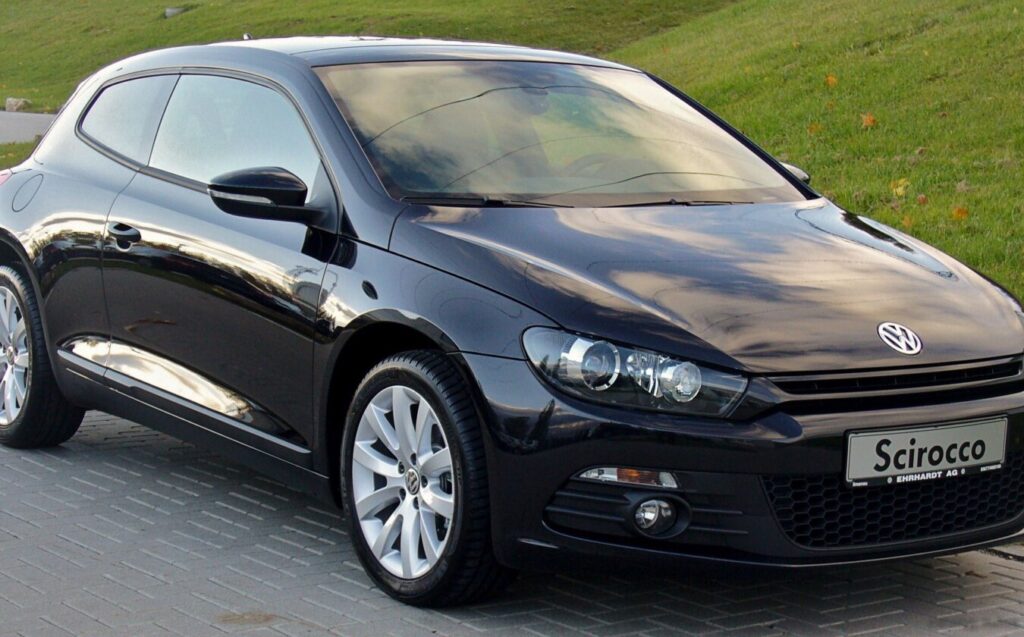
The Volkswagen Scirocco III 2.0 TDI, producing 170 horsepower, was a coupe offered between May 2009 and December 2012. It represented a key variant within the third generation Scirocco (Type 137), built on the Volkswagen Group’s A5 (PQ35) platform – shared with models like the Golf Mk5 and Audi TT. Positioned as a sporty and efficient option, the 2.0 TDI aimed to bridge the gap between the entry-level petrol engines and the more performance-focused variants. This model was primarily marketed in Europe, where diesel engines held a significant market share, offering a blend of performance and fuel economy appealing to drivers seeking a stylish coupe.
Technical Specifications
| Brand | Volkswagen |
| Model | Scirocco |
| Generation | Scirocco III |
| Type (Engine) | 2.0 TDI (170 Hp) |
| Start of production | May, 2009 |
| End of production | December, 2012 |
| Powertrain Architecture | Internal Combustion engine |
| Body type | Coupe |
| Seats | 4 |
| Doors | 3 |
| Fuel consumption (economy) – urban (NEDC) | 6.5 l/100 km (36.2 US mpg, 43.5 UK mpg, 15.4 km/l) |
| Fuel consumption (economy) – extra urban (NEDC) | 4.3 l/100 km (54.7 US mpg, 65.7 UK mpg, 23.3 km/l) |
| Fuel consumption (economy) – combined (NEDC) | 5.1 l/100 km (46.1 US mpg, 55.4 UK mpg, 19.6 km/l) |
| CO2 emissions (NEDC) | 134 g/km |
| Fuel Type | Diesel |
| Acceleration 0 – 100 km/h | 8.1 sec |
| Acceleration 0 – 62 mph | 8.1 sec |
| Acceleration 0 – 60 mph | 7.7 sec |
| Maximum speed | 222 km/h (137.94 mph) |
| Emission standard | Euro 5 |
| Weight-to-power ratio | 7.8 kg/Hp, 128.8 Hp/tonne |
| Weight-to-torque ratio | 3.8 kg/Nm, 265.2 Nm/tonne |
| Power | 170 Hp @ 4200 rpm |
| Power per litre | 86.4 Hp/l |
| Torque | 350 Nm @ 1750-2500 rpm (258.15 lb.-ft. @ 1750-2500 rpm) |
| Engine layout | Front, Transverse |
| Engine Model/Code | CBBB, CFGB |
| Engine displacement | 1968 cm3 (120.09 cu. in.) |
| Number of cylinders | 4 |
| Engine configuration | Inline |
| Cylinder Bore | 81 mm (3.19 in.) |
| Piston Stroke | 95.5 mm (3.76 in.) |
| Compression ratio | 16.5:1 |
| Number of valves per cylinder | 4 |
| Fuel injection system | Diesel Commonrail |
| Engine aspiration | Turbocharger, Intercooler |
| Valvetrain | DOHC |
| Engine oil capacity | 4.3 l (4.54 US qt | 3.78 UK qt) |
| Kerb Weight | 1320 kg (2910.1 lbs.) |
| Max. weight | 1770 kg (3902.18 lbs.) |
| Max load | 450 kg (992.08 lbs.) |
| Trunk (boot) space – minimum | 312 l (11.02 cu. ft.) |
| Trunk (boot) space – maximum | 1006 l (35.53 cu. ft.) |
| Fuel tank capacity | 55 l (14.53 US gal | 12.1 UK gal) |
| Max. roof load | 75 kg (165.35 lbs.) |
| Length | 4256 mm (167.56 in.) |
| Width | 1810 mm (71.26 in.) |
| Width including mirrors | 2080 mm (81.89 in.) |
| Height | 1404 mm (55.28 in.) |
| Wheelbase | 2578 mm (101.5 in.) |
| Front track | 1569 mm (61.77 in.) |
| Rear (Back) track | 1575 mm (62.01 in.) |
| Ride height (ground clearance) | 136 mm (5.35 in.) |
| Minimum turning circle (turning diameter) | 11 m (36.09 ft.) |
| Approach angle | 11.1° |
| Departure angle | 15.8° |
| Ramp-over (brakeover) angle | 9.4° |
| Drivetrain Architecture | The Internal combustion engine (ICE) drives the front wheels of the vehicle. |
| Drive wheel | Front wheel drive |
| Number of gears and type of gearbox | 6 gears, manual transmission |
| Front suspension | Coil spring, Wishbone, Transverse stabilizer |
| Rear suspension | Independent multi-link suspension, Transverse stabilizer |
| Front brakes | Ventilated discs |
| Rear brakes | Disc |
| Assisting systems | ABS (Anti-lock braking system) |
| Steering type | Steering rack and pinion |
| Power steering | Electric Steering |
| Tires size | 225/45 R17 |
| Wheel rims size | 7J x 17 |
Powertrain & Engine Architecture
The Scirocco III 2.0 TDI utilized the Volkswagen Group’s common rail diesel engine, specifically the CBBB or CFGB engine codes. These engines are 1.968-liter inline-four cylinder units featuring a turbocharger with an intercooler. The common rail direct injection system, supplied by Bosch, delivered fuel at extremely high pressure, optimizing combustion efficiency and reducing emissions. The engine employed a double overhead camshaft (DOHC) valvetrain with four valves per cylinder, enhancing breathing and contributing to its power output. The 16.5:1 compression ratio was typical for a diesel engine, maximizing thermal efficiency. The engine’s turbocharger provided a significant boost in power and torque, particularly at lower engine speeds. The 6-speed manual transmission was the standard offering, providing precise gear changes and contributing to the car’s sporty feel.
Driving Characteristics
The 2.0 TDI 170 hp variant offered a good balance between performance and fuel economy. While not as overtly sporty as the petrol-powered versions, it provided ample torque – 350 Nm (258 lb-ft) – available from 1750-2500 rpm. This resulted in strong acceleration in everyday driving situations, making overtaking and merging onto highways relatively effortless. The 0-60 mph time of around 7.7 seconds was respectable for a diesel coupe. The manual transmission allowed for driver engagement, but the gear ratios were tuned more for fuel efficiency than outright performance. Compared to the higher-output 2.0 TSI petrol engine, the TDI lacked the same level of responsiveness and top-end power, but it offered significantly better fuel economy.
Equipment & Trim Levels
The 2.0 TDI typically came equipped with a reasonable level of standard features. This included air conditioning, electric windows, central locking, and a basic audio system. Higher trim levels, such as the ‘Sport’ or ‘Highline’ variants, added features like alloy wheels, sports seats, a multi-function steering wheel, and upgraded audio systems. Optional extras included a sunroof, navigation system, and parking sensors. Interior upholstery was typically cloth, with leather options available on higher trims. The dashboard layout was modern and functional, with a focus on ergonomics.
Chassis & Braking
The Scirocco III featured a MacPherson strut front suspension and a multi-link rear suspension, providing a comfortable yet controlled ride. The suspension was tuned to offer a balance between handling and ride quality. The front brakes were ventilated discs, while the rear brakes were solid discs, providing adequate stopping power for the vehicle’s weight and performance. Anti-lock Braking System (ABS) was standard. The chassis was relatively lightweight, contributing to the car’s agility. Stabilizer bars were fitted to both the front and rear axles to reduce body roll during cornering.
Market Reception & Comparison
The Scirocco III 2.0 TDI was generally well-received by automotive critics. It was praised for its stylish design, comfortable interior, and fuel-efficient engine. However, some critics noted that the driving experience wasn’t as engaging as some of its rivals. Compared to the petrol-powered Scirocco variants, the TDI offered superior fuel economy but lacked the same level of performance. Against competitors like the Peugeot RCZ and Audi TT, the Scirocco TDI offered a compelling combination of value, practicality, and style. Its fuel economy was a significant selling point, particularly in European markets where diesel fuel was often cheaper than petrol.
Legacy
The Volkswagen Scirocco III 2.0 TDI has proven to be a relatively reliable vehicle, with the 2.0 TDI engine being known for its durability. Common issues include diesel particulate filter (DPF) problems, particularly on vehicles that primarily undertake short journeys. Regular maintenance, including oil changes and DPF regeneration, is crucial for ensuring long-term reliability. Today, the Scirocco III 2.0 TDI remains a popular choice in the used car market, offering a stylish and economical coupe option for those seeking a practical and well-built vehicle.