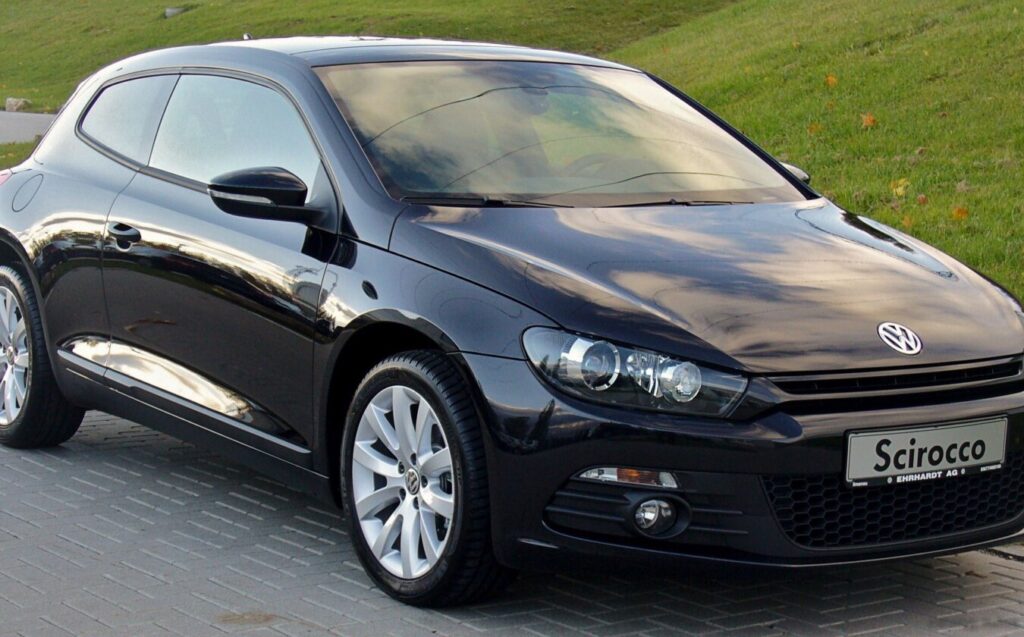
The Volkswagen Scirocco III 2.0 TSI, produced from July 2008 to October 2009, marked a significant revival of the iconic Scirocco nameplate. Positioned as the performance flagship within the third-generation Scirocco range (internally designated the 13th series), it aimed to recapture the spirit of the original, offering a sporty coupe experience. Built on the Volkswagen Group’s A5 platform – shared with the Golf Mk5 and Audi TT – the 2.0 TSI represented a substantial power upgrade over the base 1.4 TSI engine. It was primarily marketed in Europe, where the coupe market remained relatively strong, and offered a more stylish alternative to the Golf hatchback.
Technical Specifications
| Brand | Volkswagen |
| Model | Scirocco |
| Generation | Scirocco III |
| Type (Engine) | 2.0 TSI (200 Hp) |
| Start of production | July, 2008 |
| End of production | October, 2009 |
| Powertrain Architecture | Internal Combustion engine |
| Body type | Coupe |
| Seats | 4 |
| Doors | 3 |
| Fuel consumption (urban) | 10.6 l/100 km (22.2 US mpg) |
| Fuel consumption (extra urban) | 5.9 l/100 km (39.9 US mpg) |
| Fuel consumption (combined) | 7.6 l/100 km (30.9 US mpg) |
| Fuel Type | Petrol (Gasoline) |
| Acceleration 0 – 100 km/h | 6.7 sec |
| Acceleration 0 – 62 mph | 6.7 sec |
| Acceleration 0 – 60 mph | 6.4 sec |
| Maximum speed | 245 km/h (152.24 mph) |
| Emission standard | Euro 4 |
| Weight-to-power ratio | 6.9 kg/Hp |
| Weight-to-torque ratio | 3.9 kg/Nm |
| Power | 200 Hp @ 5190 rpm |
| Torque | 350 Nm @ 1610 rpm (258.15 lb.-ft. @ 1610 rpm) |
| Engine layout | Front, Transverse |
| Engine Model/Code | CAWB |
| Engine displacement | 1984 cm3 (121.07 cu. in.) |
| Number of cylinders | 4 |
| Engine configuration | Inline |
| Cylinder Bore | 82.5 mm (3.25 in.) |
| Piston Stroke | 92.8 mm (3.65 in.) |
| Compression ratio | 10.3:1 |
| Number of valves per cylinder | 4 |
| Fuel injection system | Direct injection |
| Engine aspiration | Turbocharger, Intercooler |
| Engine oil capacity | 4.7 l (4.97 US qt | 4.14 UK qt) |
| Kerb Weight | 1373 kg (3026.95 lbs.) |
| Max. weight | 1740 kg (3836.04 lbs.) |
| Max load | 367 kg (809.1 lbs.) |
| Trunk (boot) space – minimum | 292 l (10.31 cu. ft.) |
| Trunk (boot) space – maximum | 755 l (26.66 cu. ft.) |
| Fuel tank capacity | 50 l (13.21 US gal | 11 UK gal) |
| Length | 4256 mm (167.56 in.) |
| Width | 1810 mm (71.26 in.) |
| Height | 1404 mm (55.28 in.) |
| Wheelbase | 2578 mm (101.5 in.) |
| Front track | 1569 mm (61.77 in.) |
| Rear (Back) track | 1575 mm (62.01 in.) |
| Minimum turning circle | 11 m (36.09 ft.) |
| Drivetrain Architecture | Front wheel drive |
| Number of gears | 6 gears, manual transmission |
| Front suspension | Independent, type McPherson with coil spring and anti-roll bar |
| Front brakes | Ventilated discs |
| Rear brakes | Disc |
| Assisting systems | ABS (Anti-lock braking system) |
| Tires size | 235/40 R18 |
| Wheel rims size | 8J x 18 |
Powertrain & Engine Architecture
The heart of the Scirocco III 2.0 TSI was the CAWB engine, a 1.984-liter, turbocharged, direct-injection inline-four cylinder. This engine was a member of Volkswagen’s EA888 family, known for its robust construction and tuning potential. Direct injection, combined with a turbocharger and intercooler, allowed for a high compression ratio of 10.3:1 and impressive torque output. The CAWB engine featured variable valve timing on both the intake and exhaust camshafts, optimizing performance across the rev range. The 200 horsepower peak arrived at 5190 rpm, but the engine’s 350 Nm (258 lb-ft) of torque was readily available from a low 1610 rpm, providing strong in-gear acceleration. The standard transmission was a six-speed manual gearbox, offering precise shifts and a direct connection to the engine. A six-speed DSG (Direct-Shift Gearbox) dual-clutch automatic was also available as an option, providing faster shifts and a more refined driving experience, though the manual was favored by enthusiasts.
Driving Characteristics
The 2.0 TSI Scirocco offered a noticeably more engaging driving experience than the base 1.4 TSI model. The increased power and torque resulted in a 0-60 mph time of around 6.4 seconds and a top speed of 152 mph. The turbocharger provided a surge of power in the mid-range, making overtaking effortless. The six-speed manual transmission was well-matched to the engine’s characteristics, with closely spaced ratios allowing the driver to keep the engine in its sweet spot. While front-wheel drive, the Scirocco’s chassis was well-balanced, and the standard electronic stability control (ESC) helped to mitigate understeer. Compared to the 1.4 TSI, the 2.0 TSI felt significantly more capable and responsive, offering a genuine sporty feel. However, it wasn’t without its quirks; torque steer could be noticeable under hard acceleration, particularly on less-than-perfect road surfaces.
Equipment & Trim Levels
The 2.0 TSI typically came with a higher level of standard equipment than the lower-spec models. Standard features included alloy wheels (typically 18-inch), sports seats, air conditioning, a CD stereo system, and electric windows. Optional extras included leather upholstery, a sunroof, a premium sound system, and parking sensors. The interior design was modern and functional, with a focus on driver ergonomics. The dashboard featured a clean layout with easy-to-read gauges. Trim levels varied slightly depending on the market, but generally, the 2.0 TSI represented a well-equipped and stylish package.
Chassis & Braking
The Scirocco III utilized a McPherson strut front suspension and a multi-link rear suspension, providing a good balance between ride comfort and handling. The suspension was tuned to be slightly firmer than the Golf Mk5, reflecting the Scirocco’s sporty aspirations. Brakes consisted of ventilated discs at the front and solid discs at the rear. ABS (Anti-lock Braking System) was standard. The steering was precise and well-weighted, providing good feedback to the driver. The chassis was relatively lightweight, contributing to the car’s agile handling characteristics.
Market Reception & Comparison
The Scirocco III 2.0 TSI was generally well-received by automotive critics. It was praised for its stylish design, strong performance, and engaging driving dynamics. However, some critics noted that the interior space was somewhat limited, particularly in the rear seats. Compared to the 1.4 TSI, the 2.0 TSI offered a significant performance upgrade, but at a higher price point. It also consumed more fuel, although the combined fuel economy of around 30.9 US mpg was still respectable for a performance coupe. Compared to rivals such as the Audi TT and BMW 1 Series Coupe, the Scirocco offered a compelling combination of performance, style, and value.
Legacy
The CAWB engine proved to be a reliable unit when properly maintained. Common issues included occasional oil consumption and potential problems with the turbocharger, particularly if the engine was frequently driven hard. The Scirocco III 2.0 TSI has maintained a loyal following among enthusiasts, and well-maintained examples are sought after in the used car market. Its combination of sporty styling, strong performance, and relative affordability has made it a popular choice for those seeking a fun-to-drive coupe. The Scirocco III, and particularly the 2.0 TSI variant, helped to revive the Scirocco nameplate and establish it as a modern classic.