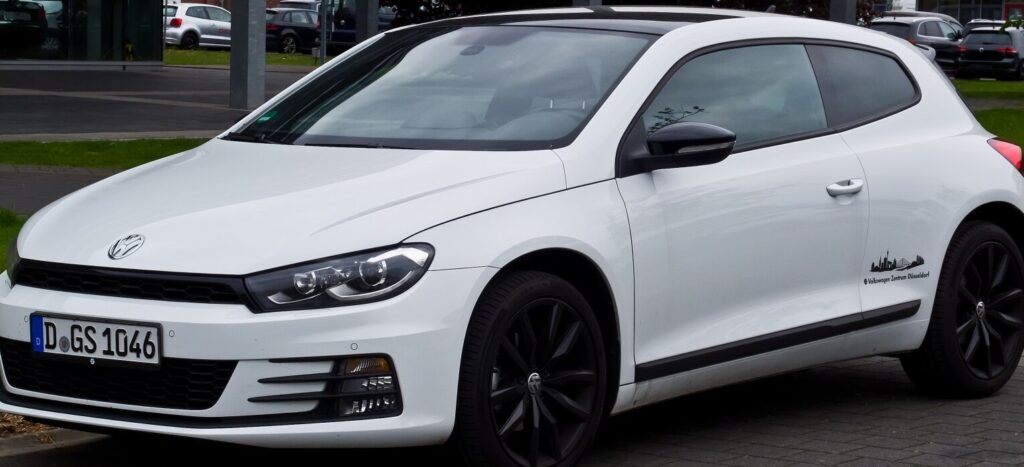
The Volkswagen Scirocco III, specifically the 2.0 TDI variant produced from April 2014 to September 2017, represented a compelling offering in the compact coupe segment. This facelifted version of the third-generation Scirocco (internally designated the 1HX0/A3 platform) aimed to blend sporty styling with diesel efficiency. Positioned as a mid-range trim, the 2.0 TDI 150 hp model offered a balance between performance and fuel economy, appealing to buyers seeking a stylish and practical coupe. It sat below the more potent petrol-powered versions, like the 2.0 TSI, and above the entry-level 1.6 TDI.
Technical Specifications
| Brand | Volkswagen |
| Model | Scirocco |
| Generation | Scirocco III (facelift 2014) |
| Type (Engine) | 2.0 TDI (150 Hp) |
| Start of production | April, 2014 |
| End of production | September, 2017 |
| Powertrain Architecture | Internal Combustion engine |
| Body type | Coupe |
| Seats | 4 |
| Doors | 3 |
| Fuel consumption (urban) | 5 l/100 km (47 US mpg, 56.5 UK mpg, 20 km/l) |
| Fuel consumption (extra urban) | 3.8 l/100 km (61.9 US mpg, 74.3 UK mpg, 26.3 km/l) |
| Fuel consumption (combined) | 4.2 l/100 km (56 US mpg, 67.3 UK mpg, 23.8 km/l) |
| CO2 emissions | 109 g/km |
| Fuel Type | Diesel |
| Acceleration 0 – 100 km/h | 8.6 sec |
| Acceleration 0 – 62 mph | 8.6 sec |
| Acceleration 0 – 60 mph | 8.2 sec |
| Maximum speed | 215 km/h (133.59 mph) |
| Emission standard | Euro 6 |
| Weight-to-power ratio | 9.2 kg/Hp, 109.1 Hp/tonne |
| Weight-to-torque ratio | 4 kg/Nm, 247.3 Nm/tonne |
| Power | 150 Hp @ 3500-4000 rpm |
| Power per litre | 76.2 Hp/l |
| Torque | 340 Nm @ 1750-3000 rpm (250.77 lb.-ft. @ 1750-3000 rpm) |
| Engine layout | Front, Transverse |
| Engine Model/Code | CUUB |
| Engine displacement | 1968 cm3 (120.09 cu. in.) |
| Number of cylinders | 4 |
| Engine configuration | Inline |
| Number of valves per cylinder | 4 |
| Fuel injection system | Diesel Commonrail |
| Engine aspiration | Turbocharger, Intercooler |
| Engine oil capacity | 4.7 l (4.97 US qt | 4.14 UK qt) |
| Kerb Weight | 1375 kg (3031.36 lbs.) |
| Max. weight | 1780 kg (3924.23 lbs.) |
| Max load | 405 kg (892.87 lbs.) |
| Trunk (boot) space – minimum | 312 l (11.02 cu. ft.) |
| Trunk (boot) space – maximum | 1006 l (35.53 cu. ft.) |
| Fuel tank capacity | 55 l (14.53 US gal | 12.1 UK gal) |
| Length | 4256 mm (167.56 in.) |
| Width | 1810 mm (71.26 in.) |
| Height | 1406 mm (55.35 in.) |
| Wheelbase | 2578 mm (101.5 in.) |
| Front track | 1569 mm (61.77 in.) |
| Rear (Back) track | 1575 mm (62.01 in.) |
| Minimum turning circle | 11 m (36.09 ft.) |
| Drivetrain Architecture | The Internal combustion engine (ICE) drives the front wheels of the vehicle. |
| Drive wheel | Front wheel drive |
| Number of gears and type of gearbox | 6 gears, manual transmission |
| Front brakes | Ventilated discs |
| Assisting systems | ABS (Anti-lock braking system) |
| Steering type | Steering rack and pinion |
| Tires size | 205/50 R17; 225/45 R17 |
| Wheel rims size | 7J x 17 |
Powertrain & Engine Architecture
The heart of the Scirocco 2.0 TDI was the CUUB engine code, a 1968cc inline-four cylinder diesel. This engine utilized a common rail direct injection system, delivering fuel at extremely high pressure for optimized combustion. A turbocharger with an intercooler was employed to boost power output and improve torque across a wider rev range. The engine featured four valves per cylinder, contributing to its efficiency and responsiveness. The 2.0 TDI produced 150 horsepower at 3500-4000 rpm and a substantial 340 Nm (250.77 lb-ft) of torque between 1750 and 3000 rpm. This torque figure was a key characteristic, providing strong pulling power for everyday driving and overtaking. The engine also incorporated a diesel particulate filter (DPF) to meet stringent Euro 6 emission standards. The standard transmission was a 6-speed manual gearbox, providing precise control and engaging driving experience.
Driving Characteristics
The 2.0 TDI 150 hp Scirocco offered a refined and capable driving experience. While not as overtly sporty as the petrol-powered variants, the diesel engine’s ample torque provided brisk acceleration. The 0-60 mph sprint took approximately 8.2 seconds, and the car could reach a top speed of 215 km/h (133.59 mph). The manual gearbox was well-matched to the engine’s characteristics, with gear ratios optimized for both fuel efficiency and performance. The long gearing helped to keep engine speeds low during cruising, contributing to a quiet and comfortable ride. Compared to the higher-output 2.0 TSI, the 2.0 TDI felt less eager to rev, but it offered superior fuel economy and a more relaxed driving experience. The manual transmission provided a more engaging feel than the optional DSG dual-clutch gearbox.
Equipment & Trim Levels
The 2.0 TDI trim typically included features such as air conditioning, a touchscreen infotainment system, alloy wheels, and electric windows. Standard safety equipment included ABS, traction control, and multiple airbags. Optional extras included a panoramic sunroof, leather upholstery, sports seats, and a premium sound system. Interior trim levels varied, with cloth upholstery being standard and leather available as an upgrade. The dashboard layout was modern and driver-focused, with clear instrumentation and intuitive controls.
Chassis & Braking
The Scirocco III utilized a MacPherson strut front suspension and a multi-link rear suspension, providing a good balance between ride comfort and handling precision. The front brakes were ventilated discs, offering strong stopping power, while the rear brakes were typically solid discs. The steering was a rack-and-pinion system, providing precise and responsive control. Stabilizer bars were fitted to both the front and rear axles to reduce body roll during cornering. Tire sizes varied depending on the trim level, with 205/50 R17 and 225/45 R17 being common options.
Market Reception & Comparison
The Scirocco 2.0 TDI 150 hp was generally well-received by automotive critics. It was praised for its stylish design, fuel efficiency, and comfortable ride. However, some reviewers noted that it lacked the outright performance of the petrol-powered variants. Compared to the 1.6 TDI, the 2.0 TDI offered a significant performance upgrade, while maintaining excellent fuel economy. Against competitors like the Ford Focus Coupe or the Peugeot RCZ, the Scirocco stood out with its distinctive styling and refined driving experience. Fuel economy figures of around 56 US mpg combined made it an attractive option for drivers seeking a practical and economical coupe.
Legacy
The Volkswagen Scirocco III 2.0 TDI, particularly the CUUB engine, has proven to be a relatively reliable powertrain. While diesel engines can be susceptible to issues with the DPF and fuel injectors, these engines are generally robust when properly maintained. In the used car market, these Sciroccos represent a good value proposition, offering a stylish and well-equipped coupe at an affordable price. The 2.0 TDI engine’s fuel efficiency and torque make it a practical choice for everyday driving, and its relatively simple mechanical design makes it easier to maintain compared to some of the more complex petrol-powered alternatives. The Scirocco III, in general, remains a popular choice among enthusiasts seeking a sporty and distinctive coupe.