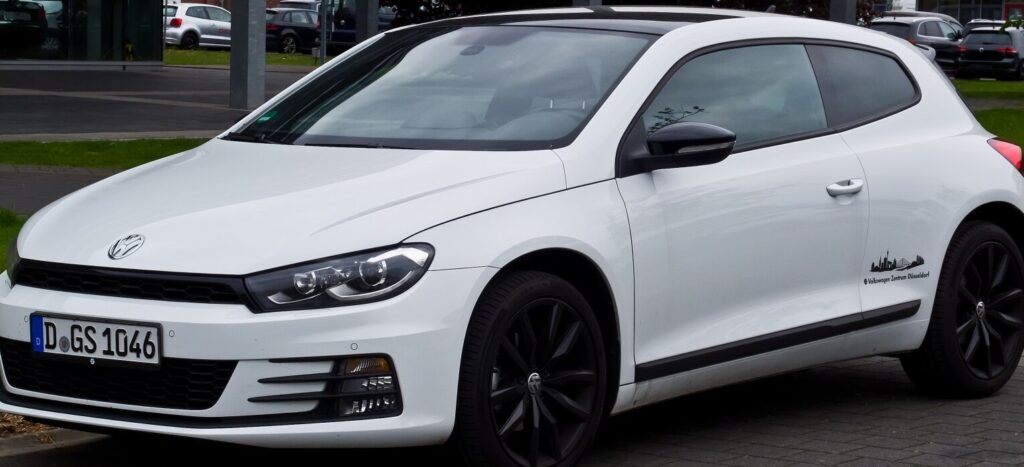
The Volkswagen Scirocco III, particularly the facelifted version introduced in June 2014 and produced through September 2017, represented a sporty and stylish offering in the compact coupe segment. The 2.0 TDI variant, equipped with 184 horsepower and a dual-clutch gearbox (DSG), was a significant model within the Scirocco III lineup, appealing to drivers seeking a balance of performance, fuel efficiency, and refinement. This iteration of the Scirocco sat in the mid-to-upper range of the trim levels, offering a step up in power and technology compared to the lower-displacement engines while remaining more accessible than potential future performance-focused models.
Technical Specifications
| Brand | Volkswagen |
| Model | Scirocco |
| Generation | Scirocco III (facelift 2014) |
| Type (Engine) | 2.0 TDI (184 Hp) DSG |
| Start of production | June, 2014 |
| End of production | September, 2017 |
| Powertrain Architecture | Internal Combustion engine |
| Body type | Coupe |
| Seats | 4 |
| Doors | 3 |
| Fuel consumption (urban) | 5.6 l/100 km (42 US mpg, 50.4 UK mpg, 17.9 km/l) |
| Fuel consumption (extra urban) | 4.3 l/100 km (54.7 US mpg, 65.7 UK mpg, 23.3 km/l) |
| Fuel consumption (combined) | 4.8 l/100 km (49 US mpg, 58.9 UK mpg, 20.8 km/l) |
| CO2 emissions | 125 g/km |
| Fuel Type | Diesel |
| Acceleration 0 – 100 km/h | 7.5 sec |
| Acceleration 0 – 62 mph | 7.5 sec |
| Acceleration 0 – 60 mph | 7.1 sec |
| Maximum speed | 228 km/h (141.67 mph) |
| Emission standard | Euro 6 |
| Weight-to-power ratio | 7.7 kg/Hp, 129.8 Hp/tonne |
| Weight-to-torque ratio | 3.7 kg/Nm, 268 Nm/tonne |
| Power | 184 Hp @ 3500-4000 rpm |
| Power per litre | 93.5 Hp/l |
| Torque | 380 Nm @ 1750-3250 rpm (280.27 lb.-ft. @ 1750-3250 rpm) |
| Engine layout | Front, Transverse |
| Engine Model/Code | CUWA, CUXA |
| Engine displacement | 1968 cm3 (120.09 cu. in.) |
| Number of cylinders | 4 |
| Engine configuration | Inline |
| Number of valves per cylinder | 4 |
| Fuel injection system | Diesel Commonrail |
| Engine aspiration | Turbocharger, Intercooler |
| Engine oil capacity | 4.7 l (4.97 US qt | 4.14 UK qt) |
| Kerb Weight | 1418 kg (3126.15 lbs.) |
| Max. weight | 1820 kg (4012.41 lbs.) |
| Max load | 402 kg (886.26 lbs.) |
| Trunk (boot) space – minimum | 312 l (11.02 cu. ft.) |
| Trunk (boot) space – maximum | 1006 l (35.53 cu. ft.) |
| Fuel tank capacity | 55 l (14.53 US gal | 12.1 UK gal) |
| Length | 4256 mm (167.56 in.) |
| Width | 1810 mm (71.26 in.) |
| Height | 1406 mm (55.35 in.) |
| Wheelbase | 2578 mm (101.5 in.) |
| Front track | 1569 mm (61.77 in.) |
| Rear (Back) track | 1575 mm (62.01 in.) |
| Minimum turning circle | 11 m (36.09 ft.) |
| Drivetrain Architecture | The Internal combustion engine (ICE) drives the front wheels of the vehicle. |
| Drive wheel | Front wheel drive |
| Number of gears and type of gearbox | 6 gears, automatic transmission DSG |
| Front brakes | Ventilated discs |
| Assisting systems | ABS (Anti-lock braking system) |
| Steering type | Steering rack and pinion |
| Tires size | 205/50 R17; 225/45 R17 |
| Wheel rims size | 7J x 17 |
INTRODUCTION
The Volkswagen Scirocco III, launched in 2008 and receiving a significant facelift in 2014, was a three-door coupe designed to recapture the spirit of the original Scirocco models from the 1970s and 80s. Built on the Volkswagen Group’s A5 (PQ35) platform – later updated to the A3 platform – the Scirocco aimed to provide a more stylish and sporty alternative to the Golf hatchback. The 2.0 TDI with 184 horsepower and the DSG transmission, introduced with the 2014 facelift, offered a compelling blend of performance and efficiency, targeting buyers who desired a refined driving experience without sacrificing practicality. It was positioned as a step above the base 1.4 TSI engine, offering more torque and quicker acceleration.
Powertrain & Engine Architecture
The heart of the Scirocco III 2.0 TDI is the Volkswagen Group’s common rail diesel engine, specifically the CUWA or CUXA engine codes. This 1968cc inline-four cylinder engine utilizes a turbocharger with an intercooler to boost power output. The engine features four valves per cylinder and direct fuel injection via a high-pressure common rail system, enabling precise fuel delivery and optimized combustion. The 2.0 TDI benefits from advanced technologies like variable geometry turbocharging (VGT) to enhance responsiveness across the rev range. The DSG (Direct-Shift Gearbox) is a six-speed dual-clutch transmission that provides rapid and seamless gear changes, contributing to both performance and fuel economy. The DSG operates similarly to two manual gearboxes in one, allowing for quick upshifts and downshifts without interrupting power delivery.
Driving Characteristics
The 184 hp 2.0 TDI with the DSG transmission delivered a noticeably more engaging driving experience compared to the lower-powered engine options. Acceleration from 0 to 60 mph took approximately 7.1-7.5 seconds, making it a competitive performer in its class. The DSG transmission’s quick shifts and intelligent gear selection maximized the engine’s torque output, providing strong acceleration in everyday driving situations. While not as overtly sporty as some rivals, the Scirocco 2.0 TDI offered a comfortable and refined ride, with well-weighted steering and predictable handling. The DSG transmission could be operated in both automatic and manual modes, allowing drivers to tailor the driving experience to their preferences. Compared to the manual transmission versions of the 2.0 TDI, the DSG offered smoother shifts and reduced driver fatigue, but some enthusiasts preferred the greater control of a manual gearbox.
Equipment & Trim Levels
The 2.0 TDI variant of the Scirocco III typically came well-equipped, reflecting its mid-range positioning. Standard features often included alloy wheels (typically 17-inch), air conditioning, a touchscreen infotainment system with Bluetooth connectivity, and a multi-function steering wheel. Higher trim levels offered upgrades such as leather upholstery, heated front seats, a panoramic sunroof, and advanced driver-assistance systems like adaptive cruise control and automatic parking assist. Interior upholstery was generally a combination of cloth and leatherette, with options for full leather available. The dashboard layout was driver-focused, with clear instrumentation and intuitive controls.
Chassis & Braking
The Scirocco III utilized a MacPherson strut front suspension and a multi-link rear suspension, providing a good balance of ride comfort and handling precision. The 2.0 TDI models typically featured ventilated front disc brakes and solid rear disc brakes, offering adequate stopping power for everyday driving. Anti-lock Braking System (ABS) was standard, enhancing safety and stability during emergency braking. Stabilizer bars were fitted to both the front and rear axles to reduce body roll during cornering. The chassis was tuned to provide a slightly firmer ride than the Golf, reflecting the Scirocco’s sporty aspirations.
Market Reception & Comparison
The Scirocco III 2.0 TDI received generally positive reviews from automotive critics. It was praised for its stylish design, refined driving experience, and fuel efficiency. However, some critics noted that the rear seats were cramped and access was limited due to the coupe body style. Compared to other diesel-powered coupes in its class, such as the Peugeot RCZ, the Scirocco offered a more balanced package of performance, practicality, and refinement. The 2.0 TDI provided significantly better fuel economy than the petrol-powered versions, making it an attractive option for drivers who covered long distances. Reliability was generally good, although some owners reported minor issues with the DSG transmission.
Legacy
The Volkswagen Scirocco III, including the 2.0 TDI variant, has established a loyal following among enthusiasts. The 2.0 TDI engine, in particular, is known for its durability and relatively low maintenance costs. On the used car market, well-maintained examples of the Scirocco III 2.0 TDI continue to hold their value, appealing to buyers seeking a stylish and efficient coupe with a sporty character. While Volkswagen discontinued the Scirocco in 2017, its legacy as a modern interpretation of a classic sports coupe endures.