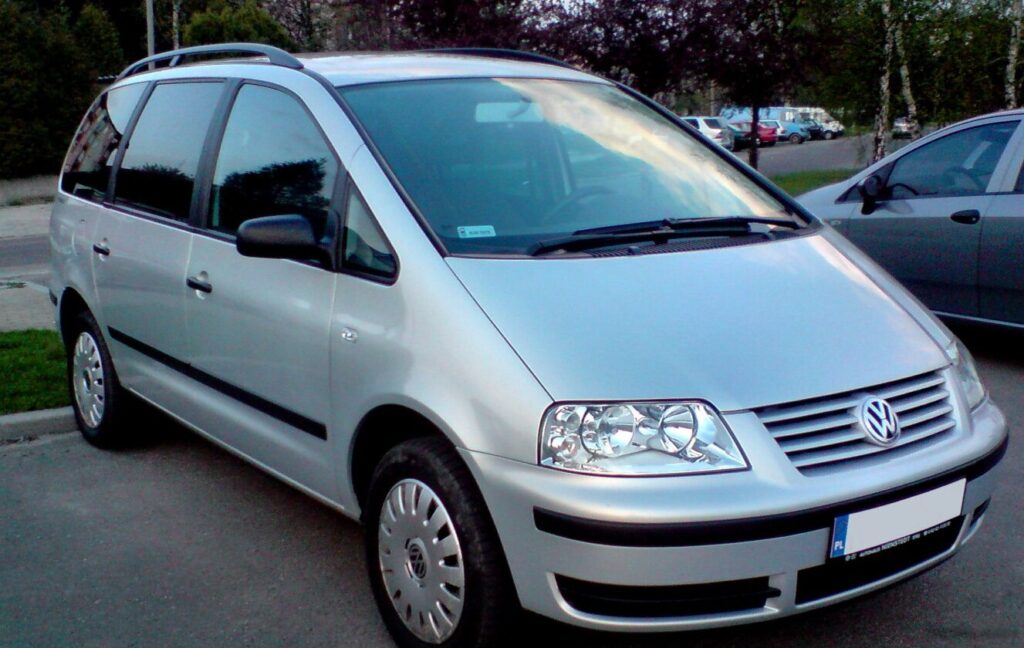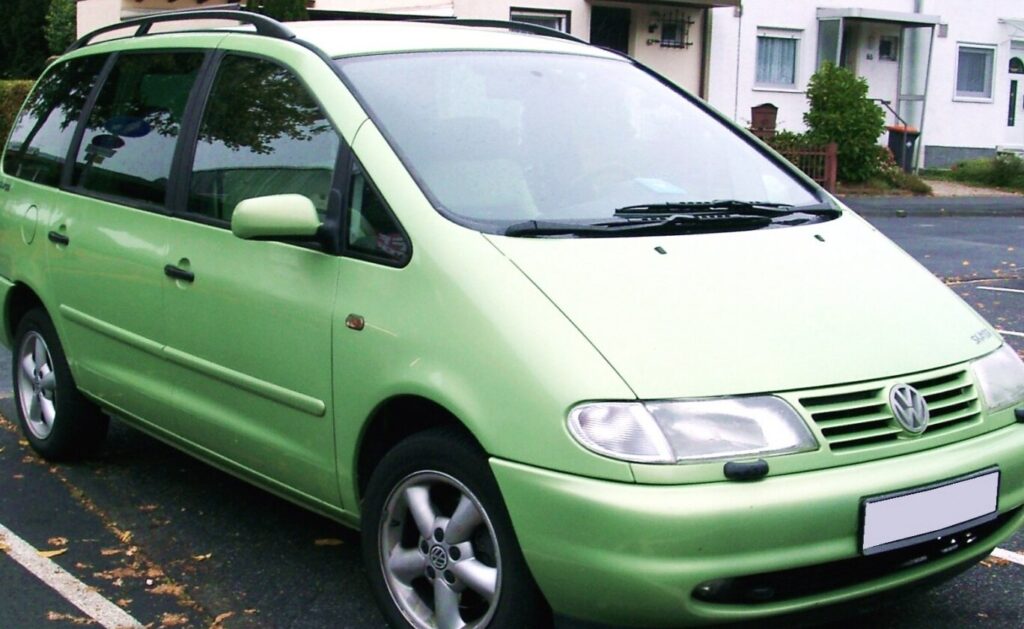
The Volkswagen Sharan I 2.8 i VR6 GL Automatic, produced between 1995 and 2000, represents a significant offering in Volkswagen’s first foray into the large MPV (Multi-Purpose Vehicle) segment. Built upon the PL45/A3 platform shared with the SEAT Alhambra and Ford Galaxy, the Sharan aimed to provide a spacious, practical, and relatively luxurious family vehicle. The 2.8 VR6 GL Automatic trim sat towards the upper end of the Sharan I lineup, offering a more powerful engine and the convenience of an automatic transmission compared to the base models. It was primarily marketed in Europe, where the demand for MPVs was strong, and positioned as a premium alternative to more utilitarian people carriers.
Technical Specifications
| Brand | Volkswagen |
| Model | Sharan |
| Generation | Sharan I |
| Type | 2.8 i VR6 GL (174 Hp) Automatic |
| Start of production | 1995 |
| End of production | 2000 |
| Powertrain Architecture | Internal Combustion engine |
| Body type | Minivan, MPV |
| Seats | 7 |
| Doors | 5 |
| Fuel consumption (urban) | 17.6 l/100 km (13.4 US mpg, 16.1 UK mpg, 5.7 km/l) |
| Fuel consumption (extra urban) | 9.7 l/100 km (24.2 US mpg, 29.1 UK mpg, 10.3 km/l) |
| Fuel Type | Petrol (Gasoline) |
| Acceleration 0 – 100 km/h | 13.2 sec |
| Acceleration 0 – 62 mph | 13.2 sec |
| Acceleration 0 – 60 mph | 12.5 sec |
| Maximum speed | 195 km/h (121.17 mph) |
| Weight-to-power ratio | 10.5 kg/Hp, 94.8 Hp/tonne |
| Weight-to-torque ratio | 7.8 kg/Nm, 128.1 Nm/tonne |
| Power | 174 Hp @ 5800 rpm |
| Power per litre | 62.3 Hp/l |
| Torque | 235 Nm @ 4200 rpm (173.33 lb.-ft. @ 4200 rpm) |
| Engine layout | Front, Transverse |
| Engine Model/Code | AAA, AMY |
| Engine displacement | 2792 cm3 (170.38 cu. in.) |
| Number of cylinders | 6 |
| Engine configuration | V-engine |
| Cylinder Bore | 81 mm (3.19 in.) |
| Piston Stroke | 90.3 mm (3.56 in.) |
| Compression ratio | 10:1 |
| Number of valves per cylinder | 2 |
| Fuel injection system | Multi-port manifold injection |
| Engine aspiration | Naturally aspirated engine |
| Valvetrain | OHC |
| Engine oil capacity | 5.5 l (5.81 US qt, 4.84 UK qt) |
| Coolant capacity | 8.2 l (8.66 US qt, 7.21 UK qt) |
| Kerb Weight | 1835 kg (4045.48 lbs.) |
| Max. weight | 2460 kg (5423.37 lbs.) |
| Max load | 625 kg (1377.89 lbs.) |
| Trunk (boot) space – minimum | 256 l (9.04 cu. ft.) |
| Trunk (boot) space – maximum | 2610 l (92.17 cu. ft.) |
| Fuel tank capacity | 75 l (19.81 US gal, 16.5 UK gal) |
| Length | 4617 mm (181.77 in.) |
| Width | 1810 mm (71.26 in.) |
| Height | 1730 mm (68.11 in.) |
| Wheelbase | 2835 mm (111.61 in.) |
| Front track | 1502 mm (59.13 in.) |
| Rear track | 1497 mm (58.94 in.) |
| Drivetrain Architecture | Front wheel drive |
| Number of gears | 4 |
| Gearbox type | Automatic transmission |
| Front suspension | Spring Strut |
| Rear suspension | Coil spring |
| Front brakes | Ventilated discs |
| Rear brakes | Disc |
| Assisting systems | ABS (Anti-lock braking system) |
| Steering type | Steering rack and pinion |
| Power steering | Hydraulic Steering |
| Tires size | 205/60 R15 H |
| Wheel rims size | 15 |
INTRODUCTION
The Volkswagen Sharan I 2.8 i VR6 GL Automatic, launched in 1995, was a key variant within the first generation Sharan range (1995-2000). The Sharan, developed in collaboration with Ford and SEAT, aimed to challenge the established MPV market dominated by vehicles like the Renault Espace. The VR6 engine, a Volkswagen hallmark, provided a significant performance upgrade over the base four-cylinder options, while the automatic transmission catered to drivers prioritizing convenience. This combination positioned the 2.8 VR6 GL Automatic as a comfortable and capable family vehicle, appealing to those willing to pay a premium for enhanced performance and ease of driving.
Powertrain & Engine Architecture
At the heart of the Sharan I 2.8 VR6 GL Automatic lies the AAA or AMY engine code, a 2.8-liter naturally aspirated V6 engine. This engine is notable for its narrow-angle V6 configuration (15 degrees between cylinder banks), which allowed it to be packaged more compactly than a traditional V6. The engine utilizes multi-port fuel injection and a single overhead camshaft (OHC) valvetrain. The VR6 is known for its relatively smooth power delivery and distinctive exhaust note. Paired with this engine is a four-speed automatic transmission, providing smooth gear changes but lacking the efficiency of more modern automatic gearboxes. The transmission was chosen for its reliability and ease of use, aligning with the target audience’s preference for a comfortable driving experience.
Driving Characteristics
The 2.8 VR6 Automatic Sharan offered a noticeable performance advantage over lower-spec models. While not a sports car, the 174 horsepower and 235 Nm (173 lb-ft) of torque provided sufficient power for comfortable highway cruising and overtaking. The four-speed automatic transmission, while smooth, did result in slightly slower acceleration compared to the manual transmission versions. The gear ratios were optimized for relaxed cruising rather than outright performance. In real-world driving, the Sharan VR6 Automatic felt composed and stable, even when fully loaded with passengers and luggage. However, the weight of the vehicle and the relatively conservative gearing meant that acceleration was not particularly brisk, with 0-60 mph times around 12.5 seconds.
Equipment & Trim Levels
The “GL” designation indicated a higher trim level, and the 2.8 VR6 Automatic Sharan came well-equipped as standard. Features typically included power windows, central locking, air conditioning, and an upgraded audio system. Interior upholstery was generally cloth, although leather options were available. Dashboard configuration was functional and straightforward, prioritizing usability over stylistic flair. Optional extras included a sunroof, upgraded sound systems, and alloy wheels. The Sharan also offered a high degree of practicality, with a flexible seating arrangement allowing for various configurations to maximize cargo space.
Chassis & Braking
The Sharan I utilized a front-wheel-drive layout with a MacPherson strut front suspension and a coil spring rear suspension. This setup provided a comfortable ride, although it wasn’t particularly sporty. The braking system consisted of ventilated discs on the front wheels and solid discs on the rear. Anti-lock Braking System (ABS) was standard, enhancing safety. The suspension was tuned to prioritize ride comfort and stability, reflecting the Sharan’s role as a family vehicle. Stabilizer bars were fitted to both the front and rear axles to reduce body roll during cornering.
Market Reception & Comparison
The Sharan I 2.8 VR6 GL Automatic received generally positive reviews, with critics praising its spacious interior, comfortable ride, and the performance offered by the VR6 engine. However, the automatic transmission was sometimes criticized for being somewhat dated and less efficient than contemporary offerings. Compared to the base models with four-cylinder engines, the VR6 Automatic provided a significant upgrade in performance and refinement. Compared to the diesel variants (like the 1.9 TDI), the VR6 offered more power but at the cost of significantly higher fuel consumption. The Sharan also competed with other MPVs like the Renault Espace and Citroën Evasion, offering a compelling alternative with its Volkswagen build quality and distinctive VR6 engine.
Legacy
The Sharan I 2.8 VR6 GL Automatic, while not a high-volume seller, has developed a following among enthusiasts who appreciate its unique combination of practicality, performance, and Volkswagen engineering. The VR6 engine is known for its durability, although regular maintenance is crucial. The automatic transmission, while reliable, can be prone to wear and tear with high mileage. Today, well-maintained examples are becoming increasingly sought after by collectors and enthusiasts. The Sharan I represented Volkswagen’s successful entry into the MPV market and laid the foundation for future generations of the Sharan, establishing it as a popular choice for families seeking a spacious and versatile vehicle.