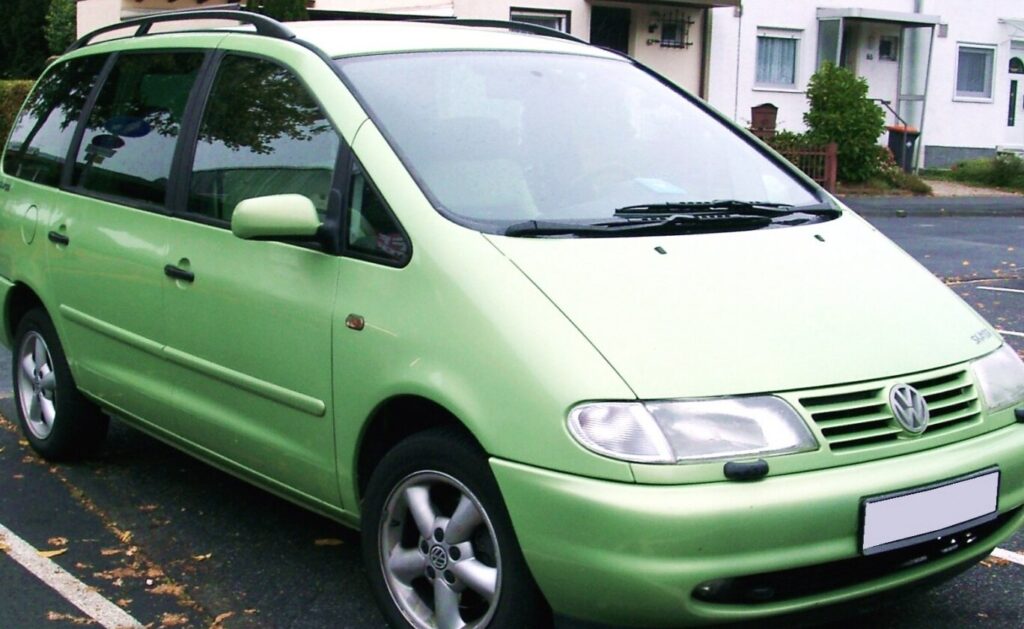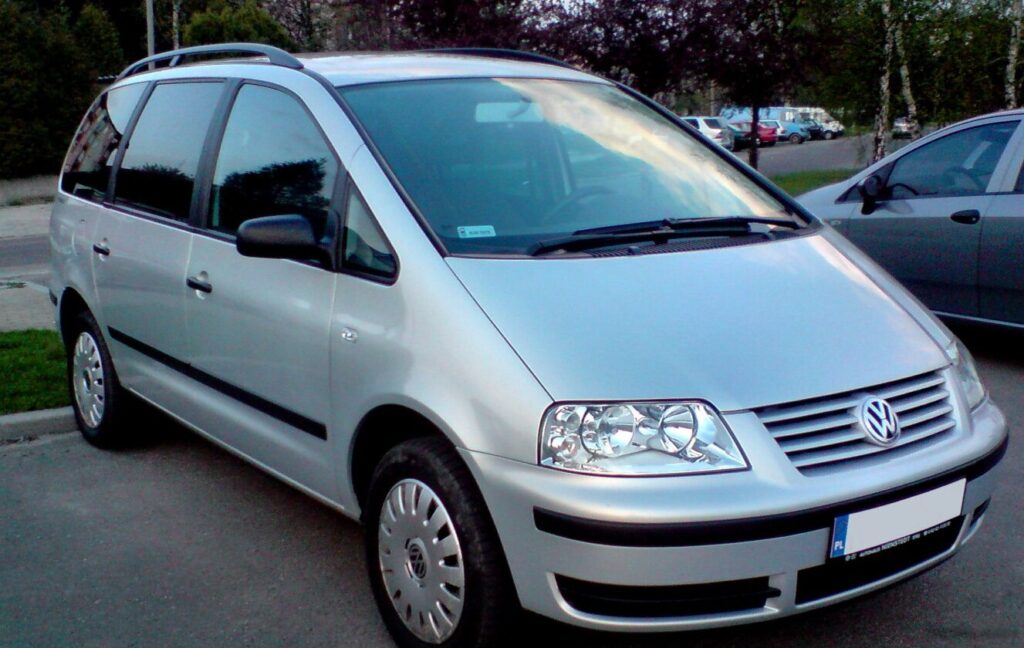
The Volkswagen Sharan I (facelift, produced from 2000 to 2004) 1.9 TDI 115 hp Tiptronic represents a specific configuration within the first generation of the Sharan, a minivan designed to compete in the European MPV (Multi-Purpose Vehicle) market. Positioned as a mid-range offering, this variant aimed to balance fuel efficiency with acceptable performance for family transport. It was part of the larger Volkswagen Group effort, sharing its platform (the 1HX0/A3 platform) with the SEAT Alhambra and Ford Galaxy, a collaboration intended to provide each brand with a competitive entry into the growing minivan segment. The facelift brought cosmetic updates and minor mechanical refinements to the original Sharan design.
Technical Specifications
| Brand | Volkswagen |
| Model | Sharan |
| Generation | Sharan I (facelift 2000) |
| Type (Engine) | 1.9 TDI (115 Hp) Tiptronic |
| Start of production | 2000 year |
| End of production | 2004 year |
| Powertrain Architecture | Internal Combustion engine |
| Body type | Minivan, MPV |
| Seats | 7 |
| Doors | 5 |
| Fuel consumption (economy) – urban (NEDC) | 9.9 l/100 km (23.8 US mpg, 28.5 UK mpg, 10.1 km/l) |
| Fuel consumption (economy) – extra urban (NEDC) | 6.5 l/100 km (36.2 US mpg, 43.5 UK mpg, 15.4 km/l) |
| Fuel consumption (economy) – combined (NEDC) | 7.8 l/100 km (30.2 US mpg, 36.2 UK mpg, 12.8 km/l) |
| CO2 emissions (NEDC) | 211 g/km |
| Fuel Type | Diesel |
| Acceleration 0 – 100 km/h | 15.1 sec |
| Acceleration 0 – 62 mph | 15.1 sec |
| Acceleration 0 – 60 mph | 14.3 sec |
| Maximum speed | 177 km/h (109.98 mph) |
| Emission standard | Euro 3 |
| Weight-to-power ratio | 16.9 kg/Hp, 59.1 Hp/tonne |
| Weight-to-torque ratio | 6.3 kg/Nm, 159.4 Nm/tonne |
| Power | 115 Hp @ 4000 rpm |
| Power per litre | 60.7 Hp/l |
| Torque | 310 Nm @ 1900 rpm (228.64 lb.-ft. @ 1900 rpm) |
| Engine layout | Front, Transverse |
| Engine Model/Code | AUY |
| Engine displacement | 1896 cm3 (115.7 cu. in.) |
| Number of cylinders | 4 |
| Engine configuration | Inline |
| Cylinder Bore | 79.5 mm (3.13 in.) |
| Piston Stroke | 95.5 mm (3.76 in.) |
| Compression ratio | 18:1 |
| Number of valves per cylinder | 2 |
| Fuel injection system | Pump-nozzle (Unit Injector) |
| Engine aspiration | Turbocharger, Intercooler |
| Valvetrain | SOHC |
| Engine oil capacity | 4.3 l (4.54 US qt, 3.78 UK qt) |
| Coolant | 6.8 l (7.19 US qt, 5.98 UK qt) |
| Kerb Weight | 1945 kg (4287.99 lbs.) |
| Max. weight | 2470 kg (5445.42 lbs.) |
| Max load | 525 kg (1157.43 lbs.) |
| Trunk (boot) space – minimum | 256 l (9.04 cu. ft.) |
| Trunk (boot) space – maximum | 2610 l (92.17 cu. ft.) |
| Fuel tank capacity | 70 l (18.49 US gal, 15.4 UK gal) |
| Max. roof load | 75 kg (165.35 lbs.) |
| Permitted trailer load with brakes (12%) | 2000 kg (4409.25 lbs.) |
| Permitted trailer load without brakes | 700 kg (1543.24 lbs.) |
| Permitted towbar download | 85 kg (187.39 lbs.) |
| Length | 4634 mm (182.44 in.) |
| Width | 1810 mm (71.26 in.) |
| Height | 1759 mm (69.25 in.) |
| Wheelbase | 2841 mm (111.85 in.) |
| Front track | 1530 mm (60.24 in.) |
| Rear (Back) track | 1524 mm (60 in.) |
| Minimum turning circle | 11.9 m (39.04 ft.) |
| Drivetrain Architecture | Front wheel drive |
| Number of gears and type of gearbox | 5 gears, automatic transmission Tiptronic |
| Front suspension | Independent type McPherson, Transverse stabilizer |
| Rear suspension | Transverse stabilizer, Trailing arm, Coil spring |
| Front brakes | Ventilated discs |
| Rear brakes | Disc |
| Assisting systems | ABS (Anti-lock braking system) |
| Steering type | Steering rack and pinion |
| Power steering | Hydraulic Steering |
| Tires size | 195/60 R16 |
| Wheel rims size | 6J x 16 |
Powertrain & Engine Architecture
The heart of this Sharan variant is the 1.9-liter (1896 cc) inline-four cylinder diesel engine, designated the AUY code. This engine is a member of Volkswagen’s well-regarded TDI (Turbocharged Direct Injection) family. It utilizes a pump-nozzle (unit injector) fuel injection system, a technology that delivers highly precise fuel metering for improved combustion efficiency and reduced emissions. The engine features a single overhead camshaft (SOHC) valvetrain operating two valves per cylinder. A turbocharger with an intercooler is employed to boost power output, providing 115 horsepower at 4000 rpm and a substantial 310 Nm (228.64 lb-ft) of torque at a relatively low 1900 rpm. The torque characteristic is particularly important for a minivan, providing strong pulling power for hauling passengers and cargo. The engine is transversely mounted in the front of the vehicle.
The “Tiptronic” transmission is a 5-speed automatic gearbox offering both fully automatic operation and a manual shift mode. This allows the driver to have some control over gear selection, which can be useful in hilly terrain or when overtaking. The Tiptronic system provides smoother shifts than a traditional automatic, but isn’t as quick or efficient as a modern dual-clutch transmission.
Driving Characteristics
The 1.9 TDI 115 hp Tiptronic Sharan delivers adequate, but not exhilarating, performance. Acceleration from 0-60 mph takes around 14.3 seconds, and top speed is approximately 109.98 mph. The focus is on usability and fuel economy rather than outright speed. The Tiptronic transmission, while convenient, does sap some power compared to the available 5-speed manual transmission. The engine’s strong low-end torque makes it feel more responsive in everyday driving situations, such as merging onto highways or climbing hills. However, the automatic transmission can sometimes hunt for the right gear, particularly under heavy load. The gear ratios are tuned for fuel efficiency and comfortable cruising, rather than sporty acceleration.
Equipment & Trim Levels
The 1.9 TDI Tiptronic Sharan typically came equipped with a reasonable level of standard features. These included power windows, central locking, air conditioning, and an audio system. Interior upholstery was generally cloth, with options for upgraded materials. Safety features included ABS (Anti-lock Braking System) and driver and passenger airbags. Optional extras could include alloy wheels, a sunroof, upgraded audio systems, and parking sensors. The trim level sat in the middle of the Sharan range, offering a good balance of features and affordability.
Chassis & Braking
The Sharan I utilizes an independent McPherson strut suspension at the front and a trailing arm setup with coil springs at the rear. A transverse stabilizer bar is fitted to both axles to reduce body roll. The braking system consists of ventilated discs at the front and solid discs at the rear. The suspension is tuned for comfort, prioritizing a smooth ride over sporty handling. The brakes are adequate for the vehicle’s weight and performance, but are not particularly powerful.
Market Reception & Comparison
The Sharan, and specifically the 1.9 TDI Tiptronic variant, was generally well-received by automotive critics as a practical and spacious family vehicle. The TDI engine was praised for its fuel efficiency and strong torque. However, the Tiptronic transmission was sometimes criticized for its lack of responsiveness compared to the manual gearbox. Compared to the higher-powered 2.8-liter VR6 Sharan, the 1.9 TDI offered significantly better fuel economy but considerably less performance. The 1.9 TDI was also more affordable to purchase and maintain than the VR6. Compared to the SEAT Alhambra and Ford Galaxy, which shared the same platform, the Sharan was often perceived as the more premium offering.
Legacy
The 1.9 TDI engine, in various iterations, proved to be remarkably durable and reliable. The AUY code engine, while not without its potential issues (such as injector wear and turbocharger failure), is generally considered a robust unit when properly maintained. Today, the Sharan I 1.9 TDI Tiptronic can be found on the used car market at relatively affordable prices. Its practicality, spaciousness, and fuel efficiency continue to make it an appealing option for families seeking a budget-friendly MPV. However, potential buyers should be aware of the age-related issues common to older vehicles, such as corrosion and wear and tear on suspension components.