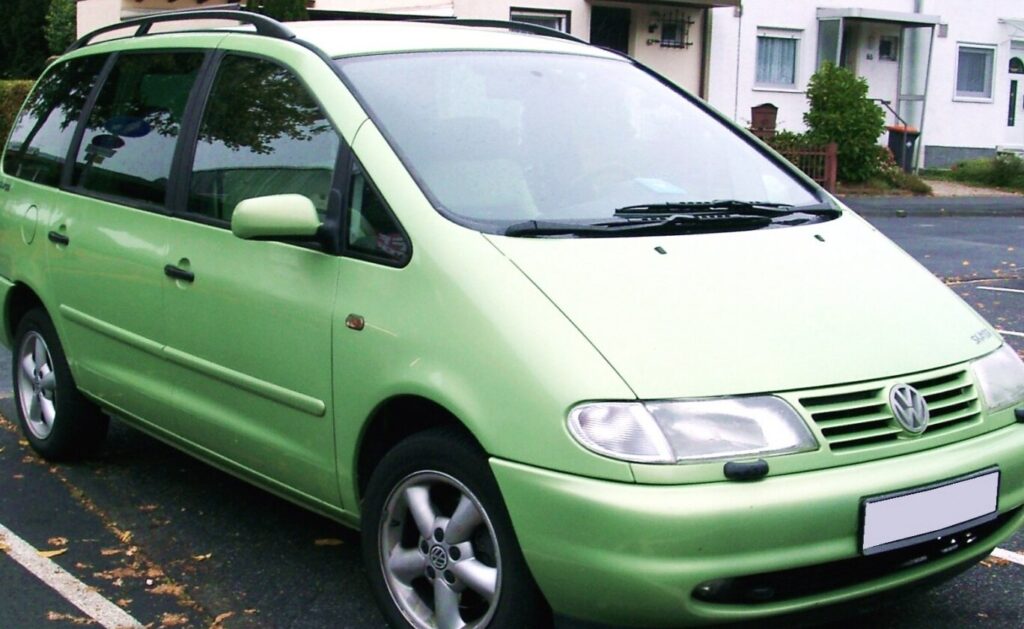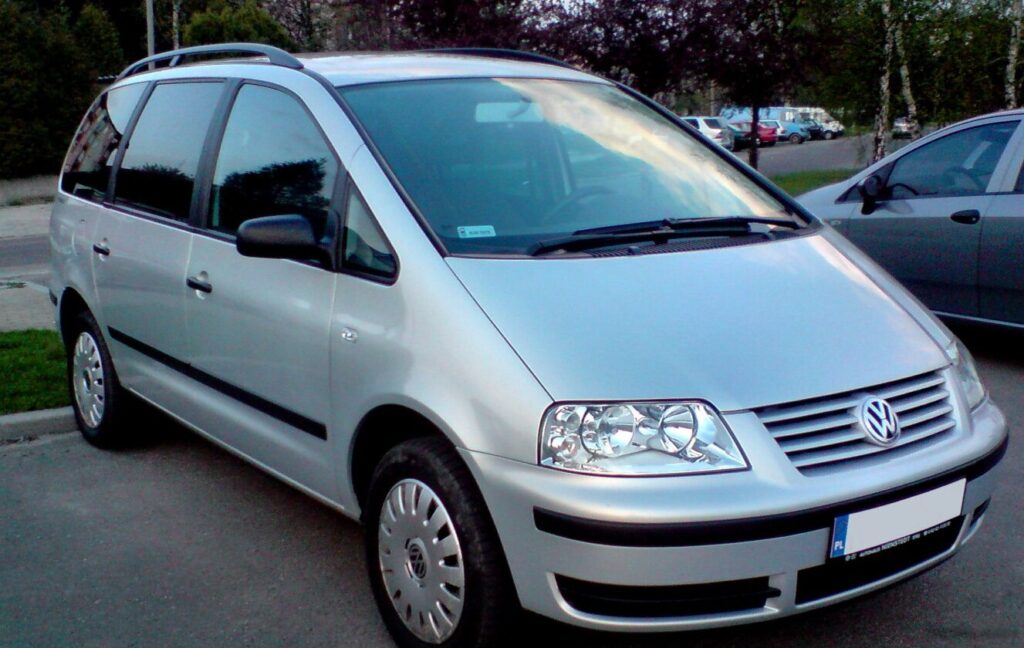
The Volkswagen Sharan I (facelift, produced from 2000 to 2004) 2.0-liter (115 hp) automatic variant represented a mid-range offering within the first generation of the Sharan minivan. Positioned between the base 1.8L engine and the more powerful 2.8L VR6, this configuration aimed to balance affordability with acceptable performance for family transportation. The Sharan, co-developed with Ford (resulting in the Ford Galaxy and Seat Alhambra), was Volkswagen’s entry into the burgeoning European MPV (Multi-Purpose Vehicle) market, designed to compete with vehicles like the Renault Espace and Citroën Evasion. This facelifted version, introduced in 2000, featured revised styling, improved safety features, and updated engine options compared to the original 1995 model.
Technical Specifications
| Brand | Volkswagen |
| Model | Sharan |
| Generation | Sharan I (facelift 2000) |
| Type (Engine) | 2.0 (115 Hp) Automatic |
| Start of production | 2000 year |
| End of production | 2004 year |
| Powertrain Architecture | Internal Combustion engine |
| Body type | Minivan, MPV |
| Seats | 7 |
| Doors | 5 |
| Fuel consumption (economy) – urban (NEDC) | 14.8 l/100 km (15.9 US mpg, 19.1 UK mpg, 6.8 km/l) |
| Fuel consumption (economy) – extra urban (NEDC) | 8.7 l/100 km (27 US mpg, 32.5 UK mpg, 11.5 km/l) |
| Fuel consumption (economy) – combined (NEDC) | 11 l/100 km (21.4 US mpg, 25.7 UK mpg, 9.1 km/l) |
| CO2 emissions (NEDC) | 264 g/km |
| Fuel Type | Petrol (Gasoline) |
| Acceleration 0 – 100 km/h | 17.2 sec |
| Acceleration 0 – 62 mph | 17.2 sec |
| Acceleration 0 – 60 mph | 16.3 sec |
| Maximum speed | 173 km/h (107.5 mph) |
| Emission standard | Euro 4 |
| Weight-to-power ratio | 16.7 kg/Hp, 60 Hp/tonne |
| Weight-to-torque ratio | 11.3 kg/Nm, 88.6 Nm/tonne |
| Power | 115 Hp @ 5200 rpm |
| Power per litre | 58 Hp/l |
| Torque | 170 Nm @ 2600 rpm (125.39 lb.-ft. @ 2600 rpm) |
| Engine layout | Front, Transverse |
| Engine Model/Code | ATM |
| Engine displacement | 1984 cm3 (121.07 cu. in.) |
| Number of cylinders | 4 |
| Engine configuration | Inline |
| Cylinder Bore | 82.5 mm (3.25 in.) |
| Piston Stroke | 92.8 mm (3.65 in.) |
| Compression ratio | 10.5:1 |
| Number of valves per cylinder | 2 |
| Fuel injection system | Multi-port manifold injection |
| Engine aspiration | Naturally aspirated engine |
| Valvetrain | SOHC |
| Engine oil capacity | 4 l (4.23 US qt | 3.52 UK qt) |
| Coolant | 8.9 l (9.4 US qt | 7.83 UK qt) |
| Kerb Weight | 1918 kg (4228.47 lbs.) |
| Max. weight | 2450 kg (5401.33 lbs.) |
| Max load | 532 kg (1172.86 lbs.) |
| Trunk (boot) space – minimum | 256 l (9.04 cu. ft.) |
| Trunk (boot) space – maximum | 2610 l (92.17 cu. ft.) |
| Fuel tank capacity | 70 l (18.49 US gal | 15.4 UK gal) |
| Max. roof load | 75 kg (165.35 lbs.) |
| Permitted trailer load with brakes (12%) | 1800 kg (3968.32 lbs.) |
| Permitted trailer load without brakes | 700 kg (1543.24 lbs.) |
| Permitted towbar download | 85 kg (187.39 lbs.) |
| Length | 4634 mm (182.44 in.) |
| Width | 1810 mm (71.26 in.) |
| Height | 1759 mm (69.25 in.) |
| Wheelbase | 2841 mm (111.85 in.) |
| Front track | 1530 mm (60.24 in.) |
| Rear (Back) track | 1524 mm (60 in.) |
| Minimum turning circle | 11.9 m (39.04 ft.) |
| Drivetrain Architecture | The Internal combustion engine (ICE) drives the front wheels of the vehicle. |
| Drive wheel | Front wheel drive |
| Number of gears and type of gearbox | 4 gears, automatic transmission |
| Front suspension | Independent type McPherson, Transverse stabilizer |
| Rear suspension | Transverse stabilizer, Trailing arm, Coil spring |
| Front brakes | Ventilated discs |
| Rear brakes | Disc |
| Assisting systems | ABS (Anti-lock braking system) |
| Steering type | Steering rack and pinion |
| Power steering | Hydraulic Steering |
| Tires size | 195/60 R16 |
| Wheel rims size | 6J x 16 |
Powertrain & Engine Architecture
The 2.0-liter inline-four engine, designated ATM, was a naturally aspirated unit utilizing multi-port fuel injection. This engine was part of Volkswagen’s EA827 family, known for its relatively simple design and durability. The SOHC (Single Overhead Camshaft) valvetrain operated two valves per cylinder. The engine produced 115 horsepower at 5200 rpm and 170 Nm (125 lb-ft) of torque at 2600 rpm. Paired with a four-speed automatic transmission, the powertrain was designed for smooth, if not particularly brisk, acceleration. The automatic transmission was a conventional hydraulic control unit, offering a ‘Drive’, ‘Reverse’, and manual shift mode. While not known for its efficiency, the combination was reliable and relatively inexpensive to maintain.
Driving Characteristics
The Sharan 2.0 Automatic wasn’t a performance-oriented vehicle. Acceleration from 0-60 mph took around 16.3 seconds, and top speed was limited to 107.5 mph. The four-speed automatic transmission, while providing comfortable shifts, lacked the responsiveness of a manual gearbox or a more modern automatic with additional gears. The gear ratios were optimized for fuel economy and cruising comfort rather than spirited driving. In real-world conditions, the engine felt strained when fully loaded with passengers and luggage, particularly on inclines. Compared to the 1.8L version, the 2.0L offered a noticeable improvement in mid-range torque, making it more manageable for highway driving. However, it fell significantly short of the performance offered by the 2.8L VR6, which provided substantially more power and quicker acceleration.
Equipment & Trim Levels
The 2.0-liter automatic Sharan typically came with a reasonable level of standard equipment. This included power windows, central locking, air conditioning, and an AM/FM radio. Interior upholstery was typically cloth, with options for upgraded velour or leather available. Higher trim levels added features such as alloy wheels, a sunroof, and upgraded audio systems. Safety features included ABS (Anti-lock Braking System) and driver and passenger airbags. Optional extras included rear parking sensors, a navigation system (a rarity for the time), and heated front seats.
Chassis & Braking
The Sharan I utilized an independent McPherson strut suspension at the front and a trailing arm setup with coil springs at the rear. A transverse stabilizer bar was fitted to both axles to reduce body roll. Braking consisted of ventilated discs at the front and solid discs at the rear. The suspension was tuned for comfort, prioritizing a smooth ride over sporty handling. The hydraulic power steering provided light and easy steering, making it convenient for maneuvering in tight spaces.
Market Reception & Comparison
The Sharan 2.0 Automatic was generally well-received as a practical and spacious family vehicle. Critics praised its versatility, comfortable ride, and generous interior space. However, the engine was often criticized for being underpowered, especially when the vehicle was fully loaded. Fuel economy was also considered average for its class. Compared to the 1.8L version, the 2.0L offered a better driving experience, particularly on the highway. However, the VR6 provided a significant performance upgrade, albeit at a higher price point. The Sharan competed directly with the Renault Espace, Citroën Evasion, and other European MPVs.
Legacy
The Volkswagen Sharan I, including the 2.0-liter automatic variant, has proven to be a relatively durable vehicle. The ATM engine, while not particularly sophisticated, is known for its reliability when properly maintained. Common issues include oil leaks and occasional problems with the automatic transmission. Today, these vehicles are relatively affordable on the used car market, making them an attractive option for budget-conscious buyers seeking a spacious and practical family vehicle. However, potential buyers should be aware of the vehicle’s age and potential maintenance requirements. The Sharan’s influence can be seen in subsequent generations of Volkswagen MPVs and in the continued popularity of the MPV segment in Europe.