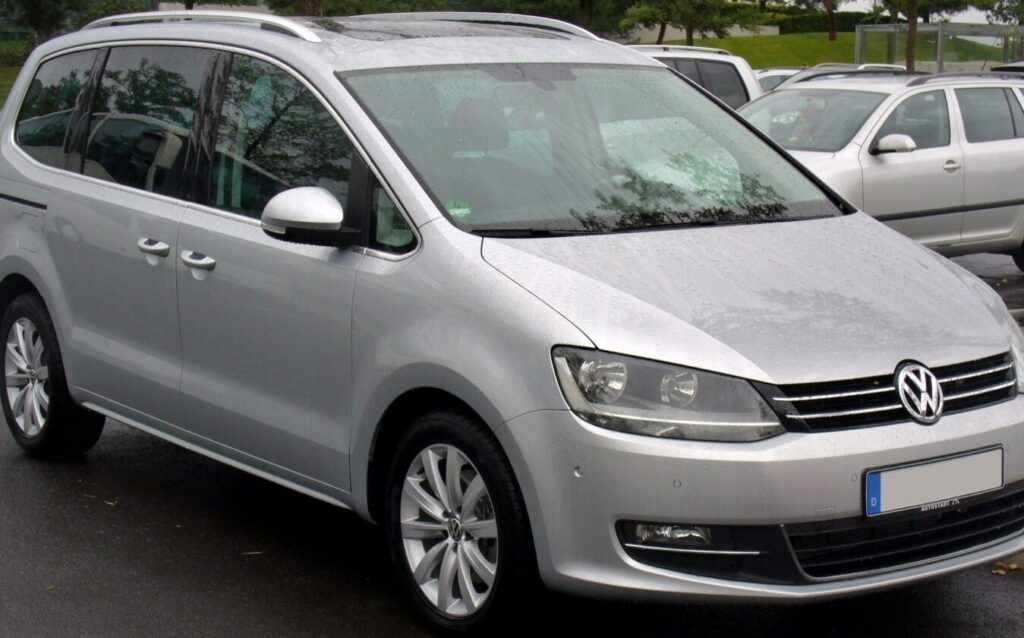
The Volkswagen Sharan II 1.4 TSI (150 hp) DSG 7-seat configuration was a popular variant of the second-generation Sharan, produced from 2010 to 2015. Positioned as a mid-range offering within the Sharan lineup, it aimed to balance fuel efficiency with adequate performance for family transport. This model played a significant role in Volkswagen’s strategy to offer a versatile and technologically advanced minivan for the European market, and to a lesser extent, other regions. It represented a shift towards smaller, turbocharged engines in a segment traditionally dominated by larger displacement naturally aspirated powerplants.
Technical Specifications
| Brand | Volkswagen |
| Model | Sharan |
| Generation | Sharan II |
| Type | 1.4 TSI (150 Hp) DSG 7 Seat |
| Start of production | 2010 |
| End of production | 2015 |
| Powertrain Architecture | Internal Combustion engine |
| Body type | Minivan, MPV |
| Seats | 7 |
| Doors | 5 |
| Fuel consumption (urban) | 9.4 l/100 km (25 US mpg, 30.1 UK mpg, 10.6 km/l) |
| Fuel consumption (extra urban) | 6.6 l/100 km (35.6 US mpg, 42.8 UK mpg, 15.2 km/l) |
| Fuel consumption (combined) | 7.6 l/100 km (30.9 US mpg, 37.2 UK mpg, 13.2 km/l) |
| CO2 emissions | 178 g/km |
| Fuel Type | Petrol (Gasoline) |
| Acceleration 0 – 100 km/h | 9.9 sec |
| Acceleration 0 – 62 mph | 9.9 sec |
| Acceleration 0 – 60 mph | 9.4 sec |
| Maximum speed | 197 km/h (122.41 mph) |
| Emission standard | Euro 5 |
| Weight-to-power ratio | 11.6 kg/Hp, 86.1 Hp/tonne |
| Weight-to-torque ratio | 7.3 kg/Nm, 137.8 Nm/tonne |
| Power | 150 Hp @ 5800 rpm |
| Power per litre | 107.9 Hp/l |
| Torque | 240 Nm @ 1750-4000 rpm (177.01 lb.-ft. @ 1750-4000 rpm) |
| Engine layout | Front, Transverse |
| Engine Model/Code | CAVA, CNWB, CTHA |
| Engine displacement | 1390 cm3 (84.82 cu. in.) |
| Number of cylinders | 4 |
| Engine configuration | Inline |
| Number of valves per cylinder | 4 |
| Fuel injection system | Direct injection |
| Engine aspiration | Turbocharging and Supercharger, Intercooler |
| Engine oil capacity | 4 l (4.23 US qt | 3.52 UK qt) |
| Coolant capacity | 5.6 l (5.92 US qt | 4.93 UK qt) |
| Kerb Weight | 1742 kg (3840.45 lbs.) |
| Max. weight | 2310 kg (5092.68 lbs.) |
| Max load | 568 kg (1252.23 lbs.) |
| Trunk (boot) space – minimum | 300 l (10.59 cu. ft.) |
| Trunk (boot) space – maximum | 2297 l (81.12 cu. ft.) |
| Fuel tank capacity | 70 l (18.49 US gal | 15.4 UK gal) |
| Length | 4854 mm (191.1 in.) |
| Width | 1904 mm (74.96 in.) |
| Height | 1720 mm (67.72 in.) |
| Wheelbase | 2919 mm (114.92 in.) |
| Front track | 1569 mm (61.77 in.) |
| Rear track | 1617 mm (63.66 in.) |
| Minimum turning circle | 11.9 m (39.04 ft.) |
| Drivetrain Architecture | Front wheel drive |
| Number of gears | 6 |
| Gearbox type | Automatic transmission DSG |
| Front brakes | Ventilated discs |
| Assisting systems | ABS (Anti-lock braking system) |
| Steering type | Steering rack and pinion |
| Tires size | 205/60 R16; 215/60 R16; 225/50 R17 |
| Wheel rims size | 6.5J x 16; 7J x 17 |
INTRODUCTION
The Volkswagen Sharan II, launched in 2010, represented a significant update to Volkswagen’s minivan offering. Built on the PQ46 platform (also known as the 1HX0/A3 platform, shared with the SEAT Alhambra and Skoda Octavia), the second generation Sharan aimed to provide a more refined and technologically advanced experience than its predecessor. The 1.4 TSI (150 hp) variant, coupled with the 7-speed DSG dual-clutch transmission and seven-seat configuration, was a core model in the range, targeting families seeking a practical and relatively economical vehicle. It filled the gap between the base engine options and the more powerful, but also more expensive, trims.
Powertrain & Engine Architecture
At the heart of the Sharan II 1.4 TSI was the CAVA, CNWB, or CTHA engine code, a 1.4-liter inline-four cylinder gasoline engine. This engine was notable for its combination of turbocharging and supercharging – a relatively uncommon setup. The supercharger provided immediate boost at low engine speeds, eliminating turbo lag, while the turbocharger took over at higher RPMs for sustained power delivery. This dual-charging system, coupled with direct fuel injection, resulted in a surprisingly responsive engine for its size. The engine produced 150 horsepower at 5800 rpm and 240 Nm (177 lb-ft) of torque between 1750 and 4000 rpm. The 7-speed DSG (Direct-Shift Gearbox) automatic transmission was a key component, offering quick and smooth gear changes. The DSG utilizes two separate clutches for even-numbered and odd-numbered gears, allowing for pre-selection of the next gear and minimizing interruption in power delivery.
Driving Characteristics
The 1.4 TSI/DSG combination in the Sharan II provided a decent driving experience, though it wasn’t particularly sporty. Acceleration from 0-60 mph took around 9.4 seconds, and top speed was 197 km/h (122 mph). The DSG transmission contributed to a smooth and refined feel, and the dual-charging system ensured good low-end torque, making it easy to navigate city traffic. Compared to the higher-output 2.0 TDI diesel or the more powerful gasoline variants, the 1.4 TSI felt less effortless when fully loaded with passengers and luggage. The gear ratios in the DSG were tuned for a balance of fuel economy and usability, rather than outright performance. While the manual transmission offered a more engaging driving experience, the DSG provided convenience and ease of use, particularly in stop-and-go traffic.
Equipment & Trim Levels
The Sharan II 1.4 TSI typically came with a respectable level of standard equipment. This included features like air conditioning, electric windows, central locking, and a basic audio system. Higher trim levels, often denoted by designations like ‘Trendline’ or ‘Comfortline’, added features such as alloy wheels, parking sensors, a touchscreen infotainment system, and climate control. Optional extras included a panoramic sunroof, leather upholstery, and advanced driver-assistance systems. Interior upholstery was typically cloth, though leather was available as an upgrade. The dashboard layout was functional and well-designed, with a focus on ergonomics and ease of use. The seven-seat configuration offered flexibility, with the rear seats folding flat to maximize cargo space.
Chassis & Braking
The Sharan II featured a MacPherson strut front suspension and a multi-link rear suspension, providing a comfortable ride quality. The suspension was tuned to prioritize comfort over sporty handling, making it well-suited for long journeys. Braking duties were handled by ventilated discs on the front wheels and either discs or drums on the rear wheels, depending on the trim level. ABS (Anti-lock Braking System) was standard. Stabilizer bars were fitted to both the front and rear axles to reduce body roll during cornering. The Sharan’s weight, around 1742 kg (3840 lbs), meant that the braking system needed to work effectively to provide adequate stopping power.
Market Reception & Comparison
The Sharan II 1.4 TSI was generally well-received by automotive critics. It was praised for its spacious interior, comfortable ride, and relatively fuel-efficient engine. However, some reviewers noted that the 1.4 TSI engine could feel strained when the vehicle was fully loaded. Compared to the 2.0 TDI diesel, the 1.4 TSI offered lower running costs in terms of fuel, but the diesel provided significantly more torque and better fuel economy overall. The 1.4 TSI was positioned as a more affordable alternative to the higher-output gasoline engines, appealing to buyers who prioritized value and practicality over outright performance.
Legacy
The Volkswagen Sharan II 1.4 TSI (150 hp) DSG has proven to be a relatively reliable powertrain in the used car market. The DSG transmission, while complex, is generally durable if properly maintained. Regular oil changes and adherence to the manufacturer’s service schedule are crucial for long-term reliability. Common issues include occasional DSG mechatronic unit failures and potential problems with the turbocharger. However, these issues are not widespread and can often be addressed with preventative maintenance. Today, the Sharan II 1.4 TSI remains a popular choice for families seeking a spacious, versatile, and relatively affordable minivan.