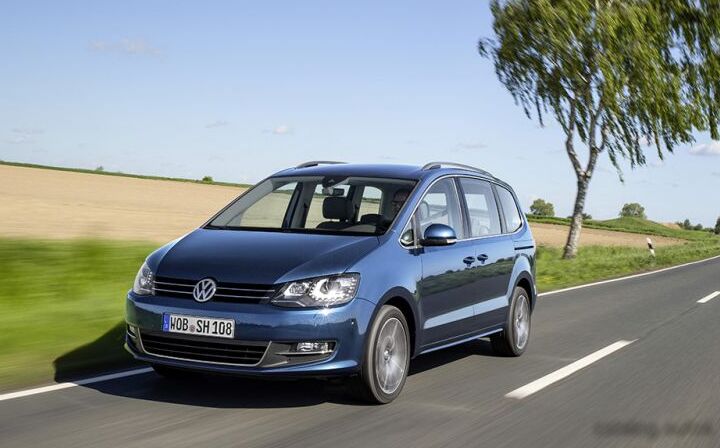
The Volkswagen Sharan II, particularly the facelifted version introduced in 2015, represented a significant evolution of Volkswagen’s minivan offering. Produced from 2015 to 2018, the 1.4 TSI (150 hp) variant occupied a key position in the Sharan lineup, aiming to balance fuel efficiency with acceptable performance for family transport. This model, built on the PQ46 platform (also known as the A6 platform in some contexts), was primarily marketed in Europe as a practical and spacious people carrier, competing with vehicles like the Ford S-Max and Renault Espace. While not officially sold in the United States, the Sharan II, and specifically this engine configuration, offers a compelling case study in modern MPV design and engineering.
Technical Specifications
| Brand | Volkswagen |
| Model | Sharan |
| Generation | Sharan II (facelift 2015) |
| Type (Engine) | 1.4 TSI (150 Hp) |
| Start of production | 2015 |
| End of production | 2018 |
| Powertrain Architecture | Internal Combustion engine |
| Body type | Minivan, MPV |
| Seats | 5 |
| Doors | 5 |
| Fuel consumption (urban) | 7.9 l/100 km (29.8 US mpg, 35.8 UK mpg, 12.7 km/l) |
| Fuel consumption (extra urban) | 5.5 l/100 km (42.8 US mpg, 51.4 UK mpg, 18.2 km/l) |
| Fuel consumption (combined) | 6.4 l/100 km (36.8 US mpg, 44.1 UK mpg, 15.6 km/l) |
| CO2 emissions | 149 – 148 g/km |
| Fuel Type | Petrol (Gasoline) |
| Acceleration 0 – 100 km/h | 6.7 sec |
| Acceleration 0 – 62 mph | 6.7 sec |
| Acceleration 0 – 60 mph | 6.4 sec |
| Maximum speed | 200 km/h (124.27 mph) |
| Emission standard | Euro 6 |
| Weight-to-power ratio | 10.9 kg/Hp, 92.1 Hp/tonne |
| Weight-to-torque ratio | 6.5 kg/Nm, 153.6 Nm/tonne |
| Power | 150 Hp @ 5000-6000 rpm |
| Power per litre | 107.5 Hp/l |
| Torque | 250 Nm @ 1500-3500 rpm (184.39 lb.-ft. @ 1500-3500 rpm) |
| Engine layout | Front, Transverse |
| Engine Model/Code | CTHA, CZDA, DJKA |
| Engine displacement | 1395 cm3 (85.13 cu. in.) |
| Number of cylinders | 4 |
| Engine configuration | Inline |
| Number of valves per cylinder | 4 |
| Fuel injection system | Direct injection |
| Engine aspiration | Turbocharger, Intercooler |
| Engine oil capacity | 4 l (4.23 US qt | 3.52 UK qt) |
| Coolant | 8 l (8.45 US qt | 7.04 UK qt) |
| Kerb Weight | 1628 kg (3589.13 lbs.) |
| Max. weight | 2300 kg (5070.63 lbs.) |
| Max load | 672 kg (1481.51 lbs.) |
| Trunk (boot) space – minimum | 955 l (33.73 cu. ft.) |
| Trunk (boot) space – maximum | 2430 l (85.81 cu. ft.) |
| Fuel tank capacity | 70 l (18.49 US gal | 15.4 UK gal) |
| Max. roof load | 100 kg (220.46 lbs.) |
| Permitted trailer load with brakes (8%) | 2000 kg (4409.25 lbs.) |
| Permitted trailer load with brakes (12%) | 1800 kg (3968.32 lbs.) |
| Permitted trailer load without brakes | 750 kg (1653.47 lbs.) |
| Permitted towbar download | 100 kg (220.46 lbs.) |
| Length | 4854 mm (191.1 in.) |
| Width | 1904 mm (74.96 in.) |
| Width including mirrors | 2081 mm (81.93 in.) |
| Height | 1720 mm (67.72 in.) |
| Wheelbase | 2920 mm (114.96 in.) |
| Front track | 1571 mm (61.85 in.) |
| Rear (Back) track | 1617 mm (63.66 in.) |
| Ride height (ground clearance) | 155 mm (6.1 in.) |
| Minimum turning circle (turning diameter) | 11.9 m (39.04 ft.) |
| Drive wheel | Front wheel drive |
| Number of gears and type of gearbox | 6 gears, manual transmission |
| Front suspension | Independent type McPherson |
| Rear suspension | Independent multi-link suspension |
| Front brakes | Ventilated discs |
| Rear brakes | Disc |
| Assisting systems | ABS (Anti-lock braking system) |
| Steering type | Steering rack and pinion |
| Power steering | Electric Steering |
| Tires size | 215/60 R16; 225/50 R17; 225/45 R18 |
| Wheel rims size | 16; 17; 18 |
INTRODUCTION
The Volkswagen Sharan II facelift, launched in 2015, represented a mid-cycle refresh of the second-generation Sharan (introduced in 2010). This update brought revised styling, improved technology, and refined engine options. The 1.4 TSI 150 hp variant was positioned as a mainstream offering, appealing to families seeking a practical and relatively economical MPV. It sat below the more powerful 2.0 TDI diesel models and the higher-output 2.0 TSI petrol versions, offering a balance between cost and usability. The Sharan II, and this variant specifically, was designed to compete in the highly competitive European MPV segment, offering a spacious interior, flexible seating arrangements, and a focus on comfort.
Powertrain & Engine Architecture
The heart of the Sharan II 1.4 TSI is the EA211 engine family. This 1.4-liter, four-cylinder engine (engine codes CTHA, CZDA, DJKA) utilizes direct fuel injection and a turbocharger with an intercooler to deliver 150 horsepower at 5000-6000 rpm and 250 Nm (184 lb-ft) of torque between 1500-3500 rpm. The direct injection system, coupled with the turbocharging, allows for a good blend of power and efficiency. The engine features four valves per cylinder and a timing chain, contributing to its durability. The 6-speed manual transmission was standard on this model, providing a relatively direct connection to the engine. While a DSG (Direct-Shift Gearbox) dual-clutch automatic transmission was available as an option on other Sharan trims, the 1.4 TSI 150 hp was primarily offered with the manual gearbox, likely to keep the price point competitive.
Driving Characteristics
The 1.4 TSI 150 hp Sharan offers adequate performance for everyday driving. Acceleration from 0-100 km/h (0-62 mph) takes around 6.7 seconds, which is respectable for a relatively large MPV. However, it’s noticeably slower than the more powerful 2.0 TSI variants. The engine’s torque delivery is relatively flat, providing good responsiveness in the mid-range. The manual transmission, while engaging, requires frequent shifting when fully loaded or tackling inclines. Compared to the diesel models, the 1.4 TSI feels less effortless at highway speeds, requiring more downshifting for overtaking. The gear ratios are tuned for fuel economy rather than outright performance, prioritizing usability over sporty driving dynamics.
Equipment & Trim Levels
The Sharan II 1.4 TSI typically came equipped with a reasonable level of standard features. These included air conditioning, electric windows, central locking, a basic audio system, and stability control. Higher trim levels, such as ‘Trendline’ and ‘Highline’, added features like alloy wheels, parking sensors, a touchscreen infotainment system, and climate control. Interior upholstery was typically cloth, with options for leather upgrades. Optional extras included a panoramic sunroof, navigation system, and advanced safety features like adaptive cruise control and lane assist. The Sharan’s interior was known for its modularity, with individual seats that could be folded, removed, or reconfigured to maximize space.
Chassis & Braking
The Sharan II utilizes an independent McPherson strut suspension at the front and an independent multi-link suspension at the rear, providing a comfortable ride quality. Stabilizer bars are fitted to both axles to reduce body roll. Braking duties are handled by ventilated discs at the front and solid discs at the rear. ABS (Anti-lock Braking System) is standard. The Sharan’s weight (approximately 1628 kg / 3589 lbs) contributes to a feeling of solidity and stability on the road. The steering is electrically assisted, providing a light and easy driving experience.
Market Reception & Comparison
The Sharan II 1.4 TSI was generally well-received by automotive critics as a practical and spacious MPV. However, some reviewers noted that the 1.4 TSI engine could feel underpowered when the vehicle was fully loaded. Fuel economy was praised, with combined figures around 6.4 l/100 km (36.8 US mpg). Compared to the 2.0 TDI diesel models, the 1.4 TSI offered lower running costs in terms of fuel, but potentially higher maintenance costs due to the complexity of the turbocharged petrol engine. The 2.0 TSI provided significantly more performance but at a higher price point and with increased fuel consumption.
Legacy
The Volkswagen Sharan II, including the 1.4 TSI 150 hp variant, has proven to be a relatively reliable vehicle in the used car market. The EA211 engine, while complex, is generally durable if properly maintained. Common issues include turbocharger wear and potential problems with the direct injection system. The Sharan’s spacious interior and flexible seating arrangements continue to make it a popular choice for families. While it has been superseded by newer MPV models and the rise of SUVs, the Sharan II remains a well-regarded and practical vehicle, offering a compelling blend of space, comfort, and economy.