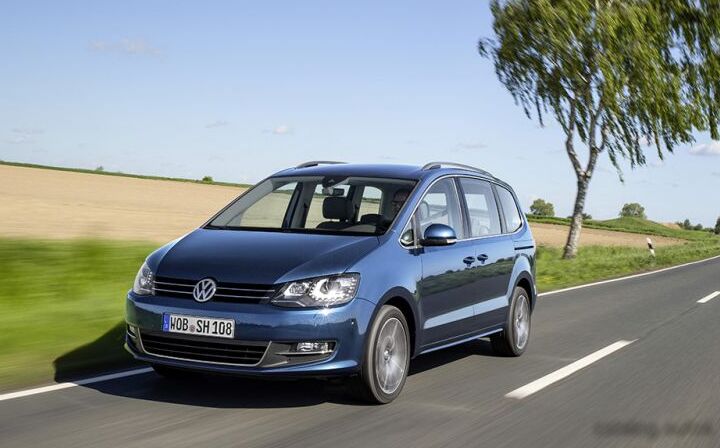
The Volkswagen Sharan II, specifically the facelifted version produced from 2015 to 2018, represented a significant evolution of Volkswagen’s minivan offering. This iteration, built on the PQ46 platform (also known as the 1HX0/A3 platform), aimed to blend practicality, comfort, and a degree of driving enjoyment within the MPV segment. The 1.4 TSI (150 hp) 7-seat variant occupied a middle ground in the Sharan lineup, offering a balance between fuel efficiency and performance, targeting families seeking a versatile and reasonably economical vehicle. It was positioned above the base engine options and below the more powerful 2.0 TDI diesel models.
Technical Specifications
| Brand | Volkswagen |
| Model | Sharan |
| Generation | Sharan II (facelift 2015) |
| Type (Engine) | 1.4 TSI (150 Hp) 7 Seat |
| Start of production | 2015 |
| End of production | 2018 |
| Powertrain Architecture | Internal Combustion engine |
| Body type | Minivan, MPV |
| Seats | 7 |
| Doors | 5 |
| Fuel consumption (urban) | 7.9 l/100 km (29.8 US mpg, 35.8 UK mpg, 12.7 km/l) |
| Fuel consumption (extra urban) | 5.5 l/100 km (42.8 US mpg, 51.4 UK mpg, 18.2 km/l) |
| Fuel consumption (combined) | 6.4 l/100 km (36.8 US mpg, 44.1 UK mpg, 15.6 km/l) |
| CO2 emissions | 149 – 148 g/km |
| Fuel Type | Petrol (Gasoline) |
| Acceleration 0 – 100 km/h | 6.7 sec |
| Acceleration 0 – 62 mph | 6.7 sec |
| Acceleration 0 – 60 mph | 6.4 sec |
| Maximum speed | 200 km/h (124.27 mph) |
| Emission standard | Euro 6 |
| Weight-to-power ratio | 10.9 kg/Hp, 92.1 Hp/tonne |
| Weight-to-torque ratio | 6.5 kg/Nm, 153.6 Nm/tonne |
| Power | 150 Hp @ 5000-6000 rpm |
| Power per litre | 107.5 Hp/l |
| Torque | 250 Nm @ 1500-3500 rpm (184.39 lb.-ft. @ 1500-3500 rpm) |
| Engine layout | Front, Transverse |
| Engine Model/Code | CTHA, CZDA, DJKA |
| Engine displacement | 1395 cm3 (85.13 cu. in.) |
| Number of cylinders | 4 |
| Engine configuration | Inline |
| Number of valves per cylinder | 4 |
| Fuel injection system | Direct injection |
| Engine aspiration | Turbocharger, Intercooler |
| Engine oil capacity | 4 l (4.23 US qt | 3.52 UK qt) |
| Coolant | 8 l (8.45 US qt | 7.04 UK qt) |
| Kerb Weight | 1628 kg (3589.13 lbs.) |
| Max. weight | 2300 kg (5070.63 lbs.) |
| Max load | 672 kg (1481.51 lbs.) |
| Trunk (boot) space – minimum | 300 l (10.59 cu. ft.) |
| Trunk (boot) space – maximum | 2297 l (81.12 cu. ft.) |
| Fuel tank capacity | 70 l (18.49 US gal | 15.4 UK gal) |
| Max. roof load | 100 kg (220.46 lbs.) |
| Permitted trailer load with brakes (8%) | 2000 kg (4409.25 lbs.) |
| Permitted trailer load with brakes (12%) | 1800 kg (3968.32 lbs.) |
| Permitted trailer load without brakes | 750 kg (1653.47 lbs.) |
| Permitted towbar download | 100 kg (220.46 lbs.) |
| Length | 4854 mm (191.1 in.) |
| Width | 1904 mm (74.96 in.) |
| Width including mirrors | 2081 mm (81.93 in.) |
| Height | 1720 mm (67.72 in.) |
| Wheelbase | 2920 mm (114.96 in.) |
| Front track | 1571 mm (61.85 in.) |
| Rear (Back) track | 1617 mm (63.66 in.) |
| Ride height (ground clearance) | 155 mm (6.1 in.) |
| Minimum turning circle (turning diameter) | 11.9 m (39.04 ft.) |
| Drive wheel | Front wheel drive |
| Number of gears and type of gearbox | 6 gears, manual transmission |
| Front suspension | Independent type McPherson |
| Rear suspension | Independent multi-link suspension |
| Front brakes | Ventilated discs |
| Rear brakes | Disc |
| Assisting systems | ABS (Anti-lock braking system) |
| Steering type | Steering rack and pinion |
| Power steering | Electric Steering |
| Tires size | 215/60 R16; 225/50 R17; 225/45 R18 |
| Wheel rims size | 16; 17; 18 |
Powertrain & Engine Architecture
The heart of this Sharan variant is the 1.4 TSI engine, part of the Volkswagen Group’s EA211 engine family. This engine utilizes direct fuel injection and a turbocharger with an intercooler to deliver a respectable 150 horsepower and 250 Nm (184 lb-ft) of torque. The engine codes commonly associated with this configuration are CTHA, CZDA, and DJKA. The direct injection system, coupled with the turbocharging, allows for a good balance of power and fuel efficiency. The engine features four valves per cylinder and a timing chain, contributing to its durability. The Sharan 1.4 TSI typically came equipped with a 6-speed manual transmission, although a 7-speed DSG (Dual-Clutch Gearbox) was also available as an option. The manual transmission offered precise shifts, while the DSG provided quicker and smoother gear changes, albeit at a higher cost.
Driving Characteristics
The 1.4 TSI engine in the Sharan provided adequate performance for everyday driving, especially considering the vehicle’s size and weight. Acceleration from 0 to 62 mph (0-100 km/h) took around 6.7 seconds. While not a sports car, the engine delivered sufficient power for overtaking maneuvers and maintaining comfortable cruising speeds on the highway. Compared to the more powerful 2.0 TDI diesel variants, the 1.4 TSI felt less effortless when fully loaded with passengers and luggage. The manual transmission’s gear ratios were well-suited for maximizing fuel economy, but required more driver involvement than the DSG option. The power delivery was relatively linear, with the turbocharger providing a noticeable boost in the mid-range.
Equipment & Trim Levels
The 1.4 TSI 7-seat Sharan typically came with a decent level of standard equipment. This included features like air conditioning, electric windows, central locking, and a basic audio system. Higher trim levels, such as the ‘Comfortline’ and ‘Highline’, added features like climate control, alloy wheels, parking sensors, a touchscreen infotainment system, and upgraded interior upholstery. Optional extras included a panoramic sunroof, leather seats, and a navigation system. Interior materials were generally of good quality, with a focus on practicality and durability. The 7-seat configuration offered flexibility for families, with the rear seats folding flat to create a large cargo area.
Chassis & Braking
The Sharan II featured an independent suspension setup, with McPherson struts at the front and a multi-link suspension at the rear. This provided a comfortable ride quality, even on uneven road surfaces. The steering was precise and well-weighted, offering good feedback to the driver. The braking system consisted of ventilated discs at the front and solid discs at the rear, providing adequate stopping power. ABS (Anti-lock Braking System) was standard, enhancing safety in emergency braking situations. Stabilizer bars were fitted to both the front and rear axles to reduce body roll during cornering.
Market Reception & Comparison
The Sharan II 1.4 TSI 7-seat variant was generally well-received by critics and consumers alike. It was praised for its spacious interior, comfortable ride, and reasonable fuel economy. However, some reviewers noted that the 1.4 TSI engine could feel underpowered when the vehicle was fully loaded. Compared to the 2.0 TDI models, the 1.4 TSI offered lower running costs but less outright performance. The 1.4 TSI also tended to be more reliable than some of the earlier diesel variants, avoiding some of the issues associated with diesel particulate filters and emissions systems.
Legacy
The Volkswagen Sharan II 1.4 TSI remains a popular choice in the used car market, particularly among families seeking a practical and versatile MPV. The EA211 engine has proven to be relatively reliable, although regular maintenance is essential to ensure its longevity. Common issues include occasional turbocharger problems and oil leaks. Overall, the 1.4 TSI engine offers a good balance of performance, fuel efficiency, and reliability, making it a sensible choice for those seeking a well-rounded minivan.