Technical Specifications
| Brand | Volkswagen |
| Model | Sharan |
| Generation | Sharan II (facelift 2015) |
| Type (Engine) | 1.4 TSI (150 Hp) DSG 7 Seat |
| Start of production | 2015 |
| End of production | 2018 |
| Powertrain Architecture | Internal Combustion engine |
| Body type | Minivan, MPV |
| Seats | 7 |
| Doors | 5 |
| Fuel consumption (urban) | 8 l/100 km (29.4 US mpg, 35.3 UK mpg, 12.5 km/l) |
| Fuel consumption (extra urban) | 5.8 l/100 km (40.6 US mpg, 48.7 UK mpg, 17.2 km/l) |
| Fuel consumption (combined) | 6.6 l/100 km (35.6 US mpg, 42.8 UK mpg, 15.2 km/l) |
| CO2 emissions | 154-155 g/km |
| Fuel Type | Petrol (Gasoline) |
| Acceleration 0 – 100 km/h | 9.9 sec |
| Acceleration 0 – 62 mph | 9.9 sec |
| Acceleration 0 – 60 mph | 9.4 sec |
| Maximum speed | 198 km/h (123.03 mph) |
| Emission standard | Euro 6 |
| Weight-to-power ratio | 10.9 kg/Hp, 91.4 Hp/tonne |
| Weight-to-torque ratio | 6.6 kg/Nm, 152.3 Nm/tonne |
| Power | 150 Hp @ 5000-6000 rpm |
| Power per litre | 107.5 Hp/l |
| Torque | 250 Nm @ 1500-3500 rpm (184.39 lb.-ft. @ 1500-3500 rpm) |
| Engine layout | Front, Transverse |
| Engine Model/Code | CTHA, CZDA, DJKA |
| Engine displacement | 1395 cm3 (85.13 cu. in.) |
| Number of cylinders | 4 |
| Engine configuration | Inline |
| Number of valves per cylinder | 4 |
| Fuel injection system | Direct injection |
| Engine aspiration | Turbocharger, Intercooler |
| Engine oil capacity | 4 l (4.23 US qt | 3.52 UK qt) |
| Coolant | 8 l (8.45 US qt | 7.04 UK qt) |
| Kerb Weight | 1642 kg (3619.99 lbs.) |
| Max. weight | 2310 kg (5092.68 lbs.) |
| Max load | 668 kg (1472.69 lbs.) |
| Trunk (boot) space – minimum | 300 l (10.59 cu. ft.) |
| Trunk (boot) space – maximum | 2297 l (81.12 cu. ft.) |
| Fuel tank capacity | 70 l (18.49 US gal | 15.4 UK gal) |
| Max. roof load | 100 kg (220.46 lbs.) |
| Permitted trailer load with brakes (8%) | 2000 kg (4409.25 lbs.) |
| Permitted trailer load with brakes (12%) | 1800 kg (3968.32 lbs.) |
| Permitted trailer load without brakes | 750 kg (1653.47 lbs.) |
| Permitted towbar download | 100 kg (220.46 lbs.) |
| Length | 4854 mm (191.1 in.) |
| Width | 1904 mm (74.96 in.) |
| Width including mirrors | 2081 mm (81.93 in.) |
| Height | 1720 mm (67.72 in.) |
| Wheelbase | 2920 mm (114.96 in.) |
| Front track | 1571 mm (61.85 in.) |
| Rear (Back) track | 1617 mm (63.66 in.) |
| Ride height (ground clearance) | 155 mm (6.1 in.) |
| Minimum turning circle (turning diameter) | 11.9 m (39.04 ft.) |
| Drive wheel | Front wheel drive |
| Number of gears and type of gearbox | 6 gears, automatic transmission DSG |
| Front suspension | Independent type McPherson |
| Rear suspension | Independent multi-link suspension |
| Front brakes | Ventilated discs |
| Rear brakes | Disc |
| Assisting systems | ABS (Anti-lock braking system) |
| Steering type | Steering rack and pinion |
| Power steering | Electric Steering |
| Tires size | 215/60 R16; 225/50 R17; 225/45 R18 |
| Wheel rims size | 16; 17; 18 |
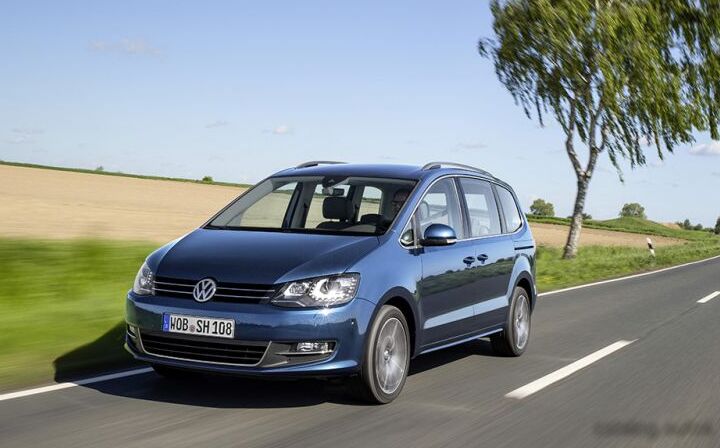
The Volkswagen Sharan II, particularly the facelifted version introduced in 2015, represented a significant evolution of Volkswagen’s minivan offering. Produced from 2015 to 2018, the 1.4 TSI (150 hp) variant equipped with a 7-speed DSG dual-clutch transmission and seven-seat configuration was a popular choice in European markets. Positioned as a mid-range option within the Sharan II lineup, it aimed to balance fuel efficiency, practicality, and a reasonable level of performance for family transport. This generation Sharan, built on the PQ46 platform (also known as the A6 platform in some contexts), shared its underpinnings with the SEAT Alhambra and Škoda Octavia, reflecting Volkswagen Group’s strategy of platform sharing to reduce development costs.
Powertrain & Engine Architecture
The heart of this Sharan variant is the 1.4 TSI engine, part of Volkswagen’s widely used EA211 engine family. This engine utilizes direct fuel injection and a turbocharger with an intercooler to deliver a balance of power and efficiency. The specific engine codes used for this output level include CTHA, CZDA, and DJKA. The engine’s 1395cc displacement is achieved through a relatively short stroke and oversquare bore, promoting high-revving characteristics. The cylinder head features four valves per cylinder, enhancing breathing and contributing to improved performance. The 7-speed DSG (Direct-Shift Gearbox) is a dual-clutch transmission known for its quick and smooth gear changes. It operates similarly to two manual gearboxes in one, allowing for pre-selection of the next gear, resulting in minimal interruption of power delivery.
Driving Characteristics
The 150 hp output, coupled with the DSG transmission, provided adequate performance for typical family duties. Acceleration from 0-60 mph took approximately 9.4 seconds, and top speed was around 123 mph. While not a sporty vehicle, the Sharan 1.4 TSI offered sufficient power for highway cruising and overtaking maneuvers. The DSG transmission’s quick shifts helped to maximize the available power, and the wide gear spread allowed for efficient operation at various speeds. Compared to the more powerful 2.0 TSI variants, this engine felt less strained during acceleration, but lacked the same level of outright performance. The automatic transmission also provided a more relaxed driving experience compared to the 6-speed manual option available on some trims.
Equipment & Trim Levels
The 1.4 TSI DSG 7-seat Sharan typically came with a good level of standard equipment. This included features like air conditioning, alloy wheels, a touchscreen infotainment system, and multiple airbags. Higher trim levels offered upgrades such as leather upholstery, parking sensors, a panoramic sunroof, and advanced driver-assistance systems. Interior upholstery was generally cloth on the base models, with leather options available as upgrades. The dashboard layout was functional and well-designed, with a focus on ergonomics and ease of use. Optional extras included a navigation system, rear entertainment system, and adaptive cruise control.
Chassis & Braking
The Sharan II utilized an independent McPherson strut suspension at the front and an independent multi-link suspension at the rear, providing a comfortable ride quality. The suspension was tuned to prioritize comfort over sporty handling, making it well-suited for long journeys. Braking duties were handled by ventilated discs at the front and solid discs at the rear. ABS (Anti-lock Braking System) was standard, enhancing safety during emergency braking situations. The steering was electrically assisted, providing light and precise control.
Market Reception & Comparison
The Sharan 1.4 TSI DSG was generally well-received by critics as a practical and efficient family vehicle. Its fuel economy of around 35.6 US mpg combined was a significant selling point, especially compared to larger, less efficient MPVs. However, some reviewers noted that the engine could feel slightly underpowered when fully loaded with passengers and luggage. Compared to the 2.0 TDI diesel variants, the 1.4 TSI offered a smoother and quieter driving experience, but lacked the same level of low-end torque. The 2.0 TSI petrol engine provided more performance but at the cost of increased fuel consumption.
Legacy
The 1.4 TSI engine, while generally reliable, has been known to exhibit some issues with carbon buildup on the intake valves over time, particularly if not regularly driven on longer journeys. The DSG transmission, while sophisticated, can require more expensive maintenance than a traditional automatic gearbox. However, with regular servicing and preventative maintenance, this powertrain combination has proven to be relatively durable. On the used car market, the Sharan 1.4 TSI DSG remains a popular choice for families seeking a spacious and practical MPV. Its balance of fuel efficiency, comfort, and practicality continues to make it a compelling option.