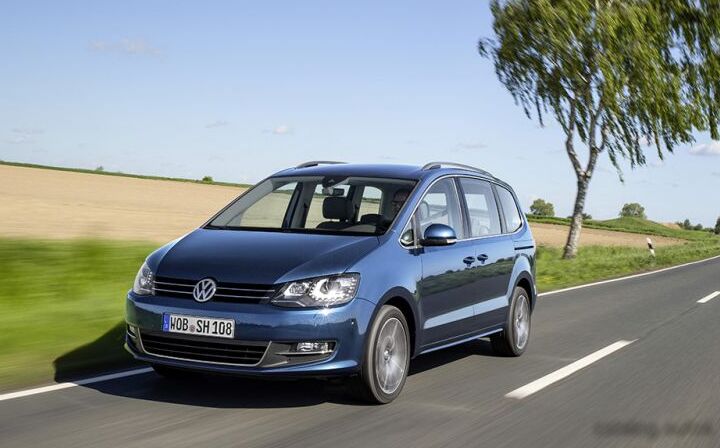
The Volkswagen Sharan II, specifically the facelifted version produced from 2015 to 2017, represented a significant evolution of Volkswagen’s minivan offering. This iteration, built on the PQ46 platform (also known as the 1HX0/A3 platform), aimed to blend practicality, comfort, and modern technology within the MPV (Multi-Purpose Vehicle) segment. The 2.0 TDI variant, producing 115 horsepower, occupied a middle ground in the Sharan lineup, offering a balance between fuel efficiency and acceptable performance for family transport. It was positioned as a sensible choice for buyers prioritizing economy and practicality over outright speed.
Technical Specifications
| Brand | Volkswagen |
| Model | Sharan |
| Generation | Sharan II (facelift 2015) |
| Type (Engine) | 2.0 TDI (115 Hp) |
| Start of production | 2015 |
| End of production | 2017 |
| Powertrain Architecture | Internal Combustion engine |
| Body type | Minivan, MPV |
| Seats | 5 |
| Doors | 5 |
| Fuel consumption (urban) | 6.0-6.1 l/100 km (39.2 – 38.6 US mpg, 47.1 – 46.3 UK mpg, 16.7 – 16.4 km/l) |
| Fuel consumption (extra urban) | 4.5-4.6 l/100 km (52.3 – 51.1 US mpg, 62.8 – 61.4 UK mpg, 22.2 – 21.7 km/l) |
| Fuel consumption (combined) | 5.0-5.1 l/100 km (47 – 46.1 US mpg, 56.5 – 55.4 UK mpg, 20 – 19.6 km/l) |
| CO2 emissions | 130-132 g/km |
| Fuel Type | Diesel |
| Acceleration 0 – 100 km/h | 12.6 sec |
| Acceleration 0 – 62 mph | 12.6 sec |
| Acceleration 0 – 60 mph | 12 sec |
| Maximum speed | 184 km/h (114.33 mph) |
| Emission standard | Euro 6 |
| Weight-to-power ratio | 14.8 kg/Hp, 67.8 Hp/tonne |
| Weight-to-torque ratio | 6.1 kg/Nm, 165 Nm/tonne |
| Power | 115 Hp @ 3500 rpm |
| Power per litre | 58.4 Hp/l |
| Torque | 280 Nm @ 1500-2750 rpm (206.52 lb.-ft. @ 1500-2750 rpm) |
| Engine layout | Front, Transverse |
| Engine Model/Code | CUVA, DFLD, DLTC |
| Engine displacement | 1968 cm3 (120.09 cu. in.) |
| Number of cylinders | 4 |
| Engine configuration | Inline |
| Number of valves per cylinder | 4 |
| Fuel injection system | Diesel Commonrail |
| Engine aspiration | Turbocharger, Intercooler |
| Engine oil capacity | 4.7 l (4.97 US qt | 4.14 UK qt) |
| Coolant | 8 l (8.45 US qt | 7.04 UK qt) |
| Kerb Weight | 1697 kg (3741.24 lbs.) |
| Max. weight | 2390 kg (5269.05 lbs.) |
| Max load | 693 kg (1527.8 lbs.) |
| Trunk (boot) space – minimum | 955 l (33.73 cu. ft.) |
| Trunk (boot) space – maximum | 2430 l (85.81 cu. ft.) |
| Fuel tank capacity | 70 l (18.49 US gal | 15.4 UK gal) |
| Max. roof load | 100 kg (220.46 lbs.) |
| Permitted trailer load with brakes (8%) | 2200 kg (4850.17 lbs.) |
| Permitted trailer load with brakes (12%) | 2000 kg (4409.25 lbs.) |
| Permitted trailer load without brakes | 750 kg (1653.47 lbs.) |
| Permitted towbar download | 100 kg (220.46 lbs.) |
| Length | 4854 mm (191.1 in.) |
| Width | 1904 mm (74.96 in.) |
| Width including mirrors | 2081 mm (81.93 in.) |
| Height | 1720 mm (67.72 in.) |
| Wheelbase | 2920 mm (114.96 in.) |
| Front track | 1571 mm (61.85 in.) |
| Rear (Back) track | 1617 mm (63.66 in.) |
| Ride height (ground clearance) | 152 mm (5.98 in.) |
| Minimum turning circle (turning diameter) | 11.9 m (39.04 ft.) |
| Drive wheel | Front wheel drive |
| Number of gears and type of gearbox | 6 gears, manual transmission |
| Front suspension | Independent type McPherson |
| Rear suspension | Independent multi-link suspension |
| Front brakes | Ventilated discs |
| Rear brakes | Disc |
| Assisting systems | ABS (Anti-lock braking system) |
| Steering type | Steering rack and pinion |
| Power steering | Electric Steering |
| Tires size | 215/60 R16; 225/50 R17; 225/45 R18 |
| Wheel rims size | 16; 17; 18 |
Powertrain & Engine Architecture
The 2.0 TDI engine in the 2015-2017 Sharan facelift utilized the common rail direct injection system, a hallmark of modern diesel engines. Engine codes such as CUVA, DFLD, and DLTC were used depending on the specific calibration and market. This engine featured a turbocharger with an intercooler, boosting power output and improving efficiency. The 115 horsepower output was achieved at 3500 rpm, while the peak torque of 280 Nm (206.52 lb.-ft.) was available from a low 1500 rpm, extending to 2750 rpm. This broad torque curve was beneficial for everyday driving and hauling loads. The engine’s four valves per cylinder and inline configuration contributed to its relatively smooth operation. The Sharan II 2.0 TDI was typically paired with a six-speed manual transmission, although a DSG (Direct-Shift Gearbox) dual-clutch automatic was also available as an option.
Driving Characteristics
The 115 hp 2.0 TDI Sharan, with its manual transmission, offered adequate performance for most driving situations. Acceleration from 0 to 100 km/h (0-62 mph) took around 12.6 seconds, which wasn’t particularly quick, but sufficient for a large MPV. The strength of this powertrain lay in its mid-range torque, making overtaking and hill climbing relatively effortless. Compared to the more powerful 140 hp or 170 hp TDI variants, the 115 hp model felt less strained during acceleration, but also lacked the same level of urgency. The six-speed manual gearbox provided precise shifts and allowed drivers to maintain optimal engine speed for fuel efficiency or performance. The gear ratios were tuned for a balance between economy and usability, prioritizing comfortable cruising over outright speed.
Equipment & Trim Levels
The 2.0 TDI Sharan typically came with a respectable level of standard equipment. This included features like air conditioning, electric windows, central locking, and a basic audio system. Higher trim levels, such as Comfortline and Highline, added features like alloy wheels, parking sensors, a touchscreen infotainment system, and climate control. Interior upholstery was typically cloth, with leather options available on higher trims. Optional extras included a panoramic sunroof, navigation system, and advanced driver-assistance systems like adaptive cruise control and lane-keeping assist.
Chassis & Braking
The Sharan II featured an independent suspension setup, with McPherson struts at the front and a multi-link system at the rear. This provided a comfortable ride quality, even when fully loaded. The front brakes were ventilated discs, offering good stopping power, while the rear brakes were typically solid discs. ABS (Anti-lock Braking System) was standard, enhancing safety during emergency braking. The steering was rack and pinion with electric power assistance, providing a light and precise feel.
Market Reception & Comparison
The 115 hp 2.0 TDI Sharan was generally well-received by critics as a practical and economical MPV. It was praised for its spacious interior, comfortable ride, and fuel efficiency. However, some reviewers noted that the engine could feel underpowered when the vehicle was fully loaded or traveling uphill. Compared to the more powerful TDI variants, the 115 hp model offered better fuel economy but sacrificed some performance. It was often seen as a good value proposition for families prioritizing practicality and affordability over outright speed.
Legacy
The 2.0 TDI engine, in various iterations, proved to be a reliable and durable powertrain. While diesel engines, in general, have faced increased scrutiny regarding emissions, the Sharan II’s 2.0 TDI engine, when properly maintained, has demonstrated good long-term reliability. In the used car market, the 115 hp variant remains a popular choice for buyers seeking a spacious and economical MPV. Its relatively simple engine design and readily available parts contribute to its affordability and ease of maintenance. However, potential buyers should be aware of the importance of regular servicing and adherence to manufacturer’s recommendations to ensure continued reliability.