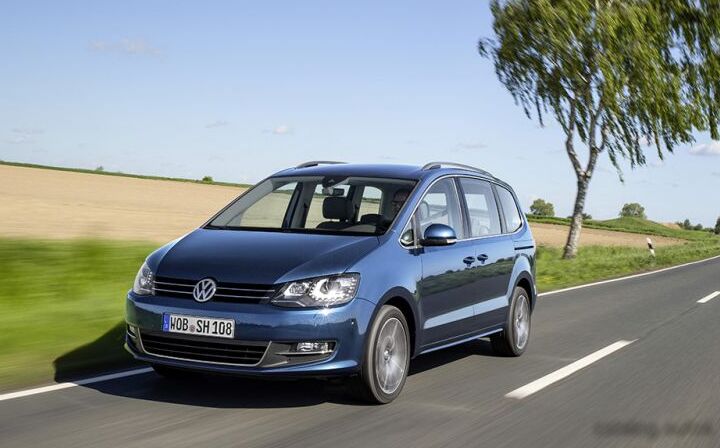
The Volkswagen Sharan II, specifically the facelifted version produced from 2015 to 2017, represented a significant evolution of Volkswagen’s minivan offering. This iteration of the Sharan, built on the PQ46 platform (also known as the 1HX0/A3 platform), aimed to blend practicality, comfort, and modern technology within the MPV (Multi-Purpose Vehicle) segment. The 2.0 TDI variant, producing 115 horsepower, was a popular choice in European markets, offering a balance between fuel efficiency and usable performance for family transportation. This particular configuration typically sat in the mid-range of the Sharan lineup, offering a step up from the base models while remaining more accessible than the higher-powered TDI options.
Technical Specifications
| Brand | Volkswagen |
| Model | Sharan |
| Generation | Sharan II (facelift 2015) |
| Type (Engine) | 2.0 TDI (115 Hp) 7 Seat |
| Start of production | 2015 |
| End of production | 2017 |
| Powertrain Architecture | Internal Combustion engine |
| Body type | Minivan, MPV |
| Seats | 7 |
| Doors | 5 |
| Fuel consumption (urban) | 6.0-6.1 l/100 km (39.2 – 38.6 US mpg) |
| Fuel consumption (extra urban) | 4.5-4.6 l/100 km (52.3 – 51.1 US mpg) |
| Fuel consumption (combined) | 5.0-5.1 l/100 km (47 – 46.1 US mpg) |
| CO2 emissions | 130-132 g/km |
| Fuel Type | Diesel |
| Acceleration 0 – 100 km/h | 12.6 sec |
| Acceleration 0 – 62 mph | 12.6 sec |
| Acceleration 0 – 60 mph | 12 sec |
| Maximum speed | 184 km/h (114.33 mph) |
| Emission standard | Euro 6 |
| Weight-to-power ratio | 14.8 kg/Hp |
| Weight-to-torque ratio | 6.1 kg/Nm |
| Power | 115 Hp @ 3500 rpm |
| Torque | 280 Nm @ 1500-2750 rpm (206.52 lb.-ft. @ 1500-2750 rpm) |
| Engine layout | Front, Transverse |
| Engine Model/Code | CUVA, DFLD, DLTC |
| Engine displacement | 1968 cm3 (120.09 cu. in.) |
| Number of cylinders | 4 |
| Engine configuration | Inline |
| Number of valves per cylinder | 4 |
| Fuel injection system | Diesel Commonrail |
| Engine aspiration | Turbocharger, Intercooler |
| Engine oil capacity | 4.7 l (4.97 US qt | 4.14 UK qt) |
| Coolant | 8 l (8.45 US qt | 7.04 UK qt) |
| Kerb Weight | 1697 kg (3741.24 lbs.) |
| Max. weight | 2390 kg (5269.05 lbs.) |
| Max load | 693 kg (1527.8 lbs.) |
| Trunk (boot) space – minimum | 300 l (10.59 cu. ft.) |
| Trunk (boot) space – maximum | 2297 l (81.12 cu. ft.) |
| Fuel tank capacity | 70 l (18.49 US gal | 15.4 UK gal) |
| Max. roof load | 100 kg (220.46 lbs.) |
| Permitted trailer load with brakes (8%) | 2200 kg (4850.17 lbs.) |
| Permitted trailer load with brakes (12%) | 2000 kg (4409.25 lbs.) |
| Permitted trailer load without brakes | 750 kg (1653.47 lbs.) |
| Permitted towbar download | 100 kg (220.46 lbs.) |
| Length | 4854 mm (191.1 in.) |
| Width | 1904 mm (74.96 in.) |
| Width including mirrors | 2081 mm (81.93 in.) |
| Height | 1720 mm (67.72 in.) |
| Wheelbase | 2920 mm (114.96 in.) |
| Front track | 1571 mm (61.85 in.) |
| Rear (Back) track | 1617 mm (63.66 in.) |
| Ride height (ground clearance) | 152 mm (5.98 in.) |
| Minimum turning circle (turning diameter) | 11.9 m (39.04 ft.) |
| Drive wheel | Front wheel drive |
| Number of gears and type of gearbox | 6 gears, manual transmission |
| Front suspension | Independent type McPherson |
| Rear suspension | Independent multi-link suspension |
| Front brakes | Ventilated discs |
| Rear brakes | Disc |
| Assisting systems | ABS (Anti-lock braking system) |
| Steering type | Steering rack and pinion |
| Power steering | Electric Steering |
| Tires size | 215/60 R16; 225/50 R17; 225/45 R18 |
| Wheel rims size | 16; 17; 18 |
INTRODUCTION
The 2015-2017 Volkswagen Sharan II facelift continued the Sharan’s role as a spacious and versatile family vehicle, primarily targeted at the European market. The Sharan, along with its mechanically similar sibling the SEAT Alhambra, offered a compelling alternative to larger SUVs, emphasizing practicality and fuel efficiency. The 2.0 TDI 115 hp engine option was positioned as an entry-level diesel choice, appealing to buyers prioritizing economy and sufficient power for everyday driving. It represented a balance within the Sharan range, which also included more powerful TDI variants and, in some markets, gasoline engine options.
Powertrain & Engine Architecture
The heart of this Sharan variant is the 2.0-liter four-cylinder diesel engine, identified by engine codes such as CUVA, DFLD, or DLTC depending on the specific production year and market. This engine utilizes a common rail direct injection system, delivering fuel directly into the combustion chamber at extremely high pressure for optimized combustion. A turbocharger with an intercooler is employed to increase power output and improve efficiency. The engine features four valves per cylinder, contributing to improved breathing and overall performance. The 115 horsepower output is achieved at 3500 rpm, while peak torque of 280 Nm (206.52 lb.-ft.) is available from 1500 to 2750 rpm, providing good low-end grunt for everyday driving. The engine is transversely mounted at the front of the vehicle. The Sharan 2.0 TDI 115 hp was typically paired with a 6-speed manual transmission, although a 6-speed DSG (Direct-Shift Gearbox) automatic transmission was also available as an option.
Driving Characteristics
The 2.0 TDI 115 hp Sharan offers a comfortable and composed driving experience, prioritizing practicality over outright performance. Acceleration from 0 to 100 km/h (0-62 mph) takes around 12.6 seconds, which is adequate for most driving situations but noticeably slower than the higher-powered TDI versions. The engine’s strong low-end torque makes it well-suited for carrying a full load of passengers and luggage. The 6-speed manual transmission provides precise gear changes, while the optional DSG automatic offers smooth and quick shifts. The gear ratios are tuned for fuel efficiency, meaning the engine doesn’t rev particularly high, even under full throttle. Compared to the more powerful TDI variants, this 115 hp version feels less responsive, particularly when overtaking at highway speeds. However, it excels in providing a relaxed and economical driving experience, especially on long journeys.
Equipment & Trim Levels
The 2.0 TDI 115 hp Sharan typically came equipped with a respectable level of standard features. These generally included air conditioning, electric windows, central locking, a basic audio system, and alloy wheels. Higher trim levels, such as Trendline or Highline, added features like climate control, a touchscreen infotainment system, parking sensors, and upgraded interior upholstery. Optional extras included a panoramic sunroof, leather seats, navigation system, and advanced driver-assistance systems like adaptive cruise control. Interior upholstery was typically cloth in the base models, with leather options available on higher trims. The dashboard layout was functional and user-friendly, with a focus on ergonomics and ease of use.
Chassis & Braking
The Sharan II utilizes an independent suspension setup, with McPherson struts at the front and a multi-link suspension at the rear. This configuration provides a comfortable ride quality and good handling characteristics. The suspension is tuned to prioritize comfort over sporty handling, making it well-suited for long-distance travel. Braking duties are handled by ventilated discs at the front and solid discs at the rear. Anti-lock Braking System (ABS) is standard, enhancing safety and stability during emergency braking. Stabilizer bars are fitted to both the front and rear axles to reduce body roll during cornering.
Market Reception & Comparison
The 2.0 TDI 115 hp Sharan was generally well-received by automotive critics as a practical and economical family vehicle. It was praised for its spacious interior, comfortable ride, and fuel efficiency. However, some critics noted that the engine lacked the punch of the more powerful TDI variants. Compared to the 140 hp or 177 hp TDI versions, the 115 hp model offered lower running costs but compromised on performance. Against competitors like the Ford Galaxy and Citroën C4 Picasso, the Sharan stood out for its build quality, spaciousness, and refined driving experience. Fuel economy figures of around 5.0-5.1 l/100 km (47-46.1 US mpg) were competitive within its class.
Legacy
The 2.0 TDI engine, in its various iterations, proved to be a reliable and durable powertrain. While diesel engines, in general, have faced increased scrutiny in recent years, the Sharan’s 2.0 TDI remains a relatively dependable unit when properly maintained. On the used car market, the 2.0 TDI 115 hp Sharan represents a good value proposition for buyers seeking a spacious and economical family vehicle. Regular servicing, including oil changes and filter replacements, is crucial for maintaining the engine’s longevity. Potential buyers should be aware of the potential for diesel particulate filter (DPF) issues, particularly on vehicles that have primarily been used for short journeys. Overall, the 2015-2017 Volkswagen Sharan II 2.0 TDI 115 hp remains a practical and well-regarded MPV, offering a compelling blend of space, comfort, and fuel efficiency.