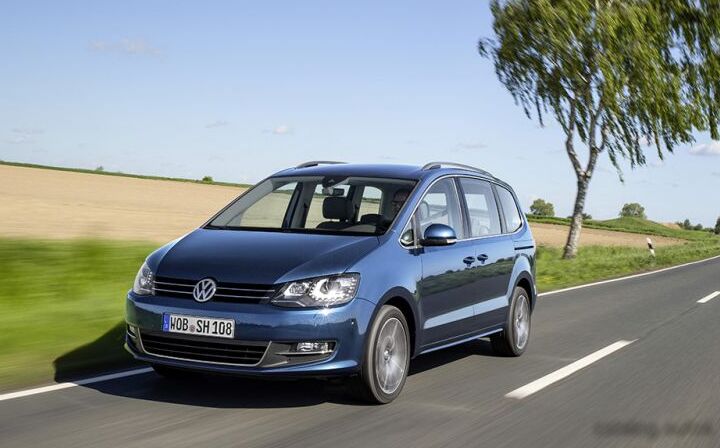
The Volkswagen Sharan II, particularly the facelifted version introduced in 2015, represented a significant evolution of Volkswagen’s minivan offering. Produced from 2015 to 2018, the 2.0 TDI 150 hp 4MOTION variant occupied a middle ground within the Sharan lineup, balancing fuel efficiency, practicality, and all-weather capability. This model was primarily aimed at European markets, where MPVs remained popular for family transport, offering a spacious and versatile alternative to SUVs. The Sharan II, built on the PQ46 platform (also known as the A6 platform in some contexts), aimed to provide a premium experience within the MPV segment.
Technical Specifications
| Brand | Volkswagen |
| Model | Sharan |
| Generation | Sharan II (facelift 2015) |
| Type (Engine) | 2.0 TDI (150 Hp) 4MOTION |
| Start of production | 2015 |
| End of production | 2018 |
| Powertrain Architecture | Internal Combustion engine |
| Body type | Minivan, MPV |
| Seats | 5 |
| Doors | 5 |
| Fuel consumption (urban) | 6.7-6.8 l/100 km (35.1 – 34.6 US mpg, 42.2 – 41.5 UK mpg, 14.9 – 14.7 km/l) |
| Fuel consumption (extra urban) | 5.0-5.1 l/100 km (47 – 46.1 US mpg, 56.5 – 55.4 UK mpg, 20 – 19.6 km/l) |
| Fuel consumption (combined) | 5.6-5.7 l/100 km (42 – 41.3 US mpg, 50.4 – 49.6 UK mpg, 17.9 – 17.5 km/l) |
| CO2 emissions | 146-147 g/km |
| Fuel Type | Diesel |
| Acceleration 0 – 100 km/h | 10.6 sec |
| Acceleration 0 – 62 mph | 10.6 sec |
| Acceleration 0 – 60 mph | 10.1 sec |
| Maximum speed | 198 km/h (123.03 mph) |
| Emission standard | Euro 6 |
| Weight-to-power ratio | 12.1 kg/Hp, 82.6 Hp/tonne |
| Weight-to-torque ratio | 5.3 kg/Nm, 187.2 Nm/tonne |
| Power | 150 Hp @ 3500 rpm |
| Power per litre | 76.2 Hp/l |
| Torque | 340 Nm @ 1750-3000 rpm (250.77 lb.-ft. @ 1750-3000 rpm) |
| Engine layout | Front, Transverse |
| Engine Model/Code | CUVC, DFLA, DLTA |
| Engine displacement | 1968 cm3 (120.09 cu. in.) |
| Number of cylinders | 4 |
| Engine configuration | Inline |
| Number of valves per cylinder | 4 |
| Fuel injection system | Diesel Commonrail |
| Engine aspiration | Turbocharger, Intercooler |
| Engine oil capacity | 4.7 l (4.97 US qt | 4.14 UK qt) |
| Coolant | 8 l (8.45 US qt | 7.04 UK qt) |
| Kerb Weight | 1816 kg (4003.59 lbs.) |
| Max. weight | 2560 kg (5643.83 lbs.) |
| Max load | 744 kg (1640.24 lbs.) |
| Trunk (boot) space – minimum | 955 l (33.73 cu. ft.) |
| Trunk (boot) space – maximum | 2430 l (85.81 cu. ft.) |
| Fuel tank capacity | 70 l (18.49 US gal | 15.4 UK gal) |
| Max. roof load | 100 kg (220.46 lbs.) |
| Permitted trailer load with brakes (8%) | 2400 kg (5291.09 lbs.) |
| Permitted trailer load with brakes (12%) | 2400 kg (5291.09 lbs.) |
| Permitted trailer load without brakes | 750 kg (1653.47 lbs.) |
| Permitted towbar download | 100 kg (220.46 lbs.) |
| Length | 4854 mm (191.1 in.) |
| Width | 1904 mm (74.96 in.) |
| Width including mirrors | 2081 mm (81.93 in.) |
| Height | 1720 mm (67.72 in.) |
| Wheelbase | 2920 mm (114.96 in.) |
| Front track | 1571 mm (61.85 in.) |
| Rear (Back) track | 1617 mm (63.66 in.) |
| Ride height (ground clearance) | 152 mm (5.98 in.) |
| Minimum turning circle (turning diameter) | 11.9 m (39.04 ft.) |
| Drive wheel | All wheel drive (4×4) |
| Number of gears and type of gearbox | 6 gears, manual transmission |
| Front suspension | Independent type McPherson |
| Rear suspension | Independent multi-link suspension |
| Front brakes | Ventilated discs |
| Rear brakes | Disc |
| Assisting systems | ABS (Anti-lock braking system) |
| Steering type | Steering rack and pinion |
| Power steering | Electric Steering |
| Tires size | 215/60 R16; 225/50 R17; 225/45 R18 |
| Wheel rims size | 16; 17; 18 |
INTRODUCTION
The Volkswagen Sharan II facelift, launched in 2015, brought updated styling, improved technology, and refined engine options to Volkswagen’s large MPV. The 2.0 TDI 150 hp 4MOTION variant was a key offering, designed to appeal to families needing space and versatility, combined with the security of all-wheel drive. This version sat in the mid-range of the Sharan lineup, offering a balance between the more affordable base models and the higher-specification trims with more powerful engines. It was a direct competitor to other large MPVs like the Ford Galaxy, Renault Espace, and Citroën Grand C4 Picasso.
Powertrain & Engine Architecture
The heart of this Sharan variant is the 2.0-liter four-cylinder diesel engine, identified by engine codes CUVC, DFLA, or DLTA depending on the specific production year and market. This engine utilizes a common rail direct injection system, delivering fuel at extremely high pressure for optimized combustion. A turbocharger with an intercooler further enhances performance. The engine produces 150 horsepower at 3500 rpm and a substantial 340 Nm (250.77 lb.-ft.) of torque between 1750 and 3000 rpm. This broad torque curve is characteristic of modern diesel engines and contributes to strong pulling power. The engine features four valves per cylinder and is transversely mounted in the front of the vehicle. The 4MOTION all-wheel-drive system is a Haldex system, primarily front-wheel drive but capable of automatically engaging the rear wheels when traction is lost. This provides enhanced stability and control, particularly in adverse weather conditions. The transmission is a 6-speed manual gearbox.
Driving Characteristics
The 150 hp 2.0 TDI with the 6-speed manual transmission offers a comfortable and capable driving experience. While not overtly sporty, the engine provides ample power for everyday driving and long-distance journeys, even when fully loaded with passengers and luggage. The 4MOTION system provides excellent grip and stability, inspiring confidence on slippery surfaces. The gear ratios are well-chosen, providing good acceleration in lower gears and relaxed cruising at highway speeds. Compared to the higher-output 184 hp TDI version, this variant feels less urgent in acceleration, but the difference is often negligible in real-world driving. The manual transmission allows for greater driver control, but it lacks the convenience of an automatic. Fuel economy is a strong point, with combined figures around 5.6-5.7 l/100 km (42-41.3 US mpg).
Equipment & Trim Levels
The 2.0 TDI 150 hp 4MOTION Sharan typically came equipped with a respectable level of standard features. These included air conditioning, electric windows, central locking, a multi-function steering wheel, and an infotainment system with a touchscreen display. Higher trim levels added features such as automatic climate control, parking sensors, a rearview camera, leather upholstery, and advanced safety systems like adaptive cruise control and lane assist. Optional extras included a panoramic sunroof, navigation system, and upgraded audio systems. Interior upholstery was typically cloth, with leather available as an upgrade. The dashboard layout was functional and well-designed, with clear instrumentation and intuitive controls.
Chassis & Braking
The Sharan II utilizes an independent suspension setup, with McPherson struts at the front and a multi-link system at the rear. This provides a comfortable ride quality, absorbing bumps and imperfections in the road surface effectively. Stabilizer bars are fitted to both axles to reduce body roll during cornering. The braking system consists of ventilated discs at the front and solid discs at the rear, providing adequate stopping power. Anti-lock braking system (ABS) is standard, enhancing safety and control during emergency braking. The steering is rack and pinion with electric power assistance, offering precise and responsive handling.
Market Reception & Comparison
The Sharan II 2.0 TDI 150 hp 4MOTION was generally well-received by automotive critics. It was praised for its spacious interior, comfortable ride, and fuel efficiency. The 4MOTION system was also highlighted as a significant benefit, particularly for drivers in regions with harsh winters. Compared to the more powerful TDI variants, this version offered a more affordable entry point into the Sharan range, while still providing ample performance for most users. Fuel economy was competitive with other MPVs in its class. Reliability was generally good, although some owners reported issues with the diesel particulate filter (DPF) and dual-mass flywheel, common concerns with modern diesel engines.
Legacy
The Volkswagen Sharan II 2.0 TDI 150 hp 4MOTION remains a practical and versatile option in the used car market. Its robust diesel engine and all-wheel-drive system contribute to its longevity and reliability. While newer MPVs and SUVs offer more advanced technology and features, the Sharan II still provides a compelling package for families needing space, comfort, and all-weather capability. Maintenance costs are generally reasonable, although it’s important to be aware of potential issues with the DPF and dual-mass flywheel. The Sharan II represents a high point in Volkswagen’s MPV development, offering a refined and well-engineered vehicle that continues to serve its owners well.