Technical Specifications
| Brand | Volkswagen |
| Model | Sharan |
| Generation | Sharan II (facelift 2015) |
| Type (Engine) | 2.0 TDI (150 Hp) 7 Seat |
| Start of production | 2015 |
| End of production | 2018 |
| Powertrain Architecture | Internal Combustion engine |
| Body type | Minivan, MPV |
| Seats | 7 |
| Doors | 5 |
| Fuel consumption (urban) | 6.0-6.1 l/100 km (39.2 – 38.6 US mpg) |
| Fuel consumption (extra urban) | 4.5-4.6 l/100 km (52.3 – 51.1 US mpg) |
| Fuel consumption (combined) | 5.0-5.1 l/100 km (47 – 46.1 US mpg) |
| CO2 emissions | 130-132 g/km |
| Fuel Type | Diesel |
| Acceleration 0 – 100 km/h | 10.3 sec |
| Acceleration 0 – 62 mph | 10.3 sec |
| Acceleration 0 – 60 mph | 9.8 sec |
| Maximum speed | 200 km/h (124.27 mph) |
| Emission standard | Euro 6 |
| Weight-to-power ratio | 11.3 kg/Hp |
| Weight-to-torque ratio | 5 kg/Nm |
| Power | 150 Hp @ 3500 rpm |
| Torque | 340 Nm @ 1750-3000 rpm (250.77 lb.-ft.) |
| Engine layout | Front, Transverse |
| Engine Model/Code | CUVC, DFLA, DLTA |
| Engine displacement | 1968 cm3 (120.09 cu. in.) |
| Number of cylinders | 4 |
| Engine configuration | Inline |
| Number of valves per cylinder | 4 |
| Fuel injection system | Diesel Commonrail |
| Engine aspiration | Turbocharger, Intercooler |
| Engine oil capacity | 4.7 l (4.97 US qt | 4.14 UK qt) |
| Coolant capacity | 8 l (8.45 US qt | 7.04 UK qt) |
| Kerb Weight | 1697 kg (3741.24 lbs.) |
| Max. weight | 2390 kg (5269.05 lbs.) |
| Max load | 693 kg (1527.8 lbs.) |
| Trunk (boot) space – minimum | 300 l (10.59 cu. ft.) |
| Trunk (boot) space – maximum | 2297 l (81.12 cu. ft.) |
| Fuel tank capacity | 70 l (18.49 US gal | 15.4 UK gal) |
| Max. roof load | 100 kg (220.46 lbs.) |
| Permitted trailer load with brakes (8%) | 2300 kg (5070.63 lbs.) |
| Permitted trailer load with brakes (12%) | 2200 kg (4850.17 lbs.) |
| Permitted trailer load without brakes | 750 kg (1653.47 lbs.) |
| Permitted towbar download | 100 kg (220.46 lbs.) |
| Length | 4854 mm (191.1 in.) |
| Width | 1904 mm (74.96 in.) |
| Width including mirrors | 2081 mm (81.93 in.) |
| Height | 1720 mm (67.72 in.) |
| Wheelbase | 2920 mm (114.96 in.) |
| Front track | 1571 mm (61.85 in.) |
| Rear track | 1617 mm (63.66 in.) |
| Ride height (ground clearance) | 152 mm (5.98 in.) |
| Minimum turning circle | 11.9 m (39.04 ft.) |
| Drive wheel | Front wheel drive |
| Number of gears and type of gearbox | 6 gears, manual transmission |
| Front suspension | Independent type McPherson |
| Rear suspension | Independent multi-link suspension |
| Front brakes | Ventilated discs |
| Rear brakes | Disc |
| Assisting systems | ABS (Anti-lock braking system) |
| Steering type | Steering rack and pinion |
| Power steering | Electric Steering |
| Tires size | 215/60 R16; 225/50 R17; 225/45 R18 |
| Wheel rims size | 16; 17; 18 |
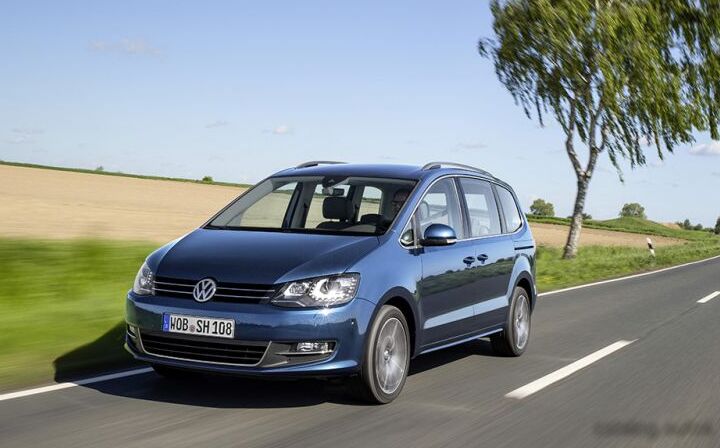
The Volkswagen Sharan II, launched in 2010 and receiving a significant facelift in 2015, was a collaborative effort with Ford, sharing a platform and many components with the Ford Galaxy and S-MAX. The 2.0 TDI 150 hp variant, produced from 2015-2018, was a mainstay of the Sharan range, offering a balance between fuel economy and performance. Built on the PQ46 platform (also known as the A6 platform in some contexts), the Sharan II aimed to provide a more refined and spacious alternative to traditional estate cars, catering to families and those requiring flexible cargo capacity. This particular engine and power output was designed to be a sweet spot for many buyers, offering enough power for comfortable cruising and hauling passengers, without the higher running costs associated with the more powerful engine options.
Powertrain & Engine Architecture
The heart of this Sharan variant is the 2.0-liter four-cylinder diesel engine, identified by engine codes such as CUVC, DFLA, and DLTA. This engine is a common rail direct injection (CRDI) diesel, utilizing piezo injectors for precise fuel delivery. The engine features a turbocharger with an intercooler, boosting power and torque. The 150 hp output is achieved through careful calibration of the engine management system, balancing performance with fuel efficiency and emissions. The engine’s valvetrain consists of four valves per cylinder, contributing to its efficient breathing. The Sharan II 2.0 TDI 150 hp was typically paired with a six-speed manual transmission, although a six-speed DSG (Direct-Shift Gearbox) dual-clutch automatic was also available as an option. The automatic transmission offered smoother gear changes and enhanced convenience, but at the expense of some fuel economy.
Driving Characteristics
The 2.0 TDI 150 hp Sharan offers a competent, if not particularly exhilarating, driving experience. Acceleration from 0-60 mph takes around 9.8 seconds, and top speed is limited to 124 mph. The engine delivers its peak torque of 340 Nm (250.77 lb-ft) between 1750 and 3000 rpm, providing ample pulling power for everyday driving and overtaking maneuvers. The six-speed manual transmission is well-matched to the engine, offering precise shifts and a reasonable spread of ratios. Compared to the higher-powered 177 hp TDI variant, the 150 hp version feels slightly less responsive, particularly when fully loaded. However, the difference is not dramatic, and the 150 hp engine provides sufficient power for most situations. The Sharan’s suspension is tuned for comfort, absorbing bumps and imperfections in the road well. However, this does result in some body roll in corners.
Equipment & Trim Levels
The 2.0 TDI 150 hp Sharan typically came equipped with a respectable level of standard features. These included air conditioning, electric windows, central locking, a CD/radio system, and alloy wheels. Higher trim levels, such as SE and SEL, added features like climate control, parking sensors, a touchscreen infotainment system, and leather upholstery. Optional extras included a panoramic sunroof, navigation system, and adaptive cruise control. Interior upholstery was typically cloth on the base models, with leather options available on higher trims. The dashboard layout was functional and well-designed, with clear instrumentation and intuitive controls.
Chassis & Braking
The Sharan II utilizes an independent McPherson strut suspension at the front and an independent multi-link suspension at the rear, providing a comfortable ride and good handling. The braking system consists of ventilated discs at the front and solid discs at the rear. Anti-lock braking system (ABS) is standard, enhancing safety and stability during emergency braking. The Sharan’s steering is electrically assisted, providing a light and precise feel. Stabilizer bars are fitted to both the front and rear axles to reduce body roll.
Market Reception & Comparison
The Volkswagen Sharan II 2.0 TDI 150 hp was generally well-received by automotive critics. It was praised for its spacious interior, comfortable ride, and fuel efficiency. However, some critics noted that the engine could feel strained when fully loaded, and that the handling was not as sharp as some of its competitors. Compared to the more powerful 177 hp TDI variant, the 150 hp version offered better fuel economy and lower running costs, making it a more attractive option for budget-conscious buyers. The Sharan also competed with other MPVs such as the Ford Galaxy, Citroën C4 Picasso, and Renault Grand Scenic.
Legacy
The Volkswagen Sharan II 2.0 TDI 150 hp has proven to be a reliable and durable vehicle. The 2.0 TDI engine is generally robust, although it is important to ensure regular servicing and maintenance. Common issues include diesel particulate filter (DPF) clogging and injector problems. On the used car market, the Sharan II 2.0 TDI 150 hp remains a popular choice for families seeking a spacious and practical MPV. Its combination of fuel efficiency, reliability, and affordability makes it a compelling option, even years after production ceased. Well-maintained examples continue to command reasonable prices, reflecting the Sharan’s enduring appeal.