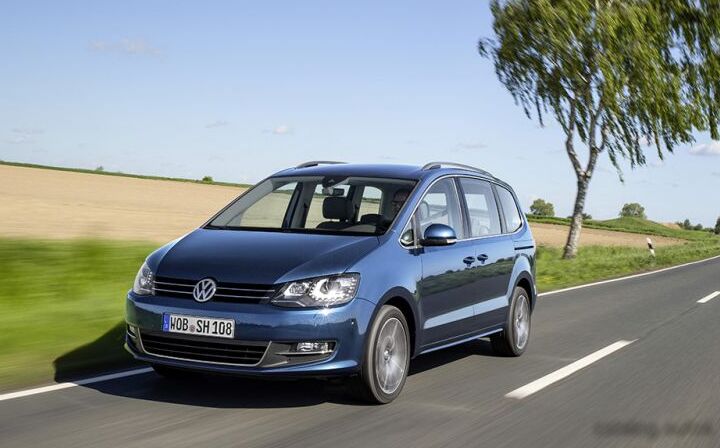
The Volkswagen Sharan II, particularly the facelifted version produced from 2015 to 2018, represented a significant evolution of Volkswagen’s minivan offering. This generation, built on the PQ46 platform (also known as the 1HX0/A3 platform), aimed to provide a spacious and versatile vehicle for families. The 2.0 TDI variant, producing 184 horsepower, was a popular choice in European markets, offering a balance of performance and fuel efficiency. It sat within the Sharan lineup as a mid-to-upper range option, positioned above the lower-powered diesel engines but below potential future performance-oriented trims.
Technical Specifications
| Brand | Volkswagen |
| Model | Sharan |
| Generation | Sharan II (facelift 2015) |
| Type (Engine) | 2.0 TDI (184 Hp) |
| Start of production | 2015 |
| End of production | 2018 |
| Powertrain Architecture | Internal Combustion engine |
| Body type | Minivan, MPV |
| Seats | 5 |
| Doors | 5 |
| Fuel consumption (urban) | 6.7 l/100 km (35.1 US mpg, 42.2 UK mpg, 14.9 km/l) |
| Fuel consumption (extra urban) | 4.5 l/100 km (52.3 US mpg, 62.8 UK mpg, 22.2 km/l) |
| Fuel consumption (combined) | 5.3 l/100 km (44.4 US mpg, 53.3 UK mpg, 18.9 km/l) |
| CO2 emissions | 138-139 g/km |
| Fuel Type | Diesel |
| Acceleration 0 – 100 km/h | 8.9 sec |
| Acceleration 0 – 62 mph | 8.9 sec |
| Acceleration 0 – 60 mph | 8.5 sec |
| Maximum speed | 215 km/h (133.59 mph) |
| Emission standard | Euro 6 |
| Weight-to-power ratio | 9.4 kg/Hp, 106.7 Hp/tonne |
| Weight-to-torque ratio | 4.5 kg/Nm, 220.3 Nm/tonne |
| Power | 184 Hp @ 3500-4000 rpm |
| Power per litre | 93.5 Hp/l |
| Torque | 380 Nm @ 1750-3250 rpm (280.27 lb.-ft. @ 1750-3250 rpm) |
| Engine layout | Front, Transverse |
| Engine Model/Code | CUWA, DFMA |
| Engine displacement | 1968 cm3 (120.09 cu. in.) |
| Number of cylinders | 4 |
| Engine configuration | Inline |
| Number of valves per cylinder | 4 |
| Fuel injection system | Diesel Commonrail |
| Engine aspiration | Turbocharger, Intercooler |
| Engine oil capacity | 4.7 l (4.97 US qt | 4.14 UK qt) |
| Coolant | 8 l (8.45 US qt | 7.04 UK qt) |
| Kerb Weight | 1725 kg (3802.97 lbs) |
| Max. weight | 2400 kg (5291.09 lbs) |
| Max load | 675 kg (1488.12 lbs) |
| Trunk (boot) space – minimum | 955 l (33.73 cu. ft) |
| Trunk (boot) space – maximum | 2430 l (85.81 cu. ft) |
| Fuel tank capacity | 70 l (18.49 US gal | 15.4 UK gal) |
| Max. roof load | 100 kg (220.46 lbs) |
| Permitted trailer load with brakes (8%) | 2400 kg (5291.09 lbs) |
| Permitted trailer load with brakes (12%) | 2200 kg (4850.17 lbs) |
| Permitted trailer load without brakes | 750 kg (1653.47 lbs) |
| Permitted towbar download | 100 kg (220.46 lbs) |
| Length | 4854 mm (191.1 in) |
| Width | 1904 mm (74.96 in) |
| Width including mirrors | 2081 mm (81.93 in) |
| Height | 1720 mm (67.72 in) |
| Wheelbase | 2920 mm (114.96 in) |
| Front track | 1571 mm (61.85 in) |
| Rear (Back) track | 1617 mm (63.66 in) |
| Ride height (ground clearance) | 152 mm (5.98 in) |
| Minimum turning circle (turning diameter) | 11.9 m (39.04 ft) |
| Drive wheel | Front wheel drive |
| Number of gears and type of gearbox | 6 gears, manual transmission |
| Front suspension | Independent type McPherson |
| Rear suspension | Independent multi-link suspension |
| Front brakes | Ventilated discs |
| Rear brakes | Disc |
| Assisting systems | ABS (Anti-lock braking system) |
| Steering type | Steering rack and pinion |
| Power steering | Electric Steering |
| Tires size | 215/60 R16; 225/50 R17; 225/45 R18 |
| Wheel rims size | 16; 17; 18 |
INTRODUCTION
The Volkswagen Sharan II facelift, launched in 2015, continued the Sharan’s reputation as a practical and well-equipped people carrier. Designed to compete with vehicles like the Ford Galaxy and Renault Espace, the Sharan offered a spacious interior, flexible seating arrangements, and a range of modern features. The 2.0 TDI 184 hp engine was a key component of the Sharan’s appeal, providing a good balance between performance and fuel economy for long-distance family travel. This engine was available with both manual and automatic transmissions, catering to a wide range of driver preferences.
Powertrain & Engine Architecture
The 2.0 TDI engine in the facelifted Sharan utilized the common rail direct injection system, a hallmark of modern diesel engines. Engine codes CUWA and DFMA were commonly associated with this power output. This system allowed for precise fuel delivery, optimizing combustion and maximizing efficiency. The engine featured a turbocharger with an intercooler, boosting power output and improving throttle response. The 1968cc inline-four cylinder engine employed four valves per cylinder, enhancing breathing and contributing to the engine’s overall performance. The Sharan typically paired this engine with a six-speed dual-clutch transmission (DSG) although a six-speed manual was also available. The DSG transmission offered smooth and quick gear changes, enhancing the driving experience and contributing to improved fuel economy.
Driving Characteristics
The 184 hp 2.0 TDI engine provided adequate performance for the Sharan, allowing for comfortable cruising on highways and effortless overtaking. While not a sports car, the Sharan with this engine offered a respectable 0-60 mph time of around 8.5 seconds. The DSG transmission, when equipped, contributed to a more responsive driving experience compared to a traditional automatic. The gear ratios were tuned for a balance of acceleration and fuel efficiency, with taller gears for relaxed highway cruising. Compared to the lower-powered diesel variants, the 184 hp engine offered a noticeable improvement in performance, particularly when fully loaded with passengers and luggage. However, it didn’t match the more spirited performance of potential higher-output engines that might have been offered in other markets or as limited editions.
Equipment & Trim Levels
The Sharan II facelift offered a range of trim levels, with the 2.0 TDI 184 hp engine typically found in mid-to-high specification models. Standard equipment often included features such as air conditioning, a touchscreen infotainment system, Bluetooth connectivity, and alloy wheels. Higher trim levels added features like leather upholstery, parking sensors, a panoramic sunroof, and advanced safety systems. The interior was designed with practicality in mind, offering a spacious and comfortable cabin with flexible seating arrangements. The second and third-row seats could be folded flat or even removed entirely, creating a large cargo area.
Chassis & Braking
The Sharan II utilized an independent suspension system on both the front and rear axles, providing a comfortable and controlled ride. The front suspension featured McPherson struts, while the rear employed a multi-link setup. This configuration helped to absorb bumps and maintain stability, even when the vehicle was fully loaded. Braking duties were handled by ventilated discs on the front wheels and solid discs on the rear. Anti-lock braking system (ABS) was standard, enhancing safety and control during emergency braking situations. The Sharan’s chassis was designed to handle the weight of passengers and luggage, providing a stable and predictable driving experience.
Market Reception & Comparison
The Volkswagen Sharan II facelift, particularly the 2.0 TDI 184 hp variant, was generally well-received by automotive critics. It was praised for its spacious interior, comfortable ride, and fuel efficiency. Critics noted that the Sharan offered a more refined driving experience compared to some of its competitors. Compared to the lower-powered diesel engines in the Sharan lineup, the 184 hp version offered a significant improvement in performance, making it a more suitable choice for drivers who frequently travel long distances or carry heavy loads. Fuel economy was competitive, averaging around 44.4 US mpg in combined driving conditions. Reliability was generally good, although some owners reported issues with the DSG transmission.
Legacy
The Volkswagen Sharan II, including the 2.0 TDI 184 hp variant, remains a popular choice in the used car market. Its reputation for practicality, reliability, and comfort has ensured its continued demand. The 2.0 TDI engine, while not without its potential maintenance needs (particularly the diesel particulate filter and potential EGR valve issues), is generally considered a robust and durable unit. The DSG transmission, if properly maintained, can provide years of reliable service. Today, the Sharan II represents a well-rounded and versatile family vehicle that continues to offer good value for money.