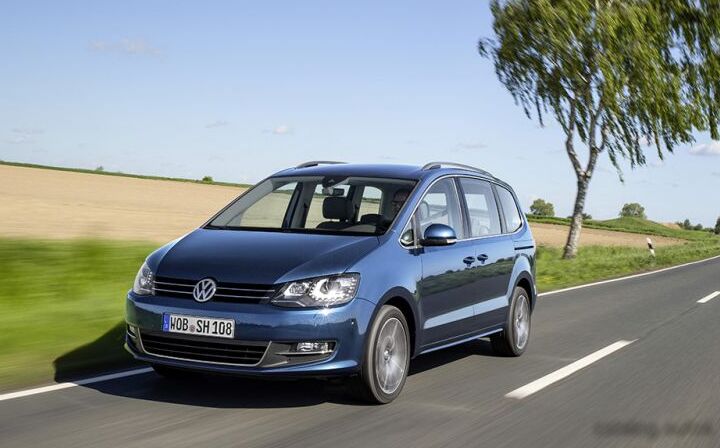
The Volkswagen Sharan II, particularly the facelifted version produced from 2015 to 2018, represented a significant evolution of Volkswagen’s minivan offering. This generation, built on the PQ46 platform (also known as the 1HX0/A3 platform), aimed to provide a spacious and versatile vehicle for families. The 2.0 TDI variant with 184 horsepower and a dual-clutch gearbox (DSG) occupied a mid-to-upper position within the Sharan lineup, offering a balance of performance, fuel efficiency, and practicality. It was primarily marketed in Europe, where large MPVs remained popular, and offered a compelling alternative to rivals like the Ford S-Max and Renault Espace.
Technical Specifications
| Brand | Volkswagen |
| Model | Sharan |
| Generation | Sharan II (facelift 2015) |
| Type (Engine) | 2.0 TDI (184 Hp) DSG |
| Start of production | 2015 |
| End of production | 2018 |
| Powertrain Architecture | Internal Combustion engine |
| Body type | Minivan, MPV |
| Seats | 5 |
| Doors | 5 |
| Fuel consumption (urban) | 6.1 l/100 km (38.6 US mpg, 46.3 UK mpg, 16.4 km/l) |
| Fuel consumption (extra urban) | 4.8 l/100 km (49 US mpg, 58.9 UK mpg, 20.8 km/l) |
| Fuel consumption (combined) | 5.3 l/100 km (44.4 US mpg, 53.3 UK mpg, 18.9 km/l) |
| CO2 emissions | 138-139 g/km |
| Fuel Type | Diesel |
| Acceleration 0 – 100 km/h | 8.9 sec |
| Acceleration 0 – 62 mph | 8.9 sec |
| Acceleration 0 – 60 mph | 8.5 sec |
| Maximum speed | 213 km/h (132.35 mph) |
| Emission standard | Euro 6 |
| Weight-to-power ratio | 9.4 kg/Hp, 106.4 Hp/tonne |
| Weight-to-torque ratio | 4.6 kg/Nm, 219.8 Nm/tonne |
| Power | 184 Hp @ 3500-4000 rpm |
| Power per litre | 93.5 Hp/l |
| Torque | 380 Nm @ 1750-3250 rpm (280.27 lb.-ft. @ 1750-3250 rpm) |
| Engine layout | Front, Transverse |
| Engine Model/Code | CUWA, DFMA |
| Engine displacement | 1968 cm3 (120.09 cu. in.) |
| Number of cylinders | 4 |
| Engine configuration | Inline |
| Number of valves per cylinder | 4 |
| Fuel injection system | Diesel Commonrail |
| Engine aspiration | Turbocharger, Intercooler |
| Engine oil capacity | 4.7 l (4.97 US qt | 4.14 UK qt) |
| Coolant | 8 l (8.45 US qt | 7.04 UK qt) |
| Kerb Weight | 1729 kg (3811.79 lbs.) |
| Max. weight | 2400 kg (5291.09 lbs.) |
| Max load | 671 kg (1479.3 lbs.) |
| Trunk (boot) space – minimum | 955 l (33.73 cu. ft.) |
| Trunk (boot) space – maximum | 2430 l (85.81 cu. ft.) |
| Fuel tank capacity | 70 l (18.49 US gal | 15.4 UK gal) |
| Max. roof load | 100 kg (220.46 lbs.) |
| Permitted trailer load with brakes (8%) | 2400 kg (5291.09 lbs.) |
| Permitted trailer load with brakes (12%) | 2200 kg (4850.17 lbs.) |
| Permitted trailer load without brakes | 750 kg (1653.47 lbs.) |
| Permitted towbar download | 100 kg (220.46 lbs.) |
| Length | 4854 mm (191.1 in.) |
| Width | 1904 mm (74.96 in.) |
| Width including mirrors | 2081 mm (81.93 in.) |
| Height | 1720 mm (67.72 in.) |
| Wheelbase | 2920 mm (114.96 in.) |
| Front track | 1571 mm (61.85 in.) |
| Rear (Back) track | 1617 mm (63.66 in.) |
| Ride height (ground clearance) | 152 mm (5.98 in.) |
| Minimum turning circle (turning diameter) | 11.9 m (39.04 ft.) |
| Drive wheel | Front wheel drive |
| Number of gears and type of gearbox | 6 gears, automatic transmission DSG |
| Front suspension | Independent type McPherson |
| Rear suspension | Independent multi-link suspension |
| Front brakes | Ventilated discs |
| Rear brakes | Disc |
| Assisting systems | ABS (Anti-lock braking system) |
| Steering type | Steering rack and pinion |
| Power steering | Electric Steering |
| Tires size | 215/60 R16; 225/50 R17; 225/45 R18 |
| Wheel rims size | 16; 17; 18 |
INTRODUCTION
The Volkswagen Sharan II facelift, produced between 2015 and 2018, continued the Sharan’s reputation as a practical and well-engineered MPV. This iteration benefited from styling updates, improved technology, and refined engine options. The 2.0 TDI variant, producing 184 horsepower and paired with a seven-speed DSG dual-clutch transmission, was a popular choice for buyers seeking a balance between fuel economy and performance. Positioned as a mid-range offering, it sat above the lower-powered diesel options and below the more expensive, fully-loaded trims. The Sharan competed directly with other European MPVs, offering a spacious interior and flexible seating arrangements.
Powertrain & Engine Architecture
The heart of this Sharan variant is the 2.0-liter four-cylinder diesel engine, identified by engine codes CUWA or DFMA. This engine is a common rail direct injection (CRDI) unit, utilizing piezo injectors for precise fuel delivery. The turbocharger, often coupled with an intercooler, provides increased air intake, boosting power and torque. The engine features four valves per cylinder and a timing belt. The 184 hp output was achieved through optimized engine mapping and turbocharger calibration compared to lower-powered versions of the same engine. The seven-speed DSG (Direct-Shift Gearbox) is a crucial component, offering quick and smooth gear changes. It operates on a dual-clutch principle, pre-selecting the next gear for near-instantaneous shifts. The DSG transmission contributes significantly to both performance and fuel efficiency.
Driving Characteristics
The 184 hp 2.0 TDI Sharan with the DSG transmission delivers a respectable driving experience for a vehicle of its size. Acceleration from 0-62 mph takes approximately 8.9 seconds, making it adequately quick for everyday driving and overtaking maneuvers. The DSG transmission ensures that power is delivered efficiently, with minimal turbo lag. Compared to the lower-powered diesel variants, this version offers noticeably more punch, particularly when fully loaded. While not a sporty vehicle, the Sharan handles reasonably well, with a comfortable ride quality. The DSG transmission allows for both automatic and manual gear selection, giving the driver some control over the driving experience. The gear ratios are tuned for a balance of acceleration and fuel economy, with taller gears for relaxed cruising on the highway.
Equipment & Trim Levels
The 2.0 TDI 184 hp Sharan typically came equipped with a good level of standard features. These included air conditioning, electric windows and mirrors, a touchscreen infotainment system with Bluetooth connectivity, and alloy wheels. Higher trim levels added features such as leather upholstery, parking sensors, a panoramic sunroof, and advanced safety systems like adaptive cruise control and lane assist. Interior upholstery was often a combination of cloth and Alcantara, with options for full leather. Dashboard configurations were generally straightforward and functional, prioritizing ease of use. Optional extras included a navigation system, rear entertainment system, and upgraded sound system.
Chassis & Braking
The Sharan II utilizes an independent suspension setup, with McPherson struts at the front and a multi-link system at the rear. This configuration provides a comfortable ride and good handling characteristics. The front brakes are ventilated discs, while the rear brakes are solid discs. ABS (Anti-lock Braking System) is standard, enhancing safety during emergency braking. Stabilizer bars are fitted to both the front and rear axles to reduce body roll. The suspension tuning is geared towards comfort rather than outright sportiness, prioritizing a smooth ride over sharp handling.
Market Reception & Comparison
The 2.0 TDI 184 hp Sharan was generally well-received by automotive critics. It was praised for its spacious interior, comfortable ride, and fuel efficiency. The DSG transmission was also a highlight, offering smooth and quick gear changes. Compared to the lower-powered diesel variants, the 184 hp version was considered a worthwhile upgrade for those who frequently carry passengers or travel long distances. Fuel economy figures of around 44.4 US mpg (combined) were competitive for its class. Reliability was generally good, although some owners reported minor issues with the DSG transmission. Compared to petrol-powered MPVs, the diesel Sharan offered significantly better fuel economy.
Legacy
The Volkswagen Sharan II, including the 2.0 TDI 184 hp variant, has proven to be a durable and reliable vehicle. On the used car market, these models continue to be sought after by families looking for a spacious and practical MPV. The 2.0 TDI engine, while subject to diesel emissions scrutiny in later years, is generally considered robust and long-lasting when properly maintained. DSG transmissions, while potentially requiring more frequent servicing than traditional automatics, are generally reliable if fluid changes are performed according to the manufacturer’s recommendations. The Sharan II remains a popular choice for those who prioritize space, comfort, and fuel efficiency in a family vehicle.