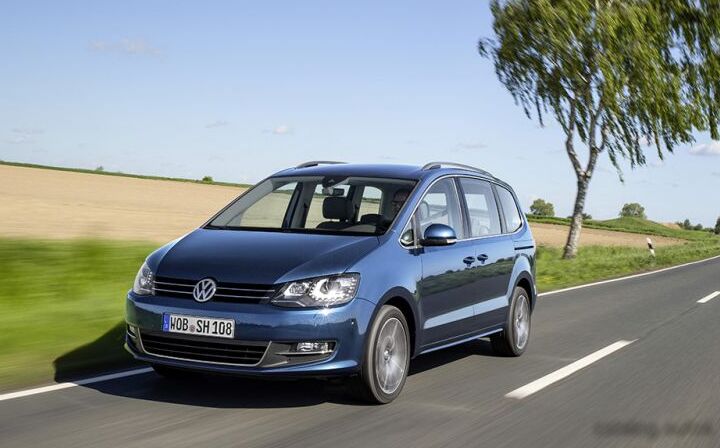
The Volkswagen Sharan II, particularly the facelifted version introduced in 2015, represented a significant evolution of Volkswagen’s minivan offering. The 2.0 TDI SCR variant, producing 150 horsepower, was a key model in the lineup, manufactured from 2018 to 2020. Positioned as a mid-range option, it aimed to balance fuel efficiency, practicality, and a reasonable level of performance for family transport. This generation Sharan (Typ 7N) shared its platform with the SEAT Alhambra and Škoda Octavia, forming a collaborative effort within the Volkswagen Group to cater to the European MPV market. The Sharan, unlike its North American counterparts, was primarily designed for the needs of European families prioritizing space, versatility, and diesel economy.
Technical Specifications
| Brand | Volkswagen |
| Model | Sharan |
| Generation | Sharan II (facelift 2015) |
| Type (Engine) | 2.0 TDI SCR (150 Hp) |
| Start of production | 2018 |
| End of production | 2020 |
| Powertrain Architecture | Internal Combustion engine |
| Body type | Minivan, MPV |
| Seats | 5-7 |
| Doors | 5 |
| Fuel consumption (urban) | 6.1-6.2 l/100 km (38.6 – 37.9 US mpg) |
| Fuel consumption (extra urban) | 4.6-4.7 l/100 km (51.1 – 50 US mpg) |
| Fuel consumption (combined) | 5.2 l/100 km (45.2 US mpg) |
| CO2 emissions | 135-137 g/km |
| Fuel Type | Diesel |
| Acceleration 0 – 100 km/h | 10.3 sec |
| Acceleration 0 – 62 mph | 10.3 sec |
| Acceleration 0 – 60 mph | 9.8 sec |
| Maximum speed | 200 km/h (124.27 mph) |
| Emission standard | Euro 6d-TEMP |
| Weight-to-power ratio | 11.9 kg/Hp |
| Weight-to-torque ratio | 5.3 kg/Nm |
| Power | 150 Hp |
| Torque | 340 Nm @ 1750-3000 rpm (250.77 lb.-ft. @ 1750-3000 rpm) |
| Engine layout | Front, Transverse |
| Engine Model/Code | CUVC, DFLA, DLTA |
| Engine displacement | 1968 cm3 (120.09 cu. in.) |
| Number of cylinders | 4 |
| Engine configuration | Inline |
| Number of valves per cylinder | 4 |
| Fuel injection system | Diesel Commonrail |
| Engine aspiration | Turbocharger, Intercooler |
| Engine oil capacity | 4.7 l (4.97 US qt | 4.14 UK qt) |
| Coolant | 8 l (8.45 US qt | 7.04 UK qt) |
| Kerb Weight | 1785 kg (3935.25 lbs.) |
| Max. weight | 2520 kg (5555.65 lbs.) |
| Max load | 735 kg (1620.4 lbs.) |
| Trunk (boot) space – minimum | 955 l (33.73 cu. ft.) |
| Trunk (boot) space – maximum | 2430 l (85.81 cu. ft.) |
| Fuel tank capacity | 70 l (18.49 US gal | 15.4 UK gal) |
| AdBlue tank | 17 l (4.49 US gal | 3.74 UK gal) |
| Max. roof load | 100 kg (220.46 lbs.) |
| Permitted trailer load with brakes (8%) | 2300-2400 kg (5070.63 – 5291.09 lbs.) |
| Permitted trailer load with brakes (12%) | 2200 kg (4850.17 lbs.) |
| Permitted trailer load without brakes | 750 kg (1653.47 lbs.) |
| Permitted towbar download | 100 kg (220.46 lbs.) |
| Length | 4854 mm (191.1 in.) |
| Width | 1904 mm (74.96 in.) |
| Width including mirrors | 2081 mm (81.93 in.) |
| Height | 1746 mm (68.74 in.) |
| Wheelbase | 2920 mm (114.96 in.) |
| Front track | 1559-1571 mm (61.38 – 61.85 in.) |
| Rear (Back) track | 1605-1617 mm (63.19 – 63.66 in.) |
| Ride height (ground clearance) | 152 mm (5.98 in.) |
| Minimum turning circle (turning diameter) | 11.9 m (39.04 ft.) |
| Drivetrain Architecture | Front wheel drive |
| Number of gears and type of gearbox | 6 gears, manual transmission |
| Front brakes | Ventilated discs |
| Rear brakes | Disc |
| Tires size | 205/60 R16 H; 225/50 R17 H; 225/45 R18 H |
| Wheel rims size | 6.5J x 16; 7J x 17; 7.5J x 18 |
Powertrain & Engine Architecture
The heart of the Sharan II 2.0 TDI SCR was the Volkswagen Group’s EA288 engine family. Specifically, the 150 horsepower variant utilized engine codes CUVC, DFLA, or DLTA, depending on the exact production year and market. This engine is a four-cylinder, inline diesel featuring common rail direct injection and a turbocharger with an intercooler. The SCR (Selective Catalytic Reduction) system, crucial for meeting Euro 6 emissions standards, used AdBlue (Diesel Exhaust Fluid) to reduce nitrogen oxide (NOx) emissions. The engine’s valvetrain employed four valves per cylinder, contributing to improved breathing and efficiency. The 2.0 TDI was known for its relatively robust construction, but the SCR system could be a source of potential issues if not properly maintained. The manual transmission offered six forward gears, providing a balance between fuel economy and drivability.
Driving Characteristics
The 150 hp 2.0 TDI SCR Sharan, paired with the six-speed manual transmission, offered adequate performance for typical family duties. Acceleration from 0-60 mph took around 9.8 seconds, and top speed was limited to 124 mph. While not a sporty vehicle, the engine delivered a respectable amount of torque (340 Nm or 250 lb-ft) from 1750-3000 rpm, making it capable of carrying a full load of passengers and luggage without feeling strained. Compared to the higher-output 184 hp version, the 150 hp model felt slightly less responsive, particularly during overtaking maneuvers. However, the lower power output also translated to slightly improved fuel economy. The gear ratios were well-chosen for everyday driving, providing smooth shifts and a comfortable cruising experience.
Equipment & Trim Levels
The Sharan II 2.0 TDI SCR 150 hp typically came with a good level of standard equipment. This included features like air conditioning, electric windows, central locking, a multi-function steering wheel, and an infotainment system with a touchscreen display. Higher trim levels added features such as automatic climate control, parking sensors, alloy wheels, and upgraded upholstery. Optional extras included a panoramic sunroof, leather seats, a navigation system, and advanced driver-assistance systems like adaptive cruise control and lane-keeping assist. Interior upholstery was generally cloth on the base models, with leather options available on higher trims. The dashboard layout was functional and user-friendly, prioritizing practicality over outright luxury.
Chassis & Braking
The Sharan II utilized a front-wheel-drive layout with independent suspension at the front (typically MacPherson struts) and a semi-independent torsion beam suspension at the rear. This setup provided a comfortable ride quality, although it wasn’t particularly sporty. Braking duties were handled by ventilated discs at the front and solid discs at the rear. Anti-lock Braking System (ABS) was standard. The suspension was tuned to prioritize comfort and stability when carrying a full load. Stabilizer bars were fitted to both the front and rear axles to reduce body roll during cornering.
Market Reception & Comparison
The Volkswagen Sharan II 2.0 TDI SCR 150 hp was generally well-received by automotive critics. It was praised for its spacious interior, versatility, and fuel efficiency. However, some reviewers noted that the engine could feel a bit underpowered when fully loaded or when tackling steep hills. Compared to the more powerful 184 hp TDI variant, the 150 hp model offered a more affordable entry point into the Sharan range. It also provided slightly better fuel economy. Against competitors like the Ford Galaxy and Citroën C4 Picasso, the Sharan was often seen as offering a more premium feel and a higher level of build quality.
Legacy
The Volkswagen Sharan II, including the 2.0 TDI SCR 150 hp variant, has proven to be a relatively reliable vehicle in the long term. The EA288 engine, while not without its potential issues (particularly related to the SCR system and diesel particulate filter), is generally considered durable. On the used car market, these models represent a good value proposition for families seeking a spacious and practical MPV. Regular maintenance, including timely servicing of the SCR system and DPF, is crucial to ensure continued reliability. The Sharan’s reputation for practicality and versatility has ensured its continued popularity among those needing a multi-purpose vehicle.