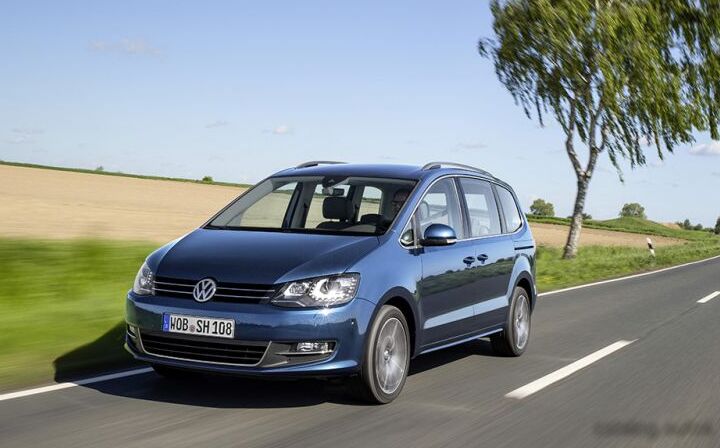
The Volkswagen Sharan II, particularly the facelifted version introduced in 2015, represented a significant evolution of Volkswagen’s minivan offering. This generation, built on the PQ46 platform (also known as the 1HX0/A3 platform), aimed to blend practicality, comfort, and a more modern driving experience. The 2.0 TSI 200 hp Automatic 7-seat variant, produced from 2015 to 2016, occupied a mid-to-upper position within the Sharan II lineup, offering a balance between performance and fuel efficiency for families and those requiring versatile passenger and cargo space. It was primarily marketed in Europe, where the minivan segment remained strong, and to a lesser extent in other markets where MPVs were popular.
Technical Specifications
| Brand | Volkswagen |
| Model | Sharan |
| Generation | Sharan II (facelift 2015) |
| Type | 2.0 TSI (200 Hp) Automatic 7 Seat |
| Start of production | 2015 |
| End of production | 2016 |
| Powertrain Architecture | Internal Combustion engine |
| Body type | Minivan, MPV |
| Seats | 7 |
| Doors | 5 |
| Fuel consumption (urban) | 9.2-9.3 l/100 km (25.6 – 25.3 US mpg) |
| Fuel consumption (extra urban) | 6.0-6.1 l/100 km (39.2 – 38.6 US mpg) |
| Fuel consumption (combined) | 7.2-7.3 l/100 km (32.7 – 32.2 US mpg) |
| CO2 emissions | 167 – 168 g/km |
| Fuel Type | Petrol (Gasoline) |
| Acceleration 0 – 100 km/h | 7.8 sec |
| Acceleration 0 – 62 mph | 7.8 sec |
| Acceleration 0 – 60 mph | 7.4 sec |
| Maximum speed | 226 km/h (140.43 mph) |
| Emission standard | Euro 6 |
| Weight-to-power ratio | 8.6 kg/Hp, 116.6 Hp/tonne |
| Weight-to-torque ratio | 4.9 kg/Nm, 204.1 Nm/tonne |
| Power | 200 Hp @ 4500-6200 rpm |
| Torque | 350 Nm @ 1500-4400 rpm (258.15 lb.-ft. @ 1500-4400 rpm) |
| Engine layout | Front, Transverse |
| Engine Model/Code | CCZA |
| Engine displacement | 1984 cm3 (121.07 cu. in.) |
| Number of cylinders | 4 |
| Engine configuration | Inline |
| Number of valves per cylinder | 4 |
| Fuel injection system | Direct injection |
| Engine aspiration | Turbocharger, Intercooler |
| Engine oil capacity | 4.7 l (4.97 US qt | 4.14 UK qt) |
| Coolant | 8 l (8.45 US qt | 7.04 UK qt) |
| Kerb Weight | 1715 kg (3780.93 lbs) |
| Max. weight | 3260 kg (7187.07 lbs) |
| Max load | 1545 kg (3406.14 lbs) |
| Trunk (boot) space – minimum | 300 l (10.59 cu. ft) |
| Trunk (boot) space – maximum | 2297 l (81.12 cu. ft) |
| Fuel tank capacity | 70 l (18.49 US gal | 15.4 UK gal) |
| Max. roof load | 100 kg (220.46 lbs) |
| Permitted trailer load with brakes (8%) | 2300 kg (5070.63 lbs) |
| Permitted trailer load with brakes (12%) | 2200 kg (4850.17 lbs) |
| Permitted trailer load without brakes | 750 kg (1653.47 lbs) |
| Permitted towbar download | 100 kg (220.46 lbs) |
| Length | 4854 mm (191.1 in) |
| Width | 1904 mm (74.96 in) |
| Width including mirrors | 2081 mm (81.93 in) |
| Height | 1720 mm (67.72 in) |
| Wheelbase | 2920 mm (114.96 in) |
| Front track | 1571 mm (61.85 in) |
| Rear track | 1617 mm (63.66 in) |
| Ride height (ground clearance) | 152 mm (5.98 in) |
| Minimum turning circle | 11.9 m (39.04 ft) |
| Drive wheel | Front wheel drive |
| Number of gears and type of gearbox | 6 gears, automatic transmission |
| Front suspension | Independent type McPherson |
| Rear suspension | Independent multi-link suspension |
| Front brakes | Ventilated discs |
| Rear brakes | Disc |
| Assisting systems | ABS (Anti-lock braking system) |
| Steering type | Steering rack and pinion |
| Power steering | Electric Steering |
| Tires size | 215/60 R16; 225/50 R17; 225/45 R18 |
| Wheel rims size | 16; 17; 18 |
Powertrain & Engine Architecture
At the heart of the Sharan II 2.0 TSI was the CCZA engine code, a 1.984-liter (121.07 cubic inches) inline-four cylinder gasoline engine. This engine was part of Volkswagen’s EA888 family, known for its robust design and tuning potential. The CCZA featured direct fuel injection (FSI) and a single turbocharger with an intercooler, allowing for a good balance of power and efficiency. The engine produced 200 horsepower at 4500-6200 rpm and 350 Nm (258.15 lb-ft) of torque between 1500-4400 rpm. The automatic transmission paired with this engine was typically a six-speed torque converter automatic, chosen for its smooth operation and suitability for family transport. This transmission was programmed for comfort and fuel economy, rather than outright performance.
Driving Characteristics
The 2.0 TSI automatic Sharan offered a comfortable and refined driving experience. While not a sports car, the 200 hp engine provided adequate power for overtaking and highway cruising, with a 0-62 mph (0-100 km/h) time of around 7.8 seconds. The automatic transmission, while smooth, wasn’t particularly quick to shift, and the gear ratios were optimized for fuel efficiency rather than acceleration. Compared to the lower-powered 1.4 TSI variants, the 2.0 TSI offered a noticeable improvement in performance, especially when fully loaded with passengers and luggage. It also felt more relaxed on long journeys. Compared to a manual transmission equipped Sharan, the automatic sacrificed some driver engagement and potentially a slight improvement in fuel economy.
Equipment & Trim Levels
The 2.0 TSI Automatic typically came with a generous level of standard equipment. This included features like climate control, an infotainment system with touchscreen display, alloy wheels, and a comprehensive suite of safety features such as ABS, ESP, and multiple airbags. Higher trim levels offered options like leather upholstery, panoramic sunroof, navigation system, and advanced driver-assistance systems like adaptive cruise control and lane-keeping assist. Interior upholstery was generally cloth on base models, with leather available as an upgrade. Dashboard configurations were relatively consistent across the range, with a focus on functionality and ease of use.
Chassis & Braking
The Sharan II utilized an independent suspension setup, with McPherson struts at the front and a multi-link system at the rear. This provided a comfortable ride quality, even on uneven surfaces. The braking system consisted of ventilated discs at the front and solid discs at the rear. ABS (Anti-lock Braking System) was standard. Stabilizer bars were fitted front and rear to reduce body roll during cornering. The suspension was tuned for comfort and stability, prioritizing a smooth ride over sporty handling.
Market Reception & Comparison
The Sharan II 2.0 TSI Automatic was generally well-received by automotive critics. It was praised for its spacious interior, comfortable ride, and practical features. The 2.0 TSI engine was considered a good compromise between performance and fuel economy. However, some critics noted that the automatic transmission could feel a bit sluggish at times. Compared to other MPVs in its class, such as the Ford S-Max and Renault Espace, the Sharan offered a more refined and premium feel. Fuel economy was competitive, but not class-leading, and reliability was generally good, although some owners reported minor issues with the electronic systems.
Legacy
The Volkswagen Sharan II, including the 2.0 TSI Automatic variant, has proven to be a relatively reliable vehicle in the long term. The EA888 engine is known for its durability, and the automatic transmission, while not without its quirks, is generally robust. In the used car market, these models hold their value reasonably well, particularly those with a full service history and low mileage. They remain a popular choice for families seeking a spacious, comfortable, and practical MPV. However, potential buyers should be aware of the possibility of needing to address issues related to the timing chain (a common concern with the EA888 engine) and the electronic parking brake.