
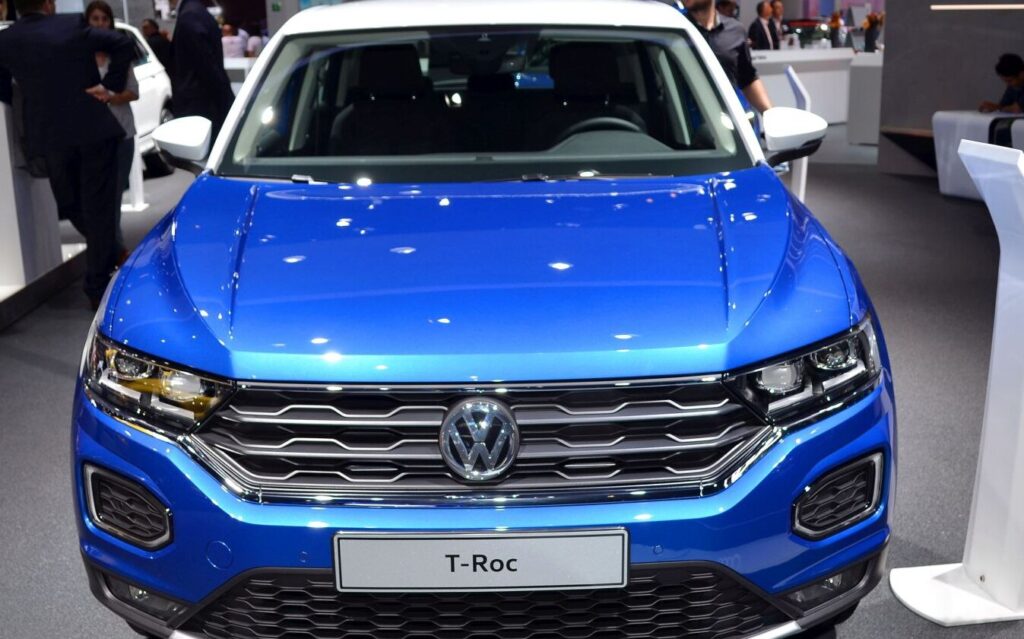
The Volkswagen T-Roc 1.0 TSI (110 hp) OPF was a front-wheel-drive subcompact SUV produced from 2020 to October 2021. Positioned as an entry-level offering within the first generation T-Roc (A110) lineup, it aimed to provide an accessible and fuel-efficient option in the increasingly popular crossover segment. The T-Roc, launched in 2018, represented Volkswagen’s attempt to capture a younger demographic with a more stylish and modern design than their traditional offerings. This particular variant, with its smaller displacement engine and moderate power output, was primarily targeted at urban drivers and those prioritizing economy over outright performance.
Technical Specifications
| Brand | Volkswagen |
| Model | T-Roc |
| Generation | T-Roc I |
| Type (Engine) | 1.0 TSI (110 Hp) OPF |
| Start of production | 2020 |
| End of production | October, 2021 |
| Powertrain Architecture | Internal Combustion engine |
| Body type | SUV |
| Seats | 5 |
| Doors | 5 |
| Fuel consumption at Low speed (WLTP) | 7.3 l/100 km (32.2 US mpg, 38.7 UK mpg, 13.7 km/l) |
| Fuel consumption at Medium speed (WLTP) | 5.6 l/100 km (42 US mpg, 50.4 UK mpg, 17.9 km/l) |
| Fuel consumption at high speed (WLTP) | 5.2 l/100 km (45.2 US mpg, 54.3 UK mpg, 19.2 km/l) |
| Fuel consumption at very high speed (WLTP) | 6.3 l/100 km (37.3 US mpg, 44.8 UK mpg, 15.9 km/l) |
| Combined fuel consumption (WLTP) | 6.0 l/100 km (39.2 US mpg, 47.1 UK mpg, 16.7 km/l) |
| CO2 emissions (WLTP) | 136 g/km |
| Fuel consumption (economy) – urban (NEDC) | 6.2 l/100 km (37.9 US mpg, 45.6 UK mpg, 16.1 km/l) |
| Fuel consumption (economy) – extra urban (NEDC) | 4.7 l/100 km (50 US mpg, 60.1 UK mpg, 21.3 km/l) |
| Fuel consumption (economy) – combined (NEDC) | 5.2 l/100 km (45.2 US mpg, 54.3 UK mpg, 19.2 km/l) |
| CO2 emissions (NEDC) | 119 g/km |
| Fuel Type | Petrol (Gasoline) |
| Acceleration 0 – 100 km/h | 10.8 sec |
| Acceleration 0 – 62 mph | 10.8 sec |
| Acceleration 0 – 60 mph | 10.3 sec |
| Maximum speed | 185 km/h (114.95 mph) |
| Emission standard | Euro 6d-ISC-FCM |
| Weight-to-power ratio | 11.1 kg/Hp, 90.2 Hp/tonne |
| Weight-to-torque ratio | 6.1 kg/Nm, 164.1 Nm/tonne |
| Power | 110 Hp @ 5500 rpm |
| Power per litre | 110.1 Hp/l |
| Torque | 200 Nm @ 2000-3500 rpm (147.51 lb.-ft. @ 2000-3500 rpm) |
| Engine layout | Front, Transverse |
| Engine Model/Code | DLAA |
| Engine displacement | 999 cm3 (60.96 cu. in.) |
| Number of cylinders | 3 |
| Engine configuration | Inline |
| Number of valves per cylinder | 4 |
| Fuel injection system | Direct injection |
| Engine aspiration | Turbocharger, Intercooler |
| Engine oil capacity | 4 l (4.23 US qt | 3.52 UK qt) |
| Kerb Weight | 1219 kg (2687.43 lbs.) |
| Max. weight | 1790 kg (3946.27 lbs.) |
| Max load | 571 kg (1258.84 lbs.) |
| Trunk (boot) space – minimum | 445 l (15.72 cu. ft.) |
| Trunk (boot) space – maximum | 1290 l (45.56 cu. ft.) |
| Fuel tank capacity | 50 l (13.21 US gal | 11 UK gal) |
| Max. roof load | 75 kg (165.35 lbs.) |
| Permitted trailer load with brakes (8%) | 1500 kg (3306.93 lbs.) |
| Permitted trailer load with brakes (12%) | 1300 kg (2866.01 lbs.) |
| Permitted trailer load without brakes | 640 kg (1410.96 lbs.) |
| Permitted towbar download | 80 kg (176.37 lbs.) |
| Length | 4234 mm (166.69 in.) |
| Width | 1819 mm (71.61 in.) |
| Width including mirrors | 1992 mm (78.43 in.) |
| Height | 1573 mm (61.93 in.) |
| Wheelbase | 2590 mm (101.97 in.) |
| Front track | 1536-1546 mm (60.47 – 60.87 in.) |
| Rear (Back) track | 1530-1540 mm (60.24 – 60.63 in.) |
| Minimum turning circle (turning diameter) | 11.1 m (36.42 ft.) |
| Drivetrain Architecture | The Internal combustion engine (ICE) drives the front wheels of the vehicle. |
| Drive wheel | Front wheel drive |
| Number of gears and type of gearbox | 6 gears, manual transmission |
| Front suspension | Independent type McPherson |
| Rear suspension | Torsion |
| Front brakes | Ventilated discs |
| Rear brakes | Disc |
| Assisting systems | ABS (Anti-lock braking system) |
| Steering type | Steering rack and pinion |
| Power steering | Electric Steering |
| Tires size | 215/60 R16 |
| Wheel rims size | 6J x 16 |
INTRODUCTION
The Volkswagen T-Roc 1.0 TSI (110 hp) OPF, produced between 2020 and 2021, represents a key variant within the first generation of Volkswagen’s popular subcompact SUV. Built on the MQB A0 platform (also known as A110), the T-Roc aimed to attract a younger audience with its contemporary styling and available technology. The 1.0 TSI engine, coupled with a six-speed manual transmission, served as the entry point to the T-Roc range, offering a balance between affordability and efficiency. The “OPF” designation indicates the inclusion of a gasoline particulate filter, a feature increasingly common in European markets to meet stricter emissions regulations.
Powertrain & Engine Architecture
At the heart of the T-Roc 1.0 TSI lies the DLAA engine code, a 999cc, three-cylinder turbocharged gasoline engine. This engine is part of Volkswagen’s EA211 family, known for its compact size and efficiency. It utilizes direct fuel injection, delivering fuel directly into the combustion chamber for improved combustion and reduced emissions. The engine features four valves per cylinder and is equipped with a single turbocharger and intercooler to boost power output. The 110 horsepower peak is achieved at 5500 rpm, while the 200 Nm (147.51 lb-ft) of torque is available between 2000 and 3500 rpm. The six-speed manual transmission provides a relatively conventional gear selection, prioritizing fuel economy over rapid acceleration. The transmission’s gear ratios are tuned for everyday driving, with a focus on maximizing efficiency at cruising speeds.
Driving Characteristics
The T-Roc 1.0 TSI (110 hp) offers a comfortable, if not particularly exhilarating, driving experience. Acceleration from 0-60 mph takes around 10.3 seconds, and the top speed is 114.95 mph. The engine feels adequate for urban driving and highway cruising, but can feel strained when attempting quick overtaking maneuvers or climbing steep hills. The manual transmission allows for a degree of driver engagement, but the relatively low power output means frequent gear changes are often necessary to maintain momentum. Compared to higher-powered T-Roc variants, such as those equipped with the 1.5 TSI or 2.0 TSI engines, this version feels noticeably slower. However, it offers a more forgiving and fuel-efficient driving experience, making it well-suited for novice drivers or those prioritizing economy.
Equipment & Trim Levels
The T-Roc 1.0 TSI typically came with a reasonable level of standard equipment. Base models included features such as air conditioning, a touchscreen infotainment system with Bluetooth connectivity, alloy wheels, and a suite of safety features including ABS, ESC (Electronic Stability Control), and multiple airbags. Interior upholstery was typically cloth, with a functional and durable design. Optional extras included features such as a larger touchscreen display, navigation system, adaptive cruise control, park assist, and a panoramic sunroof. Trim levels varied depending on the market, but generally offered progressively more features and cosmetic enhancements as you moved up the range.
Chassis & Braking
The T-Roc’s chassis utilizes an independent McPherson strut suspension at the front and a torsion beam suspension at the rear. This setup provides a good balance between ride comfort and handling. The front brakes are ventilated discs, while the rear brakes are solid discs. ABS (Anti-lock Braking System) is standard, providing enhanced braking performance in emergency situations. The steering is electric power-assisted, offering a light and responsive feel. The suspension tuning is geared towards comfort, absorbing bumps and imperfections in the road surface effectively. Stabilizer bars are fitted to both the front and rear axles to reduce body roll during cornering.
Market Reception & Comparison
The T-Roc 1.0 TSI (110 hp) was generally well-received by critics as an affordable and practical entry point into the subcompact SUV segment. Its fuel economy, averaging around 39.2 US mpg combined, was a key selling point. However, some reviewers criticized its lack of outright performance, particularly when compared to rivals offering more powerful engines. Compared to other T-Roc variants, the 1.0 TSI offered a lower price point but sacrificed performance and refinement. The 1.5 TSI, for example, provided significantly more power and a smoother driving experience, but at a higher cost. The 1.6 TDI diesel variant offered even better fuel economy, but was less popular due to concerns about diesel emissions.
Legacy
The Volkswagen T-Roc 1.0 TSI (110 hp) remains a relatively common sight on the used car market. The DLAA engine has proven to be generally reliable, although regular maintenance is essential. Potential issues to watch out for include turbocharger wear and tear, and potential problems with the gasoline particulate filter, particularly on vehicles that have primarily been used for short journeys. Overall, the T-Roc 1.0 TSI represents a sensible and economical choice for buyers seeking a practical and affordable subcompact SUV. Its blend of style, efficiency, and practicality has ensured its continued popularity in the used car market.
