
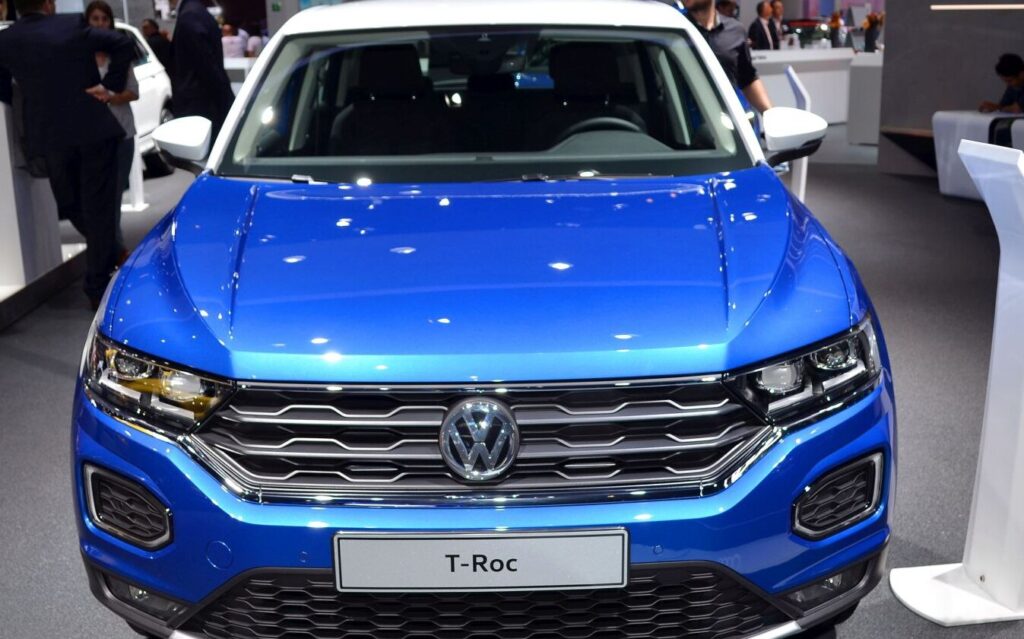
The Volkswagen T-Roc 1.5 TSI, producing 150 horsepower, was a key variant in the initial launch of the T-Roc (A110) series, beginning in 2017. Positioned as a mid-range offering, it aimed to balance performance and fuel efficiency within Volkswagen’s burgeoning compact SUV lineup. This model year (2017-2018) represented the first generation of the T-Roc, built on the MQB platform – a modular transverse matrix architecture shared with several other Volkswagen Group vehicles like the Audi A3 and SEAT Leon. The T-Roc was intended to appeal to a younger demographic seeking a stylish and practical crossover, and the 1.5 TSI engine played a significant role in achieving that goal in the European market.
Technical Specifications
| Brand | Volkswagen |
| Model | T-Roc |
| Generation | T-Roc I |
| Type (Engine) | 1.5 TSI (150 Hp) |
| Start of production | 2017 |
| End of production | 2018 |
| Powertrain Architecture | Internal Combustion engine |
| Body type | SUV |
| Seats | 5 |
| Doors | 5 |
| Fuel consumption (urban) | 6.6 l/100 km (35.6 US mpg, 42.8 UK mpg, 15.2 km/l) |
| Fuel consumption (extra urban) | 4.6 l/100 km (51.1 US mpg, 61.4 UK mpg, 21.7 km/l) |
| Fuel consumption (combined) | 5.3 l/100 km (44.4 US mpg, 53.3 UK mpg, 18.9 km/l) |
| CO2 emissions | 121 g/km |
| Fuel Type | Petrol (Gasoline) |
| Acceleration 0 – 100 km/h | 8.4 sec |
| Acceleration 0 – 62 mph | 8.4 sec |
| Acceleration 0 – 60 mph | 8 sec |
| Maximum speed | 205 km/h (127.38 mph) |
| Emission standard | Euro 6 |
| Weight-to-power ratio | 8.9 kg/Hp, 112.8 Hp/tonne |
| Weight-to-torque ratio | 5.3 kg/Nm, 188 Nm/tonne |
| Power | 150 Hp @ 5000-6000 rpm |
| Power per litre | 100.1 Hp/l |
| Torque | 250 Nm @ 1500-3500 rpm (184.39 lb.-ft. @ 1500-3500 rpm) |
| Engine layout | Front, Transverse |
| Engine Model/Code | EA211evo / DADA |
| Engine displacement | 1498 cm3 (91.41 cu. in.) |
| Number of cylinders | 4 |
| Engine configuration | Inline |
| Number of valves per cylinder | 4 |
| Fuel injection system | Direct injection |
| Engine aspiration | Turbocharger, Intercooler |
| Engine oil capacity | 4.3 l (4.54 US qt | 3.78 UK qt) |
| Kerb Weight | 1330 kg (2932.15 lbs.) |
| Max. weight | 1850 kg (4078.55 lbs.) |
| Max load | 520 kg (1146.4 lbs.) |
| Fuel tank capacity | 50 l (13.21 US gal | 11 UK gal) |
| Max. roof load | 75 kg (165.35 lbs.) |
| Permitted trailer load with brakes (8%) | 1700 kg (3747.86 lbs.) |
| Permitted trailer load with brakes (12%) | 1500 kg (3306.93 lbs.) |
| Permitted trailer load without brakes | 660 kg (1455.05 lbs.) |
| Permitted towbar download | 80 kg (176.37 lbs.) |
| Length | 4234 mm (166.69 in.) |
| Width | 1819 mm (71.61 in.) |
| Height | 1573 mm (61.93 in.) |
| Wheelbase | 2590 mm (101.97 in.) |
| Front track | 1538-1546 mm (60.55 – 60.87 in.) |
| Rear track | 1533-1541 mm (60.35 – 60.67 in.) |
| Minimum turning circle | 11.1 m (36.42 ft.) |
| Drivetrain Architecture | Front wheel drive |
| Number of gears | 6 gears, manual transmission |
| Front brakes | Ventilated discs |
| Rear brakes | Ventilated discs |
INTRODUCTION
The Volkswagen T-Roc 1.5 TSI 150 hp represented a significant step for Volkswagen in the increasingly popular compact SUV segment. Introduced in 2017, it was designed to attract a younger, more style-conscious buyer than traditional Volkswagen offerings. The T-Roc, built on the MQB platform, aimed to provide a blend of practicality, technology, and a sporty driving experience. The 1.5 TSI engine, part of Volkswagen’s EA211 engine family, was a key component in achieving this balance. This particular variant was primarily sold in Europe, where smaller, more fuel-efficient vehicles are favored, and it served as a bridge between the entry-level 1.0 TSI and the more powerful 2.0 TSI models.
Powertrain & Engine Architecture
The heart of the T-Roc 1.5 TSI is the EA211evo engine, specifically the DADA engine code. This is a turbocharged, direct-injection four-cylinder petrol engine displacing 1498cc. A key feature of this engine is its use of a Miller cycle, which improves thermal efficiency by reducing pumping losses. This is achieved through variable valve timing on the intake side, effectively shortening the intake stroke. The engine utilizes a single turbocharger with an intercooler to boost power and torque. Fuel is delivered via direct injection, operating at pressures up to 250 bar, ensuring precise fuel atomization and efficient combustion. The 150 hp version of the 1.5 TSI produces 250 Nm (184 lb-ft) of torque between 1500 and 3500 rpm. The engine is typically paired with a six-speed manual transmission, although a seven-speed dual-clutch gearbox (DSG) was also available as an option.
Driving Characteristics
The T-Roc 1.5 TSI offers a generally pleasant driving experience. While not overtly sporty, the 150 hp engine provides adequate power for everyday driving and occasional highway overtaking. Acceleration from 0-100 km/h (0-62 mph) takes around 8.4 seconds. The engine’s torque curve is relatively flat, providing good responsiveness across a wide range of engine speeds. Compared to the base 1.0 TSI engine, the 1.5 TSI offers a noticeable improvement in performance, particularly when fully loaded or tackling uphill climbs. However, it doesn’t match the outright pace of the 2.0 TSI models. The six-speed manual transmission is well-matched to the engine, offering smooth gear changes and a reasonably engaging driving experience. The front-wheel-drive configuration provides predictable handling, although it can suffer from torque steer under hard acceleration.
Equipment & Trim Levels
The T-Roc 1.5 TSI was available in several trim levels, each offering a different level of equipment. Standard features typically included air conditioning, a touchscreen infotainment system with App-Connect (Apple CarPlay and Android Auto), alloy wheels, and a suite of safety features such as ABS, ESC, and multiple airbags. Higher trim levels added features like automatic climate control, a larger touchscreen display, adaptive cruise control, park assist, and a panoramic sunroof. Interior upholstery ranged from basic cloth to more premium leather options. Optional extras included a premium sound system, navigation system, and various styling packages.
Chassis & Braking
The T-Roc’s chassis is based on the MQB platform, featuring a MacPherson strut front suspension and a multi-link rear suspension. This setup provides a good balance between ride comfort and handling. The steering is electrically assisted, offering a light and precise feel. Braking duties are handled by ventilated disc brakes on all four wheels. The T-Roc 1.5 TSI typically features a stabilizer bar on both the front and rear axles to reduce body roll during cornering. The suspension tuning is generally geared towards comfort, but it remains composed and stable even when pushed.
Market Reception & Comparison
The Volkswagen T-Roc 1.5 TSI was generally well-received by automotive critics. It was praised for its stylish design, practical interior, and enjoyable driving experience. The 1.5 TSI engine was considered a good compromise between performance and fuel efficiency. Compared to the 1.0 TSI, the 1.5 TSI offered a significant performance boost without a substantial penalty in fuel economy. However, some critics noted that the interior materials could be improved, and the ride could be a bit firm on rough roads. In terms of fuel economy, the 1.5 TSI typically achieves around 5.3 l/100 km (44.4 US mpg) in combined driving, making it a relatively efficient option in its class. Reliability reports have been generally positive, with few major issues reported with the 1.5 TSI engine.
Legacy
The Volkswagen T-Roc 1.5 TSI has proven to be a popular and reliable vehicle in the used car market. The EA211evo engine has a good reputation for durability, and the T-Roc’s overall build quality is generally high. The 1.5 TSI engine continues to be offered in other Volkswagen Group vehicles, demonstrating its ongoing relevance. As a first-generation T-Roc, these early models represent a significant milestone in Volkswagen’s SUV strategy, and the 1.5 TSI variant remains a desirable option for buyers seeking a stylish, practical, and efficient compact crossover.
