
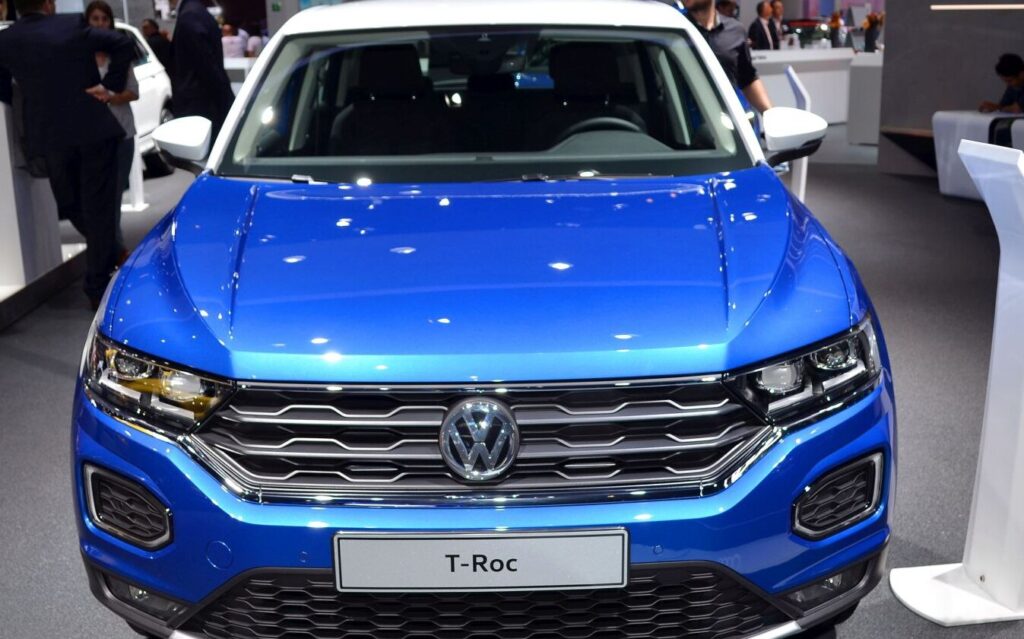
The Volkswagen T-Roc 1.5 TSI (150 hp) ACT represents a significant entry in Volkswagen’s compact SUV lineup, launched in 2018 and continuing through 2019. Positioned as a mid-range offering within the first generation (T-Roc I) of the model, it aimed to balance performance, fuel efficiency, and affordability. Built on the A05 (PQ25) platform – shared with the Audi Q2 and SEAT Arona – the T-Roc sought to appeal to buyers looking for a stylish and practical crossover with a modern powertrain. This variant was particularly important in European markets, where smaller SUVs were gaining significant traction, and offered a compelling alternative to rivals like the Nissan Juke and Peugeot 2008.
Technical Specifications
| Brand | Volkswagen |
| Model | T-Roc |
| Generation | T-Roc I |
| Type (Engine) | 1.5 TSI (150 Hp) ACT |
| Start of production | 2018 |
| End of production | 2019 |
| Powertrain Architecture | Internal Combustion engine |
| Body type | SUV |
| Seats | 5 |
| Doors | 5 |
| Fuel consumption (urban) | 6.5-6.6 l/100 km (36.2 – 35.6 US mpg) |
| Fuel consumption (extra urban) | 4.6-4.8 l/100 km (51.1 – 49 US mpg) |
| Fuel consumption (combined) | 5.3-5.4 l/100 km (44.4 – 43.6 US mpg) |
| CO2 emissions | 121-123 g/km |
| Fuel Type | Petrol (Gasoline) |
| Acceleration 0 – 100 km/h | 8.4 sec |
| Acceleration 0 – 62 mph | 8.4 sec |
| Acceleration 0 – 60 mph | 8 sec |
| Maximum speed | 205 km/h (127.38 mph) |
| Emission standard | Euro 6d-TEMP |
| Weight-to-power ratio | 8.9 kg/Hp |
| Weight-to-torque ratio | 5.3 kg/Nm |
| Power | 150 Hp |
| Torque | 250 Nm @ 1500-3500 rpm (184.39 lb.-ft. @ 1500-3500 rpm) |
| Engine layout | Front, Transverse |
| Engine Model/Code | EA211evo / DADA |
| Engine displacement | 1498 cm3 (91.41 cu. in.) |
| Number of cylinders | 4 |
| Engine configuration | Inline |
| Number of valves per cylinder | 4 |
| Fuel injection system | Direct injection |
| Engine aspiration | Turbocharger, Intercooler |
| Engine oil capacity | 4.3 l (4.54 US qt | 3.78 UK qt) |
| Kerb Weight | 1330 kg (2932.15 lbs.) |
| Max. weight | 1850 kg (4078.55 lbs.) |
| Max load | 520 kg (1146.4 lbs.) |
| Trunk (boot) space – minimum | 445 l (15.72 cu. ft.) |
| Trunk (boot) space – maximum | 1290 l (45.56 cu. ft.) |
| Fuel tank capacity | 50 l (13.21 US gal | 11 UK gal) |
| Max. roof load | 75 kg (165.35 lbs.) |
| Permitted trailer load with brakes (8%) | 1700 kg (3747.86 lbs.) |
| Permitted trailer load with brakes (12%) | 1500 kg (3306.93 lbs.) |
| Permitted trailer load without brakes | 660 kg (1455.05 lbs.) |
| Permitted towbar download | 80 kg (176.37 lbs.) |
| Length | 4234 mm (166.69 in.) |
| Width | 1819 mm (71.61 in.) |
| Width including mirrors | 1992 mm (78.43 in.) |
| Height | 1573 mm (61.93 in.) |
| Wheelbase | 2590 mm (101.97 in.) |
| Front track | 1538-1546 mm (60.55 – 60.87 in.) |
| Rear (Back) track | 1533-1541 mm (60.35 – 60.67 in.) |
| Ride height (ground clearance) | 161 mm (6.34 in.) |
| Minimum turning circle | 11.1 m (36.42 ft.) |
| Drivetrain Architecture | Front wheel drive |
| Number of gears and type of gearbox | 6 gears, manual transmission |
| Front brakes | Ventilated discs |
| Rear brakes | Ventilated discs |
| Tires size | 215/60 R16; 215/55 R17; 215/50 R18 |
| Wheel rims size | 6.5J x 16; 7J x 17; 7J x 18 |
INTRODUCTION
The Volkswagen T-Roc 1.5 TSI (150 hp) ACT, produced from 2018 to 2019, is a front-wheel-drive compact SUV that formed a crucial part of Volkswagen’s strategy to capture a larger share of the burgeoning crossover market. The “ACT” designation stands for Active Cylinder Technology, a fuel-saving feature that deactivates two cylinders under light load conditions. This variant sat in the middle of the T-Roc range, offering a step up in performance from the base 1.0 TSI engine while remaining more accessible than the higher-powered 2.0 TSI models. It was designed to appeal to buyers who prioritized a balance of efficiency, comfort, and practicality.
Powertrain & Engine Architecture
At the heart of the T-Roc 1.5 TSI ACT lies the EA211evo engine family, specifically the DADA engine code. This 1.5-liter inline-four cylinder engine utilizes direct fuel injection and a single turbocharger with an intercooler to deliver 150 horsepower. The key innovation is the Active Cylinder Technology (ACT), which shuts down cylinders two and three during cruising or low-demand situations, reducing fuel consumption. The engine employs a Miller cycle for improved thermal efficiency. The engine’s valvetrain features variable valve timing on both the intake and exhaust sides, optimizing performance across the rev range. The 150 hp version typically paired with a 6-speed manual transmission, although a 7-speed dual-clutch transmission (DSG) was also available as an option. The DSG offered quicker shifts and a more refined driving experience, but at a higher cost.
Driving Characteristics
The T-Roc 1.5 TSI with the manual transmission provides a reasonably engaging driving experience. Acceleration from 0-60 mph takes around 8 seconds, which is adequate for everyday driving and overtaking maneuvers. The engine delivers a usable 250 Nm (184 lb-ft) of torque between 1500 and 3500 rpm, providing good responsiveness in most situations. The ACT system is generally seamless in operation, with minimal noticeable disruption during cylinder deactivation. Compared to the base 1.0 TSI engine, the 1.5 TSI offers a noticeable improvement in performance, particularly when fully loaded or tackling uphill climbs. However, it doesn’t possess the outright punch of the 2.0 TSI models. The 6-speed manual gearbox is well-matched to the engine, offering precise shifts and a decent spread of ratios. The front-wheel-drive configuration provides predictable handling, although it lacks the all-weather capability of the optional 4MOTION all-wheel-drive system.
Equipment & Trim Levels
The T-Roc 1.5 TSI was available in several trim levels, each offering a different level of equipment. Standard features typically included air conditioning, a touchscreen infotainment system with Apple CarPlay and Android Auto compatibility, alloy wheels, and a suite of safety features such as automatic emergency braking and lane departure warning. Higher trim levels added features like climate control, a larger touchscreen display, adaptive cruise control, and parking sensors. Interior upholstery ranged from cloth to leatherette, and optional extras included a panoramic sunroof, heated seats, and a premium sound system. The dashboard layout was modern and driver-focused, with a clear instrument cluster and intuitive controls.
Chassis & Braking
The T-Roc’s chassis is tuned for a comfortable ride, prioritizing everyday usability over outright sportiness. The front suspension utilizes MacPherson struts, while the rear suspension employs a multi-link setup. This configuration provides a good balance of ride quality and handling. The 1.5 TSI variant typically came equipped with ventilated disc brakes on all four wheels, providing ample stopping power. Anti-lock braking system (ABS) and electronic stability control (ESC) were standard safety features. The steering is electrically assisted, offering light and precise control. Stabilizer bars are fitted to both the front and rear axles to reduce body roll during cornering.
Market Reception & Comparison
The Volkswagen T-Roc 1.5 TSI was generally well-received by automotive critics. It was praised for its stylish design, comfortable ride, and efficient engine. The ACT technology was seen as a clever innovation that helped to reduce fuel consumption without significantly compromising performance. Compared to the base 1.0 TSI model, the 1.5 TSI offered a noticeable improvement in performance and refinement. However, some critics noted that the interior materials weren’t quite as premium as those found in some of its rivals. Fuel economy figures of around 44-45 mpg (combined) were competitive for the segment. Reliability reports have been generally positive, with few major issues reported with the 1.5 TSI engine and DSG transmission.
Legacy
The Volkswagen T-Roc 1.5 TSI (150 hp) ACT has proven to be a reliable and popular choice in the used car market. The EA211evo engine is known for its durability and relatively low running costs. The ACT system has generally proven to be trouble-free. As a result, well-maintained examples of this variant continue to command reasonable prices. The T-Roc’s success helped to establish Volkswagen as a major player in the compact SUV segment, and the 1.5 TSI engine remains a popular choice in other Volkswagen models today. Its blend of practicality, efficiency, and style ensures its continued appeal to buyers seeking a versatile and modern crossover.
