
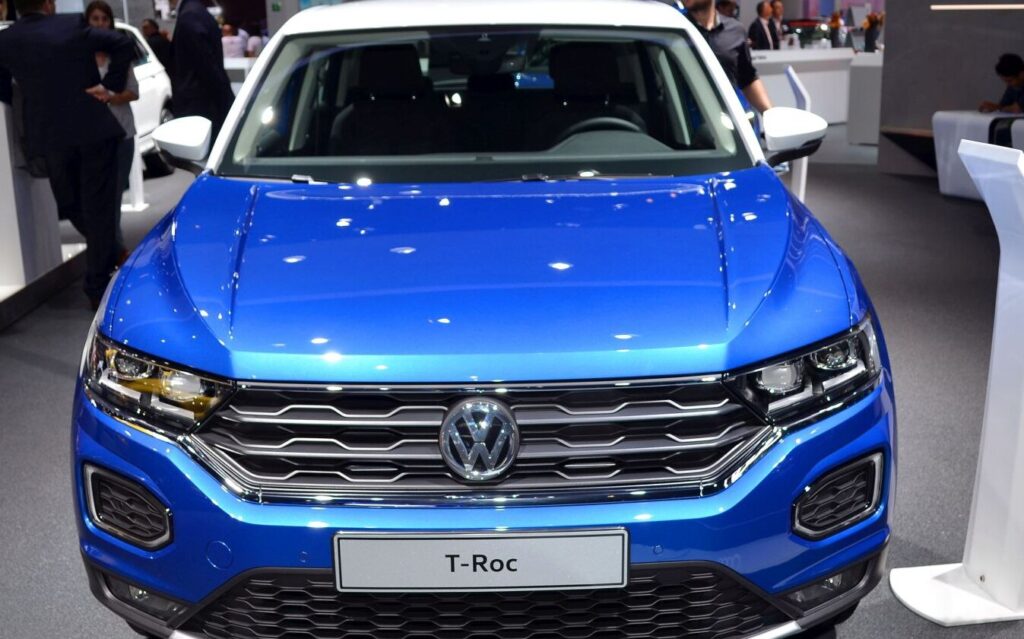
The Volkswagen T-Roc 1.5 TSI (150 hp) OPF is a front-wheel-drive subcompact SUV produced by the German manufacturer Volkswagen from 2020 to October 2021. It represents a key variant within the first generation (T-Roc I) of the T-Roc model line, positioned as a mid-range offering balancing performance, fuel efficiency, and price. The T-Roc itself was Volkswagen’s entry into the rapidly growing subcompact SUV segment, aimed at a younger demographic and offering a more stylish alternative to traditional small hatchbacks. This particular engine and transmission combination was significant in European markets, offering a compelling blend of power and economy.
Technical Specifications
| Brand | Volkswagen |
| Model | T-Roc |
| Generation | T-Roc I |
| Type (Engine) | 1.5 TSI (150 Hp) OPF |
| Start of production | 2020 |
| End of production | October, 2021 |
| Powertrain Architecture | Internal Combustion engine |
| Body type | SUV |
| Seats | 5 |
| Doors | 5 |
| Fuel consumption at Low speed (WLTP) | 8.0 l/100 km (29.4 US mpg, 35.3 UK mpg, 12.5 km/l) |
| Fuel consumption at Medium speed (WLTP) | 6.0 l/100 km (39.2 US mpg, 47.1 UK mpg, 16.7 km/l) |
| Fuel consumption at high speed (WLTP) | 5.4 l/100 km (43.6 US mpg, 52.3 UK mpg, 18.5 km/l) |
| Fuel consumption at very high speed (WLTP) | 6.6 l/100 km (35.6 US mpg, 42.8 UK mpg, 15.2 km/l) |
| Combined fuel consumption (WLTP) | 6.3 l/100 km (37.3 US mpg, 44.8 UK mpg, 15.9 km/l) |
| CO2 emissions (WLTP) | 143 g/km |
| Fuel consumption (economy) – urban (NEDC) | 6.2 l/100 km (37.9 US mpg, 45.6 UK mpg, 16.1 km/l) |
| Fuel consumption (economy) – extra urban (NEDC) | 4.7 l/100 km (50 US mpg, 60.1 UK mpg, 21.3 km/l) |
| Fuel consumption (economy) – combined (NEDC) | 5.3 l/100 km (44.4 US mpg, 53.3 UK mpg, 18.9 km/l) |
| CO2 emissions (NEDC) | 120 g/km |
| Fuel Type | Petrol (Gasoline) |
| Maximum speed | 205 km/h (127.38 mph) |
| Emission standard | Euro 6d-ISC-FCM |
| Weight-to-power ratio | 8.5 kg/Hp, 117.9 Hp/tonne |
| Weight-to-torque ratio | 5.1 kg/Nm, 196.5 Nm/tonne |
| Power | 150 Hp @ 5000 rpm |
| Power per litre | 100.1 Hp/l |
| Torque | 250 Nm @ 1500-3500 rpm (184.39 lb.-ft. @ 1500-3500 rpm) |
| Engine layout | Front, Transverse |
| Engine Model/Code | DPCA |
| Engine displacement | 1498 cm3 (91.41 cu. in.) |
| Number of cylinders | 4 |
| Engine configuration | Inline |
| Number of valves per cylinder | 4 |
| Fuel injection system | Direct injection |
| Engine aspiration | Turbocharger, Intercooler |
| Engine oil capacity | 4.3 l (4.54 US qt | 3.78 UK qt) |
| Kerb Weight | 1272 kg (2804.28 lbs.) |
| Max. weight | 1860 kg (4100.6 lbs.) |
| Max load | 588 kg (1296.32 lbs.) |
| Trunk (boot) space – minimum | 445 l (15.72 cu. ft.) |
| Trunk (boot) space – maximum | 1290 l (45.56 cu. ft.) |
| Fuel tank capacity | 50 l (13.21 US gal | 11 UK gal) |
| Max. roof load | 75 kg (165.35 lbs.) |
| Permitted trailer load with brakes (8%) | 1700 kg (3747.86 lbs.) |
| Permitted trailer load with brakes (12%) | 1500 kg (3306.93 lbs.) |
| Permitted trailer load without brakes | 670 kg (1477.1 lbs.) |
| Permitted towbar download | 80 kg (176.37 lbs.) |
| Length | 4234 mm (166.69 in.) |
| Width | 1819 mm (71.61 in.) |
| Width including mirrors | 1992 mm (78.43 in.) |
| Height | 1573 mm (61.93 in.) |
| Wheelbase | 2590 mm (101.97 in.) |
| Front track | 1538-1546 mm (60.55 – 60.87 in.) |
| Rear (Back) track | 1533-1541 mm (60.35 – 60.67 in.) |
| Minimum turning circle (turning diameter) | 11.1 m (36.42 ft.) |
| Drivetrain Architecture | The Internal combustion engine (ICE) drives the front wheels of the vehicle. |
| Drive wheel | Front wheel drive |
| Number of gears and type of gearbox | 6 gears, manual transmission |
| Front suspension | Independent type McPherson |
| Rear suspension | Torsion |
| Front brakes | Ventilated discs |
| Rear brakes | Disc |
| Assisting systems | ABS (Anti-lock braking system) |
| Steering type | Steering rack and pinion |
| Power steering | Electric Steering |
| Tires size | 205/60 R 16; 215/55 R 17 |
| Wheel rims size | 16; 17 |
INTRODUCTION
The Volkswagen T-Roc 1.5 TSI (150 hp) OPF, launched in 2020, quickly became a popular choice within the T-Roc range. Built on the MQB platform (specifically the A1 variant, also used for the Audi A3 and SEAT Leon), the T-Roc aimed to offer a more youthful and dynamic alternative to Volkswagen’s more conservative offerings. The 1.5 TSI engine, part of Volkswagen’s EA211 family, was a key component in this strategy, providing a good balance of performance and fuel economy. The “OPF” designation indicates the inclusion of a gasoline particulate filter, a feature increasingly common in European vehicles to meet stricter emissions regulations. This variant occupied a middle ground in the T-Roc lineup, offering more power than the base 1.0 TSI engine but remaining more affordable than the higher-output 2.0 TSI models.
Powertrain & Engine Architecture
The heart of the T-Roc 1.5 TSI is the DPCA engine code, a 1.5-liter inline-four cylinder gasoline engine. This engine utilizes direct fuel injection and a single turbocharger with intercooling to achieve its 150 horsepower output at 5000 rpm and 250 Nm (184 lb-ft) of torque between 1500 and 3500 rpm. A notable feature of this engine is its Miller cycle combustion process, which improves efficiency by reducing pumping losses. The engine also incorporates variable valve timing on both the intake and exhaust sides. The T-Roc 1.5 TSI was typically paired with a 6-speed manual transmission, although a 7-speed dual-clutch transmission (DSG) was also available as an option. The engine’s transverse mounting and front-wheel-drive configuration contribute to its compact footprint and efficient packaging.
Driving Characteristics
The 1.5 TSI engine in the T-Roc provides a responsive and enjoyable driving experience. While not overtly sporty, the 150 hp output is sufficient for confident acceleration and comfortable highway cruising. The peak torque available from 1500 rpm ensures good low-end grunt, making it easy to navigate urban environments. Compared to the base 1.0 TSI engine, the 1.5 TSI offers a noticeable improvement in performance, particularly when fully loaded or tackling inclines. The 6-speed manual transmission is well-matched to the engine’s characteristics, offering precise shifts and a reasonable gear spread. The front-wheel-drive configuration provides predictable handling, although it lacks the all-weather capability of the optional 4MOTION all-wheel-drive system. The steering is light and accurate, making the T-Roc easy to maneuver.
Equipment & Trim Levels
The T-Roc 1.5 TSI typically came equipped with a generous level of standard equipment. Base models included features such as air conditioning, a touchscreen infotainment system with Apple CarPlay and Android Auto compatibility, alloy wheels, and a suite of safety features including automatic emergency braking and lane departure warning. Higher trim levels added features such as adaptive cruise control, a larger touchscreen display, a digital instrument cluster, and upgraded interior upholstery. Optional extras included a panoramic sunroof, a premium sound system, and parking assist. Interior materials were generally of good quality, with a focus on durability and practicality. The dashboard layout was modern and driver-focused.
Chassis & Braking
The T-Roc utilizes a McPherson strut front suspension and a torsion beam rear suspension. This setup provides a good balance of ride comfort and handling. The front suspension incorporates a stabilizer bar to reduce body roll during cornering. Braking duties are handled by ventilated discs at the front and solid discs at the rear. Anti-lock braking system (ABS) and electronic stability control (ESC) are standard features. The T-Roc’s relatively lightweight construction contributes to its agile handling and efficient braking performance.
Market Reception & Comparison
The Volkswagen T-Roc 1.5 TSI was generally well-received by automotive critics. It was praised for its stylish design, comfortable ride, and efficient engine. Compared to the 1.0 TSI variant, the 1.5 TSI offered a significant performance upgrade without a substantial increase in fuel consumption. Against competitors such as the Nissan Juke, Renault Captur, and Peugeot 2008, the T-Roc stood out for its refined interior and sophisticated driving dynamics. Some critics noted that the rear passenger space was somewhat limited, but this was a common trade-off in the subcompact SUV segment. Fuel economy figures were competitive, with the WLTP combined cycle rating of 6.3 l/100 km (37.3 US mpg) being a strong selling point.
Legacy
The Volkswagen T-Roc 1.5 TSI (150 hp) OPF has proven to be a reliable and durable vehicle. The EA211 engine family is known for its longevity, and the 1.5 TSI variant has generally experienced few major issues. On the used car market, these models hold their value reasonably well, reflecting their popularity and reputation for quality. Regular maintenance, including oil changes and timing belt replacements, is essential to ensure long-term reliability. The T-Roc’s combination of style, practicality, and efficiency continues to make it a desirable choice for buyers seeking a subcompact SUV.
