
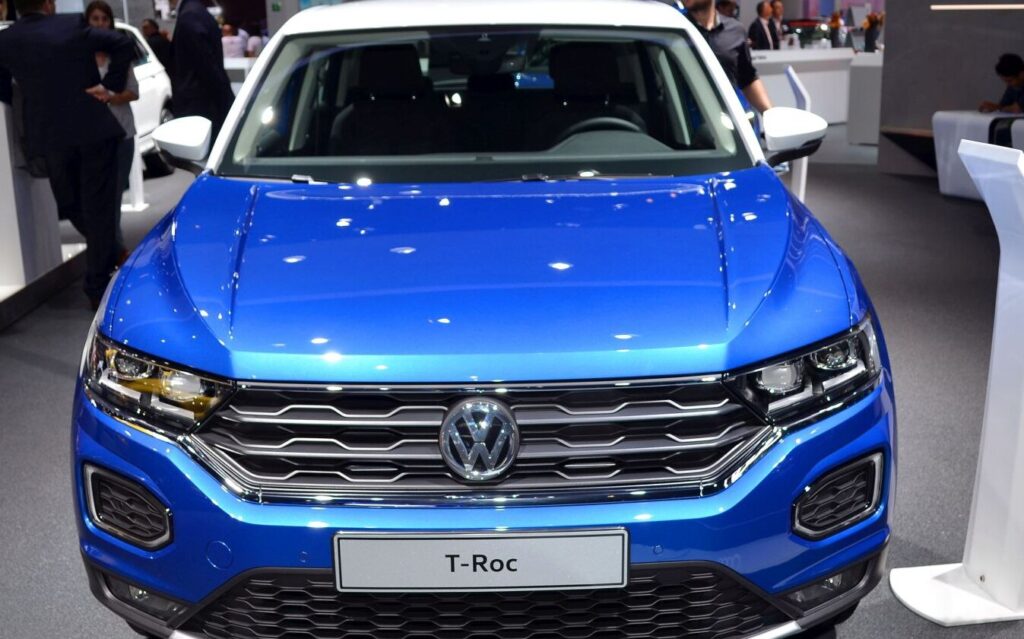
The Volkswagen T-Roc 2.0 TDI SCR, producing 150 horsepower, was a key variant in the initial lineup of the T-Roc (A110) series, launched in 2018 and continuing through 2019. Positioned as a mid-range offering, it aimed to balance fuel efficiency with respectable performance within Volkswagen’s burgeoning compact SUV segment. The T-Roc, itself a new model for Volkswagen, was designed to appeal to a younger demographic and compete with vehicles like the Nissan Juke and Renault Captur, primarily in the European market. This 2.0 TDI SCR model offered a diesel option for buyers prioritizing economy and torque, differentiating itself from the gasoline-powered variants.
Technical Specifications
| Brand | Volkswagen |
| Model | T-Roc |
| Generation | T-Roc I |
| Type (Engine) | 2.0 TDI SCR (150 Hp) |
| Start of production | 2018 |
| End of production | 2019 |
| Powertrain Architecture | Internal Combustion engine |
| Body type | SUV |
| Seats | 5 |
| Doors | 5 |
| Fuel consumption (urban) | 5.6 l/100 km (42 US mpg, 50.4 UK mpg, 17.9 km/l) |
| Fuel consumption (extra urban) | 4.1 l/100 km (57.4 US mpg, 68.9 UK mpg, 24.4 km/l) |
| Fuel consumption (combined) | 4.6-4.7 l/100 km (51.1 – 50 US mpg, 61.4 – 60.1 UK mpg, 21.7 – 21.3 km/l) |
| CO2 emissions | 122-123 g/km |
| Fuel Type | Diesel |
| Acceleration 0 – 100 km/h | 8.8 sec |
| Acceleration 0 – 62 mph | 8.8 sec |
| Acceleration 0 – 60 mph | 8.4 sec |
| Maximum speed | 205 km/h (127.38 mph) |
| Emission standard | Euro 6d-TEMP |
| Weight-to-power ratio | 9.4 kg/Hp, 106 Hp/tonne |
| Weight-to-torque ratio | 4.2 kg/Nm, 240.3 Nm/tonne |
| Power | 150 Hp |
| Power per litre | 76.2 Hp/l |
| Torque | 340 Nm @ 1750-3000 rpm (250.77 lb.-ft. @ 1750-3000 rpm) |
| Engine layout | Front, Transverse |
| Engine Model/Code | DFFA |
| Engine displacement | 1968 cm3 (120.09 cu. in.) |
| Number of cylinders | 4 |
| Engine configuration | Inline |
| Number of valves per cylinder | 4 |
| Fuel injection system | Diesel Commonrail |
| Engine aspiration | Turbocharger, Intercooler |
| Engine oil capacity | 4.7 l (4.97 US qt | 4.14 UK qt) |
| Kerb Weight | 1415 kg (3119.54 lbs.) |
| Max. weight | 1920 kg (4232.88 lbs.) |
| Max load | 505 kg (1113.33 lbs.) |
| Trunk (boot) space – minimum | 445 l (15.72 cu. ft.) |
| Trunk (boot) space – maximum | 1290 l (45.56 cu. ft.) |
| Fuel tank capacity | 50 l (13.21 US gal | 11 UK gal) |
| Max. roof load | 75 kg (165.35 lbs.) |
| Permitted trailer load with brakes (8%) | 1800 kg (3968.32 lbs.) |
| Permitted trailer load with brakes (12%) | 1600 kg (3527.4 lbs.) |
| Permitted trailer load without brakes | 700 kg (1543.24 lbs.) |
| Permitted towbar download | 80 kg (176.37 lbs.) |
| Length | 4234 mm (166.69 in.) |
| Width | 1819 mm (71.61 in.) |
| Width including mirrors | 1992 mm (78.43 in.) |
| Height | 1573 mm (61.93 in.) |
| Wheelbase | 2590 mm (101.97 in.) |
| Front track | 1538-1546 mm (60.55 – 60.87 in.) |
| Rear (Back) track | 1533-1541 mm (60.35 – 60.67 in.) |
| Ride height (ground clearance) | 161 mm (6.34 in.) |
| Minimum turning circle | 11.1 m (36.42 ft.) |
| Drivetrain Architecture | Front wheel drive |
| Number of gears and type of gearbox | 6 gears, manual transmission |
| Front brakes | Ventilated discs |
| Rear brakes | Ventilated discs |
| Assisting systems | ABS (Anti-lock braking system) |
| Steering type | Steering rack and pinion |
| Power steering | Electric Steering |
| Tires size | 215/55 R17; 215/50 R18 |
| Wheel rims size | 7J x 17; 7J x 18 |
Powertrain & Engine Architecture
The heart of this T-Roc variant is the DFFA engine, a 2.0-liter inline-four cylinder diesel engine. This engine falls under Volkswagen’s broader TDI (Turbocharged Direct Injection) family. The ‘SCR’ designation indicates the inclusion of Selective Catalytic Reduction technology, a system designed to reduce nitrogen oxide (NOx) emissions by injecting AdBlue (Diesel Exhaust Fluid) into the exhaust stream. The DFFA engine utilizes a common rail direct injection system, delivering fuel at extremely high pressures for optimized combustion. A turbocharger with an intercooler is employed to boost power output and improve efficiency. The engine produces 150 horsepower and a substantial 340 Nm (250.77 lb-ft) of torque between 1750 and 3000 rpm. This torque curve provides strong pulling power, particularly useful for everyday driving and occasional towing. The engine is transversely mounted, driving the front wheels. The 6-speed manual transmission was standard, offering a balance between fuel economy and driver engagement.
Driving Characteristics
The 2.0 TDI SCR 150 hp T-Roc delivers a composed and practical driving experience. While not overtly sporty, the engine’s torque provides brisk acceleration, achieving 0-60 mph in approximately 8.4 seconds. The manual transmission allows for a degree of driver control, although the gear ratios are tuned more for fuel efficiency than outright performance. Compared to the 1.0-liter TSI gasoline engine, the TDI offers significantly more low-end torque, making it easier to navigate city traffic and maintain speed on inclines. However, it lacks the higher-revving enthusiasm of the gasoline counterpart. Against higher-output TDI variants (like those exceeding 180 hp), this version feels less urgent, but it offers a more economical and potentially more reliable option.
Equipment & Trim Levels
The 2.0 TDI SCR 150 hp T-Roc typically came equipped with a reasonable level of standard features. These included air conditioning, a touchscreen infotainment system with Bluetooth connectivity, alloy wheels, and a suite of safety systems such as ABS, ESC (Electronic Stability Control), and multiple airbags. Higher trim levels offered options like automatic climate control, a larger touchscreen display, navigation, parking sensors, and adaptive cruise control. Interior upholstery was typically cloth, with the option of leather upgrades. The dashboard layout was modern and functional, prioritizing ease of use.
Chassis & Braking
The T-Roc’s chassis is based on the MQB platform, shared with other Volkswagen Group vehicles. The suspension consists of MacPherson struts at the front and a multi-link setup at the rear, providing a comfortable ride quality. The braking system features ventilated discs on all four wheels, offering adequate stopping power for the vehicle’s weight and performance. ABS (Anti-lock Braking System) is standard. Stabilizer bars are fitted front and rear to reduce body roll during cornering.
Market Reception & Comparison
The T-Roc 2.0 TDI SCR was generally well-received by automotive critics. It was praised for its fuel efficiency, comfortable ride, and practical interior. However, some reviewers noted that the styling was somewhat conservative and that the driving experience wasn’t particularly engaging. Compared to the gasoline-powered T-Roc variants, the TDI offered superior fuel economy and torque, making it a popular choice for drivers covering long distances. Its reliability was generally considered good, typical of Volkswagen’s diesel engines, although the SCR system did introduce a potential point of failure requiring AdBlue refills.
Legacy
The 2.0 TDI SCR 150 hp T-Roc remains a relatively common sight on the used car market. Its robust diesel engine and practical design have contributed to its longevity. While diesel engines have faced increased scrutiny in recent years due to emissions concerns, this particular variant, equipped with SCR technology, meets Euro 6d-TEMP standards. The DFFA engine, when properly maintained, is known for its durability. However, potential buyers should be aware of the maintenance requirements of the SCR system and the potential for issues with the diesel particulate filter (DPF). Overall, the T-Roc 2.0 TDI SCR represents a sensible and economical choice for buyers seeking a compact SUV with a focus on fuel efficiency and practicality.
