
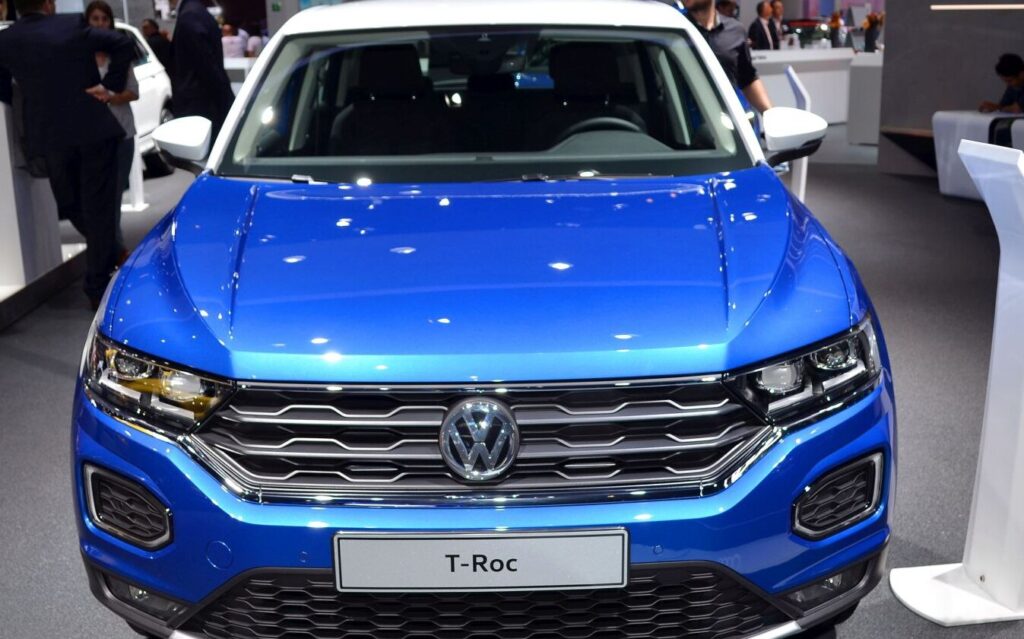
The Volkswagen T-Roc 2.0 TDI SCR with 150 horsepower and a dual-clutch gearbox (DSG) was a key variant in the first generation of the T-Roc (T-Roc I), produced from 2018 to 2019. Positioned as a mid-range offering, it aimed to balance fuel efficiency with respectable performance in the highly competitive European compact SUV segment. The T-Roc, launched in late 2017, represented Volkswagen’s entry into the burgeoning market for smaller, more stylish SUVs, designed to appeal to a younger demographic. This 2.0 TDI SCR variant was particularly significant in European markets where diesel engines remained popular due to their fuel economy and lower running costs.
Technical Specifications
| Brand | Volkswagen |
| Model | T-Roc |
| Generation | T-Roc I |
| Type (Engine) | 2.0 TDI SCR (150 Hp) DSG |
| Start of production | 2018 |
| End of production | 2019 |
| Powertrain Architecture | Internal Combustion engine |
| Body type | SUV |
| Seats | 5 |
| Doors | 5 |
| Fuel consumption (urban) | 5.3-5.4 l/100 km (44.4 – 43.6 US mpg) |
| Fuel consumption (extra urban) | 4.2-4.3 l/100 km (56 – 54.7 US mpg) |
| Fuel consumption (combined) | 4.6-4.7 l/100 km (51.1 – 50 US mpg) |
| CO2 emissions | 121-123 g/km |
| Fuel Type | Diesel |
| Acceleration 0 – 100 km/h | 8.8 sec |
| Acceleration 0 – 62 mph | 8.8 sec |
| Acceleration 0 – 60 mph | 8.4 sec |
| Maximum speed | 205 km/h (127.38 mph) |
| Emission standard | Euro 6d-TEMP |
| Weight-to-power ratio | 9.6 kg/Hp |
| Weight-to-torque ratio | 4.2 kg/Nm |
| Power | 150 Hp |
| Torque | 340 Nm @ 1750-3000 rpm (250.77 lb.-ft. @ 1750-3000 rpm) |
| Engine layout | Front, Transverse |
| Engine Model/Code | DFFA |
| Engine displacement | 1968 cm3 (120.09 cu. in.) |
| Number of cylinders | 4 |
| Engine configuration | Inline |
| Number of valves per cylinder | 4 |
| Fuel injection system | Diesel Commonrail |
| Engine aspiration | Turbocharger, Intercooler |
| Engine oil capacity | 4.7 l (4.97 US qt | 4.14 UK qt) |
| Kerb Weight | 1440 kg (3174.66 lbs.) |
| Max. weight | 1950 kg (4299.01 lbs.) |
| Max load | 510 kg (1124.36 lbs.) |
| Trunk (boot) space – minimum | 445 l (15.72 cu. ft.) |
| Trunk (boot) space – maximum | 1290 l (45.56 cu. ft.) |
| Fuel tank capacity | 50 l (13.21 US gal | 11 UK gal) |
| Max. roof load | 75 kg (165.35 lbs.) |
| Permitted trailer load with brakes (8%) | 1800 kg (3968.32 lbs.) |
| Permitted trailer load with brakes (12%) | 1600 kg (3527.4 lbs.) |
| Permitted trailer load without brakes | 720 kg (1587.33 lbs.) |
| Permitted towbar download | 80 kg (176.37 lbs.) |
| Length | 4234 mm (166.69 in.) |
| Width | 1819 mm (71.61 in.) |
| Width including mirrors | 1992 mm (78.43 in.) |
| Height | 1573 mm (61.93 in.) |
| Wheelbase | 2590 mm (101.97 in.) |
| Front track | 1538-1546 mm (60.55 – 60.87 in.) |
| Rear (Back) track | 1533-1541 mm (60.35 – 60.67 in.) |
| Ride height (ground clearance) | 161 mm (6.34 in.) |
| Minimum turning circle | 11.1 m (36.42 ft.) |
| Drivetrain Architecture | Front wheel drive |
| Number of gears and type of gearbox | 7 gears, automatic transmission DSG |
| Front brakes | Ventilated discs |
| Rear brakes | Ventilated discs |
INTRODUCTION
The Volkswagen T-Roc 2.0 TDI SCR 150 DSG, launched in 2018, was a significant addition to Volkswagen’s compact SUV lineup. Built on the MQB platform (specifically the A1 variant, also used for the Audi A3 and VW Golf), the T-Roc aimed to attract a younger audience with its modern styling and available customization options. The 2.0 TDI SCR variant, equipped with a seven-speed dual-clutch transmission (DSG), offered a balance between fuel efficiency, performance, and driving comfort. It sat in the middle of the T-Roc range, offering more power and refinement than the entry-level 1.0 TSI petrol engine, but at a lower price point than the more powerful and feature-rich trims.
Powertrain & Engine Architecture
At the heart of the T-Roc 2.0 TDI SCR 150 DSG lies the DFFA engine code, a 1968cc inline-four cylinder diesel engine. This engine utilizes a common rail direct injection system, delivering fuel at extremely high pressure for optimized combustion. A turbocharger with an intercooler further enhances performance by forcing more air into the cylinders. The “SCR” designation indicates the presence of a Selective Catalytic Reduction system, designed to reduce nitrogen oxide (NOx) emissions by injecting AdBlue (Diesel Exhaust Fluid) into the exhaust stream. The engine produces 150 horsepower and 340 Nm (250.77 lb-ft) of torque between 1750 and 3000 rpm. The seven-speed DSG transmission provides quick and smooth gear changes, contributing to both performance and fuel efficiency. This particular DSG unit is known for its responsiveness and ability to adapt to driving conditions.
Driving Characteristics
The T-Roc 2.0 TDI SCR 150 DSG offered a comfortable and refined driving experience. While not overtly sporty, the engine provided ample power for everyday driving and overtaking maneuvers. The DSG transmission contributed to brisk acceleration, with a 0-62 mph (0-100 km/h) time of 8.8 seconds. The gear ratios were well-chosen to maximize fuel efficiency while still providing responsive performance. Compared to the lower-powered 1.0 TSI petrol version, the 2.0 TDI offered significantly more torque, making it more effortless on inclines and when fully loaded. Compared to the higher-output 2.0 TDI variants, this 150 hp version prioritized fuel economy over outright performance, making it a more sensible choice for drivers covering long distances.
Equipment & Trim Levels
The T-Roc 2.0 TDI SCR 150 DSG typically came equipped with a respectable level of standard features. These included air conditioning, a touchscreen infotainment system with Bluetooth connectivity, alloy wheels, and a suite of safety features such as ABS, ESC (Electronic Stability Control), and multiple airbags. Higher trim levels offered additional features such as automatic climate control, a larger touchscreen display, navigation system, parking sensors, and adaptive cruise control. Interior upholstery was typically cloth, with options for leather upgrades. Customization options were a key selling point of the T-Roc, allowing buyers to personalize the exterior and interior with a wide range of colors and trims.
Chassis & Braking
The T-Roc’s chassis was tuned to provide a comfortable ride without sacrificing handling. The front suspension utilized MacPherson struts, while the rear suspension employed a multi-link setup. This configuration provided a good balance between ride comfort and stability. Braking duties were handled by ventilated discs on all four wheels, providing ample stopping power. The electronic stability control system helped to maintain control in challenging driving conditions. The weight distribution was reasonably balanced, contributing to predictable handling characteristics.
Market Reception & Comparison
The T-Roc 2.0 TDI SCR 150 DSG was generally well-received by automotive critics. It was praised for its fuel efficiency, comfortable ride, and refined powertrain. However, some critics noted that the interior materials were not as premium as those found in some competitors. Compared to rivals such as the Nissan Qashqai and Peugeot 3008, the T-Roc offered a more engaging driving experience and a more modern interior design. In terms of fuel economy, the 2.0 TDI SCR variant consistently outperformed the petrol-powered versions, making it a popular choice for drivers prioritizing running costs. Reliability reports generally indicated good reliability, although DSG transmissions can require more frequent servicing than traditional automatic gearboxes.
Legacy
The Volkswagen T-Roc 2.0 TDI SCR 150 DSG remains a popular choice in the used car market. Its combination of fuel efficiency, practicality, and reliability has ensured its continued appeal. The DFFA engine, while subject to the scrutiny of diesel emissions regulations, has proven to be a durable and long-lasting unit when properly maintained. DSG transmissions, while potentially requiring more attention to servicing, offer a smooth and efficient driving experience. The T-Roc’s success helped to establish Volkswagen as a major player in the compact SUV segment, and the 2.0 TDI SCR 150 DSG variant played a key role in that achievement.
