
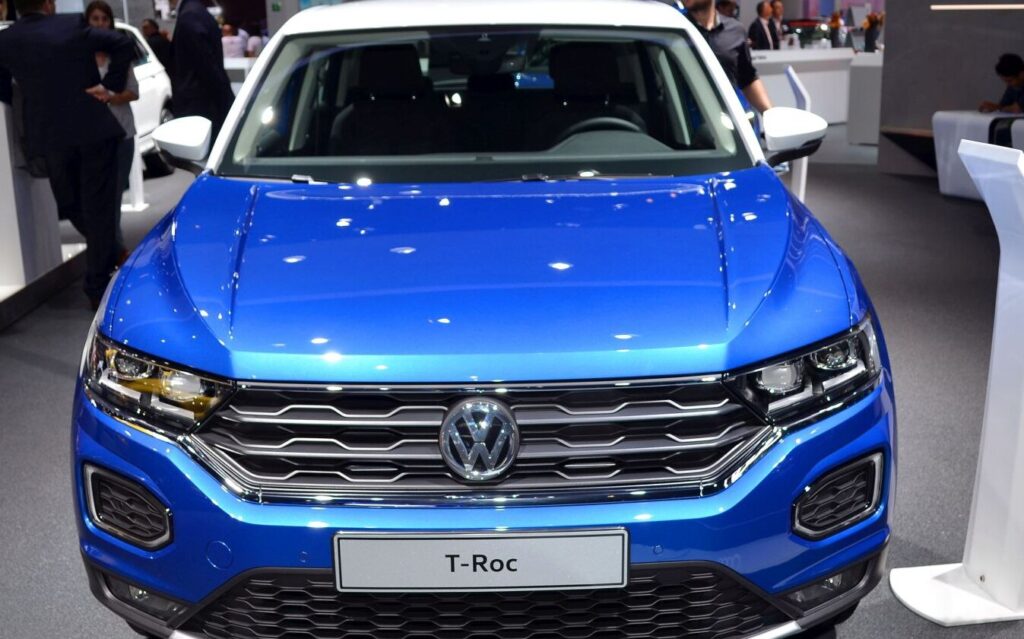
The Volkswagen T-Roc 2.0 TSI 4MOTION DSG, produced from 2017 to 2018, represents a performance-oriented variant within the first generation (T-Roc I) of Volkswagen’s compact SUV. Positioned as a mid-to-upper trim level, it offered a significant step up in power and all-wheel-drive capability compared to the base models. This version aimed to appeal to drivers seeking a sporty and versatile vehicle capable of handling diverse driving conditions. It was primarily marketed in Europe, where the compact SUV segment was rapidly gaining popularity, offering a blend of practicality, style, and performance.
Technical Specifications
| Brand | Volkswagen |
| Model | T-Roc |
| Generation | T-Roc I |
| Type (Engine) | 2.0 TSI (190 Hp) 4MOTION DSG |
| Start of production | 2017 |
| End of production | 2018 |
| Powertrain Architecture | Internal Combustion engine |
| Body type | SUV |
| Seats | 5 |
| Doors | 5 |
| Fuel consumption (urban) | 8.4-8.5 l/100 km (28 – 27.7 US mpg, 33.6 – 33.2 UK mpg, 11.9 – 11.8 km/l) |
| Fuel consumption (extra urban) | 5.7-5.8 l/100 km (41.3 – 40.6 US mpg, 49.6 – 48.7 UK mpg, 17.5 – 17.2 km/l) |
| Fuel consumption (combined) | 6.7-6.8 l/100 km (35.1 – 34.6 US mpg, 42.2 – 41.5 UK mpg, 14.9 – 14.7 km/l) |
| CO2 emissions | 152-155 g/km |
| Fuel Type | Petrol (Gasoline) |
| Acceleration 0 – 100 km/h | 7.2 sec |
| Acceleration 0 – 62 mph | 7.2 sec |
| Acceleration 0 – 60 mph | 6.8 sec |
| Maximum speed | 216 km/h (134.22 mph) |
| Emission standard | Euro 6 |
| Weight-to-power ratio | 7.5 kg/Hp, 133.8 Hp/tonne |
| Weight-to-torque ratio | 4.4 kg/Nm, 225.4 Nm/tonne |
| Power | 190 Hp @ 4200-6000 rpm |
| Torque | 320 Nm @ 1500-4180 rpm (236.02 lb.-ft. @ 1500-4180 rpm) |
| Engine layout | Front, Transverse |
| Engine Model/Code | EA888 / CZPB |
| Engine displacement | 1984 cm3 (121.07 cu. in.) |
| Number of cylinders | 4 |
| Engine configuration | Inline |
| Cylinder Bore | 82.5 mm (3.25 in.) |
| Piston Stroke | 92.8 mm (3.65 in.) |
| Compression ratio | 11.65:1 |
| Number of valves per cylinder | 4 |
| Fuel injection system | Direct injection and Multi-port manifold injection |
| Engine aspiration | Turbocharger, Intercooler |
| Valvetrain | DOHC |
| Engine oil capacity | 5.7 l (6.02 US qt | 5.02 UK qt) |
| Kerb Weight | 1420 kg (3130.56 lbs.) |
| Max. weight | 1990 kg (4387.2 lbs.) |
| Max load | 570 kg (1256.63 lbs.) |
| Trunk (boot) space – minimum | 445 l (15.72 cu. ft.) |
| Trunk (boot) space – maximum | 1290 l (45.56 cu. ft.) |
| Fuel tank capacity | 55 l (14.53 US gal | 12.1 UK gal) |
| Max. roof load | 75 kg (165.35 lbs.) |
| Permitted trailer load with brakes (8%) | 1900 kg (4188.78 lbs.) |
| Permitted trailer load with brakes (12%) | 1700 kg (3747.86 lbs.) |
| Permitted trailer load without brakes | 740 kg (1631.42 lbs.) |
| Permitted towbar download | 80 kg (176.37 lbs.) |
| Length | 4234 mm (166.69 in.) |
| Width | 1819 mm (71.61 in.) |
| Width including mirrors | 1992 mm (78.43 in.) |
| Height | 1573 mm (61.93 in.) |
| Wheelbase | 2590 mm (101.97 in.) |
| Front track | 1538-1546 mm (60.55 – 60.87 in.) |
| Rear (Back) track | 1533-1541 mm (60.35 – 60.67 in.) |
| Minimum turning circle | 11.1 m (36.42 ft.) |
| Drivetrain Architecture | All wheel drive (4×4). ICE drives front wheels, rear driven via clutch. |
| Number of gears and type of gearbox | 7 gears, automatic transmission DSG |
| Front suspension | Independent, McPherson with coil spring and anti-roll bar |
| Rear suspension | Independent multi-link spring suspension with stabilizer |
| Front brakes | Ventilated discs |
| Rear brakes | Disc |
| Assisting systems | ABS (Anti-lock braking system) |
| Steering type | Steering rack and pinion |
| Power steering | Electric Steering |
| Tires size | 215/55 R17; 215/50 R18; 225/40 R19 |
| Wheel rims size | 7J x 17; 7J x 18; 8J x 19 |
INTRODUCTION
The Volkswagen T-Roc 2.0 TSI 4MOTION DSG, launched in 2017, was a key component of Volkswagen’s strategy to capture a larger share of the burgeoning compact SUV market. Built on the MQB platform (specifically the A1 variant, also used for the Audi A3 and Volkswagen Golf), the T-Roc aimed to offer a more youthful and dynamic alternative to more conservative SUVs. The 2.0 TSI 4MOTION DSG variant represented the performance peak of the initial lineup, combining a potent turbocharged engine with the security of all-wheel drive and the convenience of a dual-clutch transmission. Production of this specific configuration continued through 2018 before being revised with minor updates in subsequent model years.
Powertrain & Engine Architecture
At the heart of the T-Roc 2.0 TSI 4MOTION DSG lies the EA888 engine, specifically the CZPB code variant. This is a 1.984-liter (121.07 cubic inches) inline-four cylinder engine featuring direct fuel injection and a turbocharger with an intercooler. The engine produces 190 horsepower at 4200-6000 rpm and 320 Nm (236.02 lb.-ft.) of torque between 1500-4180 rpm. The EA888 engine family is known for its robust construction and tunability. The direct injection system ensures precise fuel delivery, maximizing efficiency and power output. The DOHC (Double Overhead Camshaft) valvetrain, with four valves per cylinder, further enhances breathing and performance. The engine is paired with a seven-speed dual-clutch transmission (DSG), known for its rapid and smooth gear changes. The 4MOTION all-wheel-drive system utilizes a Haldex clutch to distribute power between the front and rear axles as needed, providing enhanced traction and stability.
Driving Characteristics
The 2.0 TSI 4MOTION DSG variant of the T-Roc delivers a noticeably more engaging driving experience than the lower-powered versions. The 190 hp engine provides brisk acceleration, achieving 0-62 mph (0-100 km/h) in 7.2 seconds. The DSG transmission contributes to this performance with its quick shifts and intelligent gear selection. The 4MOTION system provides excellent grip in various conditions, inspiring confidence on both dry and wet roads. While not a dedicated sports SUV, the T-Roc 2.0 TSI offers a well-balanced ride, combining comfort with a degree of agility. The gear ratios are tuned for a blend of acceleration and fuel efficiency, with the DSG effectively managing power delivery across the rev range. Compared to the manual transmission options, the DSG offers greater convenience, particularly in urban driving, but some enthusiasts may prefer the more direct feel of a manual gearbox.
Equipment & Trim Levels
The 2.0 TSI 4MOTION DSG trim typically included a generous level of standard equipment. This often included features such as automatic climate control, a touchscreen infotainment system with smartphone integration (Apple CarPlay and Android Auto), and a suite of safety systems including ABS, electronic stability control, and multiple airbags. Interior upholstery was typically a combination of cloth and leatherette, with options for full leather available. Optional extras could include a panoramic sunroof, adaptive cruise control, park assist, and upgraded sound systems. The dashboard layout was modern and driver-focused, with a clear instrument cluster and intuitive controls.
Chassis & Braking
The T-Roc’s chassis is designed to provide a comfortable yet controlled ride. The front suspension utilizes a McPherson strut setup with a coil spring and anti-roll bar, while the rear features an independent multi-link suspension with a stabilizer bar. This configuration helps to minimize body roll and provide precise handling. The braking system consists of ventilated discs on the front wheels and solid discs on the rear. ABS (Anti-lock Braking System) is standard, ensuring effective braking performance in emergency situations. The suspension tuning is slightly firmer in the 2.0 TSI variant compared to the base models, reflecting its performance-oriented nature.
Market Reception & Comparison
The Volkswagen T-Roc 2.0 TSI 4MOTION DSG was generally well-received by automotive critics. It was praised for its powerful engine, capable all-wheel-drive system, and refined driving experience. However, some reviewers noted that the price was relatively high compared to other compact SUVs in the segment. Compared to the lower-powered 1.0 TSI variants, the 2.0 TSI offered a significant performance upgrade, but at the cost of slightly reduced fuel economy. The 2.0 TDI diesel variant provided comparable torque but a different power delivery characteristic, appealing to drivers prioritizing fuel efficiency over outright performance. The 4MOTION system added a premium over the front-wheel-drive models, but provided enhanced traction and stability, particularly in inclement weather.
Legacy
The Volkswagen T-Roc 2.0 TSI 4MOTION DSG has proven to be a relatively reliable vehicle, with the EA888 engine being a well-established and durable unit. Common maintenance items include regular oil changes, spark plug replacements, and DSG transmission servicing. The 4MOTION system generally requires minimal maintenance. On the used car market, these models hold their value reasonably well, reflecting their performance and all-wheel-drive capability. While not without its potential issues (like any vehicle), the T-Roc 2.0 TSI 4MOTION DSG remains a popular choice for buyers seeking a stylish, practical, and engaging compact SUV.
