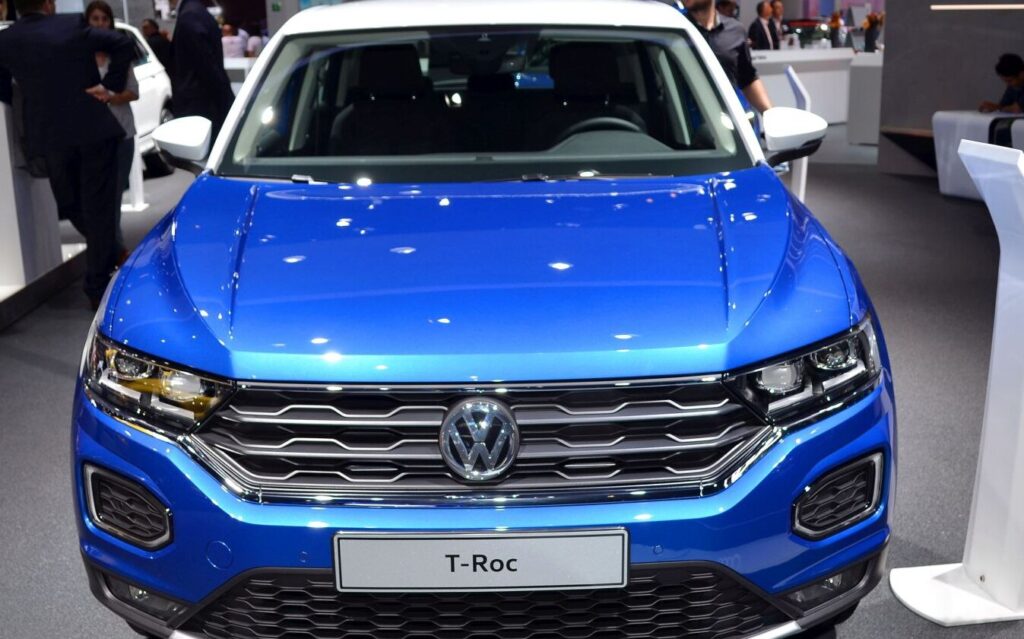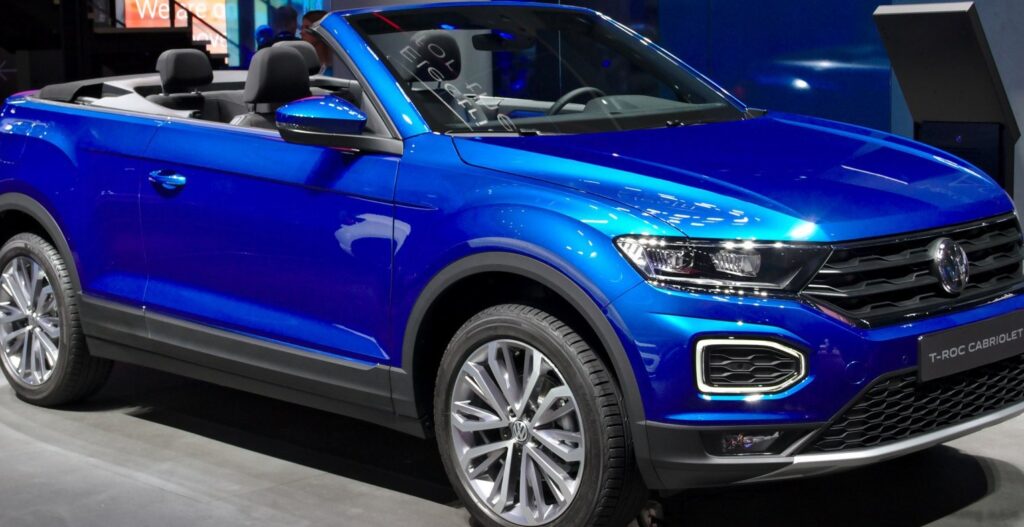
The Volkswagen T-Roc Cabriolet 1.0 TSI (115 hp) with OPF (Otto Particulate Filter) was a compact, front-wheel-drive convertible SUV produced from 2019 to October 2021. Positioned as an entry-level offering within the T-Roc Cabriolet range, it aimed to provide an affordable and stylish open-top motoring experience. This variant was primarily marketed in Europe, capitalizing on the popularity of small convertibles and the growing demand for SUV-inspired designs. It represented Volkswagen’s attempt to capture a niche market segment, offering a unique combination of practicality and open-air freedom. The T-Roc Cabriolet itself is based on the Volkswagen Group’s A05 (Polo) platform, though extensively modified to accommodate the convertible top mechanism.
Technical Specifications
| Brand | Volkswagen |
| Model | T-Roc |
| Generation | T-Roc I Cabriolet |
| Type (Engine) | 1.0 TSI (115 Hp) OPF |
| Start of production | 2019 |
| End of production | October, 2021 |
| Powertrain Architecture | Internal Combustion engine |
| Body type | Cabriolet, SUV |
| Seats | 4 |
| Doors | 2 |
| Fuel consumption at Low speed (WLTP) | 7.6 l/100 km (30.9 US mpg, 37.2 UK mpg, 13.2 km/l) |
| Fuel consumption at Medium speed (WLTP) | 6.0 l/100 km (39.2 US mpg, 47.1 UK mpg, 16.7 km/l) |
| Fuel consumption at high speed (WLTP) | 5.4 l/100 km (43.6 US mpg, 52.3 UK mpg, 18.5 km/l) |
| Fuel consumption at very high speed (WLTP) | 6.6 l/100 km (35.6 US mpg, 42.8 UK mpg, 15.2 km/l) |
| Combined fuel consumption (WLTP) | 6.3 l/100 km (37.3 US mpg, 44.8 UK mpg, 15.9 km/l) |
| CO2 emissions (WLTP) | 142 g/km |
| Fuel consumption (economy) – urban (NEDC) | 6.3 l/100 km (37.3 US mpg, 44.8 UK mpg, 15.9 km/l) |
| Fuel consumption (economy) – extra urban (NEDC) | 4.8 l/100 km (49 US mpg, 58.9 UK mpg, 20.8 km/l) |
| Fuel consumption (economy) – combined (NEDC) | 5.4 l/100 km (43.6 US mpg, 52.3 UK mpg, 18.5 km/l) |
| CO2 emissions (NEDC) | 123 g/km |
| Fuel Type | Petrol (Gasoline) |
| Maximum speed | 187 km/h (116.2 mph) |
| Emission standard | Euro 6d-TEMP-EVAP-ISC |
| Weight-to-power ratio | 12.3 kg/Hp, 81.4 Hp/tonne |
| Weight-to-torque ratio | 7.1 kg/Nm, 141.6 Nm/tonne |
| Power | 115 Hp @ 5000-5500 rpm |
| Power per litre | 115.1 Hp/l |
| Torque | 200 Nm @ 2000-3500 rpm (147.51 lb.-ft. @ 2000-3500 rpm) |
| Engine layout | Front, Transverse |
| Engine Model/Code | DKRA, DKRF |
| Engine displacement | 999 cm3 (60.96 cu. in.) |
| Engine configuration | Inline |
| Number of valves per cylinder | 4 |
| Fuel injection system | Direct injection |
| Engine aspiration | Turbocharger, Intercooler |
| Engine oil capacity | 4 l (4.23 US qt | 3.52 UK qt) |
| Kerb Weight | 1412 kg (3112.93 lbs.) |
| Max. weight | 1850 kg (4078.55 lbs.) |
| Max load | 438 kg (965.62 lbs.) |
| Trunk (boot) space – minimum | 284 l (10.03 cu. ft.) |
| Fuel tank capacity | 50 l (13.21 US gal | 11 UK gal) |
| Permitted trailer load with brakes (8%) | 1500 kg (3306.93 lbs.) |
| Permitted trailer load with brakes (12%) | 1300 kg (2866.01 lbs.) |
| Permitted trailer load without brakes | 740 kg (1631.42 lbs.) |
| Permitted towbar download | 80 kg (176.37 lbs.) |
| Length | 4268 mm (168.03 in.) |
| Width | 1811 mm (71.3 in.) |
| Width including mirrors | 1998 mm (78.66 in.) |
| Height | 1522 mm (59.92 in.) |
| Wheelbase | 2630 mm (103.54 in.) |
| Front track | 1538-1546 mm (60.55 – 60.87 in.) |
| Rear (Back) track | 1539-1547 mm (60.59 – 60.91 in.) |
| Minimum turning circle (turning diameter) | 11 m (36.09 ft.) |
| Drivetrain Architecture | The Internal combustion engine (ICE) drives the front wheels of the vehicle. |
| Drive wheel | Front wheel drive |
| Number of gears and type of gearbox | 6 gears, manual transmission |
| Front suspension | Independent type McPherson |
| Rear suspension | Independent multi-link suspension |
| Front brakes | Ventilated discs |
| Rear brakes | Disc |
| Assisting systems | ABS (Anti-lock braking system) |
| Steering type | Steering rack and pinion |
| Power steering | Electric Steering |
| Tires size | 215/55 R17 |
| Wheel rims size | 7J x 17 |
Powertrain & Engine Architecture
The T-Roc Cabriolet 1.0 TSI utilizes the Volkswagen Group’s EA211 family of engines, specifically the 1.0-liter turbocharged three-cylinder engine. Engine codes DKRA and DKRF were commonly used for this configuration. This engine features direct fuel injection and a single-scroll turbocharger with an intercooler, contributing to its relatively efficient power output. The engine’s aluminum block helps to reduce weight. The 6-speed manual transmission was standard, designed to optimize fuel economy and provide adequate performance for everyday driving. The engine’s valvetrain employs four valves per cylinder, enhancing breathing and contributing to its power delivery. The OPF (Otto Particulate Filter) was included to meet stringent Euro 6d-TEMP emission standards, reducing particulate matter emissions.
Driving Characteristics
The 115 hp 1.0 TSI engine in the T-Roc Cabriolet provided adequate, though not exhilarating, performance. Acceleration from 0 to 62 mph (0-100 km/h) took around 10.4 seconds. The engine’s 200 Nm (147.51 lb-ft) of torque, available from 2000-3500 rpm, provided sufficient pull for everyday overtaking and highway cruising. Compared to higher-output T-Roc variants, such as those with the 1.5 TSI or 2.0 TSI engines, this version felt noticeably less powerful. The manual transmission offered precise shifts, but the gear ratios were tuned for fuel efficiency rather than outright performance. The Cabriolet’s added weight compared to the standard T-Roc hatchback also impacted its responsiveness. The driving experience was generally comfortable, with the suspension tuned to prioritize ride quality over sporty handling.
Equipment & Trim Levels
The 1.0 TSI Cabriolet typically came with a reasonable level of standard equipment. This included air conditioning, a touchscreen infotainment system with App-Connect (Apple CarPlay and Android Auto), alloy wheels, and a leather-wrapped multi-function steering wheel. Safety features such as ABS, ESC (Electronic Stability Control), and multiple airbags were standard. Optional extras included features like adaptive cruise control, park assist, and upgraded upholstery. Trim levels varied by market, but generally offered packages that added features like larger alloy wheels, upgraded interior trim, and advanced driver-assistance systems. The interior design was functional and modern, reflecting the T-Roc’s overall aesthetic.
Chassis & Braking
The T-Roc Cabriolet’s chassis was reinforced to compensate for the lack of a fixed roof, adding weight but maintaining structural rigidity. The front suspension utilized an independent McPherson strut setup, while the rear employed an independent multi-link suspension. This configuration provided a good balance of ride comfort and handling. The braking system consisted of ventilated discs at the front and solid discs at the rear. ABS (Anti-lock Braking System) was standard. The steering was an electric power-assisted rack and pinion system, offering light and precise control. The standard tire size was 215/55 R17.
Market Reception & Comparison
The T-Roc Cabriolet 1.0 TSI was generally well-received by critics as an affordable and stylish entry point into the convertible SUV segment. However, some reviewers noted that the 1.0-liter engine felt underpowered, particularly when the car was fully loaded. Fuel economy was a strong point, with the WLTP combined cycle rating of 6.3 l/100 km (37.3 US mpg) being competitive for its class. Compared to other trims in the T-Roc Cabriolet lineup, the 1.0 TSI offered the lowest price but also the least performance. It appealed to buyers who prioritized style and fuel efficiency over outright speed.
Legacy
The 1.0 TSI engine, while not known for exceptional longevity, has proven to be generally reliable when properly maintained. Common issues include occasional turbocharger problems and potential issues with the OPF system, particularly on vehicles that primarily undertake short journeys. In the used car market, the T-Roc Cabriolet 1.0 TSI represents a relatively affordable option for those seeking a stylish and practical convertible. Its compact size and fuel efficiency make it well-suited for urban driving. However, potential buyers should be aware of the engine’s limitations and ensure that the vehicle has been regularly serviced.