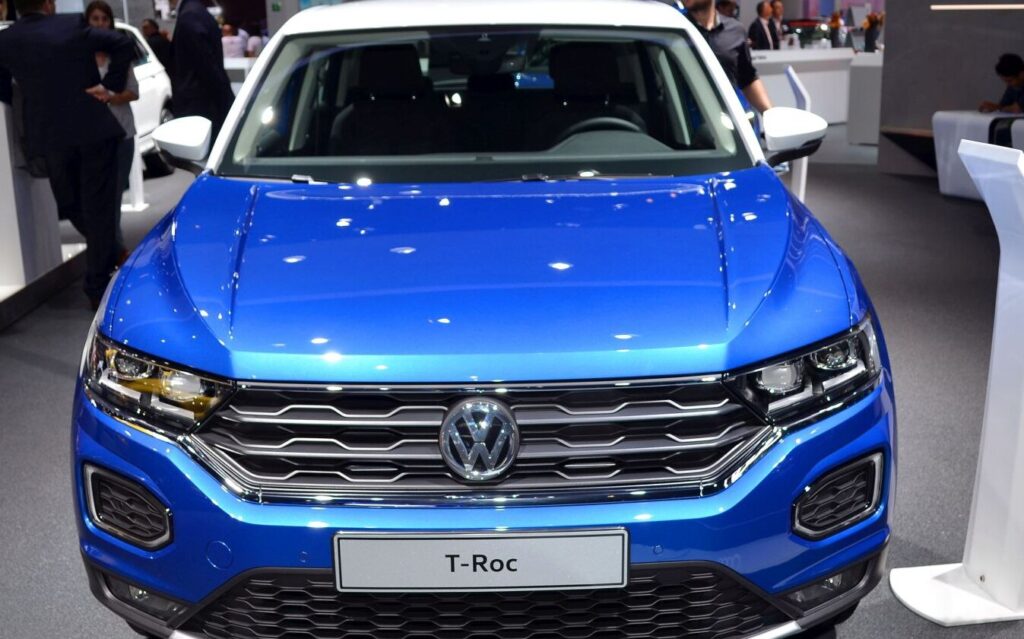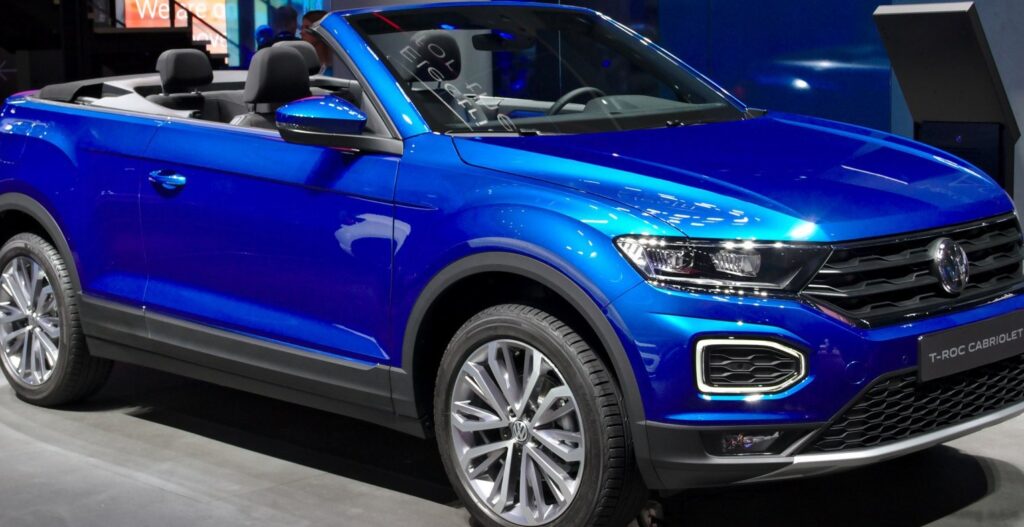
The Volkswagen T-Roc Cabriolet 1.5 TSI (150 hp) DSG ACT OPF represents a unique offering within the broader T-Roc range, produced for a limited period between 2019 and 2020. This variant combined the increasingly popular compact SUV silhouette with the open-air enjoyment of a convertible, targeting a market segment seeking style and versatility. It was positioned as a mid-range option within the T-Roc Cabriolet lineup, offering a balance between performance, fuel efficiency, and features. The “ACT” designation refers to Active Cylinder Technology, a fuel-saving measure, while “OPF” denotes the presence of a gasoline particulate filter, reflecting increasingly stringent European emissions standards.
Technical Specifications
| Brand | Volkswagen |
| Model | T-Roc |
| Generation | T-Roc I Cabriolet |
| Type (Engine) | 1.5 TSI (150 Hp) DSG ACT OPF |
| Start of production | 2019 |
| End of production | 2020 |
| Powertrain Architecture | Internal Combustion engine |
| Body type | Cabriolet, SUV |
| Seats | 4 |
| Doors | 2 |
| Fuel consumption (urban) | 6.5-6.7 l/100 km (36.2 – 35.1 US mpg, 43.5 – 42.2 UK mpg, 15.4 – 14.9 km/l) |
| Fuel consumption (extra urban) | 5.0-5.3 l/100 km (47 – 44.4 US mpg, 56.5 – 53.3 UK mpg, 20 – 18.9 km/l) |
| Fuel consumption (combined) | 5.6-5.8 l/100 km (42 – 40.6 US mpg, 50.4 – 48.7 UK mpg, 17.9 – 17.2 km/l) |
| CO2 emissions | 127-132 g/km |
| Fuel Type | Petrol (Gasoline) |
| Maximum speed | 250 km/h (155.34 mph) |
| Emission standard | Euro 6d – TEMP – EVAP – ISC |
| Weight-to-power ratio | 9.8 kg/Hp, 102.4 Hp/tonne |
| Weight-to-torque ratio | 5.9 kg/Nm, 170.6 Nm/tonne |
| Power | 150 Hp |
| Power per litre | 100.1 Hp/l |
| Torque | 250 Nm @ 1500-3500 rpm (184.39 lb.-ft. @ 1500-3500 rpm) |
| Engine layout | Front, Transverse |
| Engine Model/Code | DPCA |
| Engine displacement | 1498 cm3 (91.41 cu. in.) |
| Number of cylinders | 4 |
| Engine configuration | Inline |
| Number of valves per cylinder | 4 |
| Fuel injection system | Direct injection |
| Engine aspiration | Turbocharger, Intercooler |
| Engine oil capacity | 4.3 l (4.54 US qt | 3.78 UK qt) |
| Kerb Weight | 1465 kg (3229.77 lbs.) |
| Max. weight | 1900 kg (4188.78 lbs.) |
| Max load | 435 kg (959.01 lbs.) |
| Trunk (boot) space – minimum | 280 l (9.89 cu. ft.) |
| Fuel tank capacity | 50 l (13.21 US gal | 11 UK gal) |
| Max. roof load | 75 kg (165.35 lbs.) |
| Permitted trailer load with brakes (8%) | 1700 kg (3747.86 lbs.) |
| Permitted trailer load with brakes (12%) | 1500 kg (3306.93 lbs.) |
| Permitted trailer load without brakes | 750 kg (1653.47 lbs.) |
| Permitted towbar download | 80 kg (176.37 lbs.) |
| Length | 4268 mm (168.03 in.) |
| Width | 1811 mm (71.3 in.) |
| Width including mirrors | 1998 mm (78.66 in.) |
| Height | 1522 mm (59.92 in.) |
| Wheelbase | 2630 mm (103.54 in.) |
| Front track | 1538-1546 mm (60.55 – 60.87 in.) |
| Rear (Back) track | 1539-1547 mm (60.59 – 60.91 in.) |
| Minimum turning circle (turning diameter) | 11 m (36.09 ft.) |
| Drivetrain Architecture | Front wheel drive |
| Number of gears and type of gearbox | 7 gears, automatic transmission DSG |
| Front suspension | Independent type McPherson |
| Rear suspension | Independent multi-link suspension |
| Front brakes | Ventilated discs |
| Rear brakes | Disc |
| Assisting systems | ABS (Anti-lock braking system) |
| Steering type | Steering rack and pinion |
| Power steering | Electric Steering |
| Tires size | 215/55 R17 |
| Wheel rims size | 7J x 17 |
Powertrain & Engine Architecture
The heart of the T-Roc Cabriolet 1.5 TSI is the DPCA engine code, a 1.5-liter turbocharged inline-four cylinder gasoline engine. This engine is part of Volkswagen’s EA211 family, known for its compact design and efficiency. It utilizes direct fuel injection, delivering fuel directly into the combustion chamber for improved combustion and power output. The engine also features an intercooler to cool the intake air, further enhancing performance. A key technology employed in this engine is Active Cylinder Technology (ACT), which can deactivate two cylinders under light load conditions to reduce fuel consumption. The engine’s turbocharger provides a boost in power and torque, delivering 150 horsepower and 250 Nm (184 lb-ft) of torque between 1500 and 3500 rpm. This power is then channeled through a seven-speed dual-clutch transmission (DSG), known for its quick and smooth gear changes. The DSG transmission contributes to both performance and fuel efficiency.
Driving Characteristics
The 1.5 TSI engine paired with the seven-speed DSG transmission provides a responsive and enjoyable driving experience. While not a performance-oriented variant, the 150 hp output is sufficient for everyday driving and provides adequate acceleration. The DSG transmission allows for quick shifts, making overtaking maneuvers relatively effortless. Compared to lower-powered T-Roc variants, this version offers a noticeable improvement in performance. However, it doesn’t match the punch of the higher-output engines available in the range. The Cabriolet’s added weight compared to the standard T-Roc is noticeable, but the engine manages to provide a reasonable power-to-weight ratio. The gear ratios are tuned for a balance between fuel economy and performance, with taller gears for cruising and shorter gears for quicker acceleration.
Equipment & Trim Levels
The T-Roc Cabriolet 1.5 TSI typically came equipped with a respectable level of standard features. These included air conditioning, a touchscreen infotainment system with smartphone integration (Apple CarPlay and Android Auto), and a suite of safety features such as ABS, electronic stability control, and multiple airbags. Interior upholstery was typically cloth, with options for leather upgrades. Depending on the specific market and optional packages, features like automatic climate control, parking sensors, a rearview camera, and upgraded audio systems were available. The dashboard layout was modern and driver-focused, with a clear instrument cluster and intuitive controls.
Chassis & Braking
The T-Roc Cabriolet utilizes a McPherson strut front suspension and a multi-link rear suspension, providing a comfortable and controlled ride. The Cabriolet version received specific chassis reinforcements to compensate for the lack of a fixed roof, enhancing structural rigidity. The braking system consists of ventilated discs at the front and solid discs at the rear, providing adequate stopping power for the vehicle’s weight and performance. ABS (Anti-lock Braking System) is standard, enhancing safety during emergency braking situations. Steering is rack and pinion with electric power assistance, offering precise and responsive handling.
Market Reception & Comparison
The T-Roc Cabriolet 1.5 TSI was generally well-received by automotive critics, who praised its stylish design and enjoyable driving experience. However, some reviewers noted the limited rear seat space and the relatively small trunk capacity, typical compromises for a convertible. Compared to other T-Roc variants, the 1.5 TSI offered a good balance between performance and fuel economy. The lower-powered engines were more economical but lacked the same level of responsiveness, while the higher-output engines offered more performance but at the expense of fuel efficiency. The 1.5 TSI’s fuel economy figures were competitive within its segment, and its reliability was generally considered good, based on the proven track record of the EA211 engine family.
Legacy
The Volkswagen T-Roc Cabriolet 1.5 TSI, despite its short production run, has become a desirable used car option for those seeking a stylish and versatile convertible. The 1.5 TSI engine has proven to be relatively reliable, with few major issues reported. Regular maintenance, including oil changes and timely replacement of wear items, is crucial for ensuring long-term reliability. The DSG transmission requires periodic servicing to maintain optimal performance. As a unique and relatively rare variant, the T-Roc Cabriolet 1.5 TSI holds its value well in the used car market, appealing to buyers who appreciate its combination of style, practicality, and driving enjoyment.