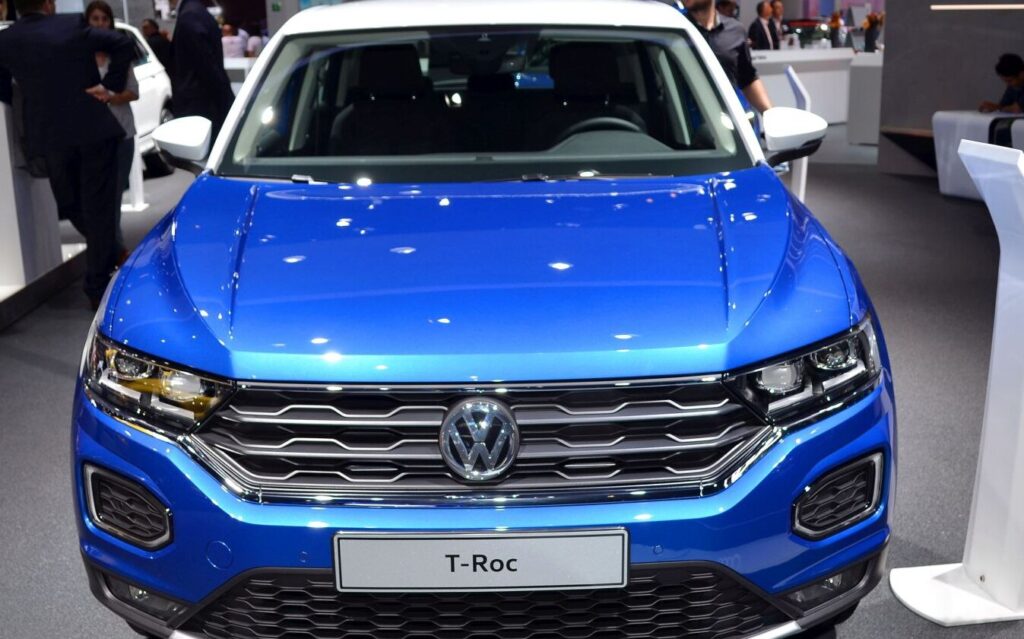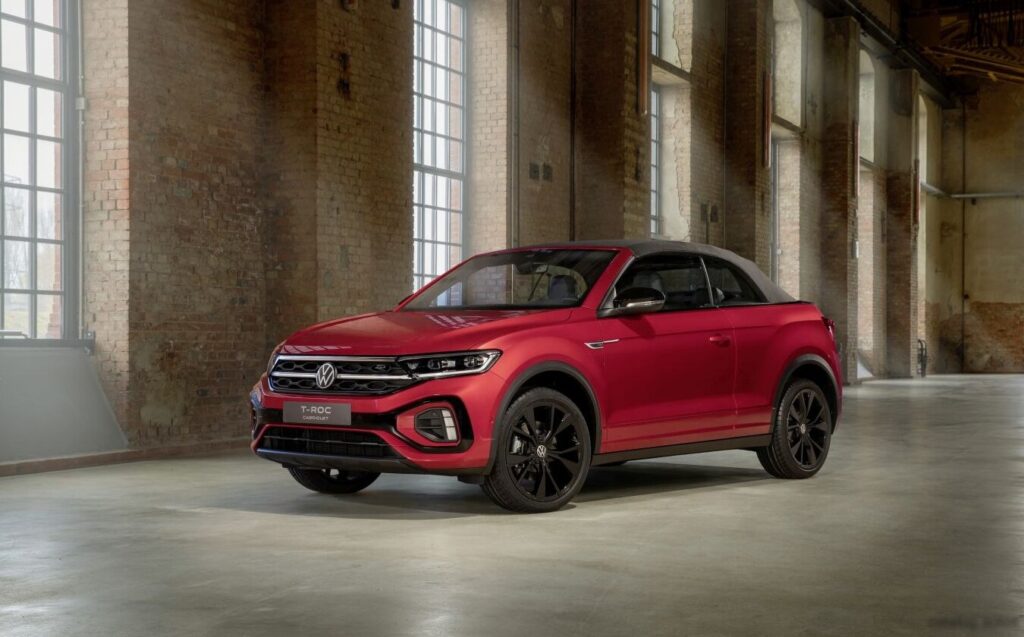
The Volkswagen T-Roc Cabriolet, introduced in 2020, brought open-top motoring to Volkswagen’s popular compact SUV range. The facelifted model, launched in 2022 for the 2024 model year, continued this offering with updated styling and technology. Among the engine options available, the 1.0 TSI producing 116 horsepower represented an entry-level choice, aimed at buyers prioritizing fuel efficiency and affordability over outright performance. This variant occupied the lower end of the T-Roc Cabriolet lineup, positioned below the more powerful 1.5 TSI engines.
Technical Specifications
| Brand | Volkswagen |
| Model | T-Roc |
| Generation | T-Roc I Cabriolet (facelift 2022) |
| Type (Engine) | 1.0 TSI (116 Hp) |
| Start of production | 2024 |
| Powertrain Architecture | Internal Combustion engine |
| Body type | Cabriolet, SUV |
| Seats | 5 |
| Doors | 2 |
| Fuel consumption at Low speed (WLTP) | 7.7 l/100 km (30.5 US mpg, 36.7 UK mpg, 13 km/l) |
| Fuel consumption at Medium speed (WLTP) | 5.9 l/100 km (39.9 US mpg, 47.9 UK mpg, 16.9 km/l) |
| Fuel consumption at high speed (WLTP) | 5.1 l/100 km (46.1 US mpg, 55.4 UK mpg, 19.6 km/l) |
| Fuel consumption at very high speed (WLTP) | 6.4 l/100 km (36.8 US mpg, 44.1 UK mpg, 15.6 km/l) |
| Combined fuel consumption (WLTP) | 6.1 l/100 km (38.6 US mpg, 46.3 UK mpg, 16.4 km/l) |
| CO2 emissions (WLTP) | 138 g/km |
| Fuel Type | Petrol (Gasoline) |
| Maximum speed | 187 km/h (116.2 mph) |
| Emission standard | Euro 6 EA |
| Weight-to-power ratio | 12.3 kg/Hp, 81.3 Hp/tonne |
| Weight-to-torque ratio | 7.1 kg/Nm, 140.2 Nm/tonne |
| Power | 116 Hp |
| Power per litre | 116.1 Hp/l |
| Torque | 200 Nm @ 2000-3500 rpm (147.51 lb.-ft. @ 2000-3500 rpm) |
| Engine layout | Front, Transverse |
| Engine Model/Code | EA211 evo2 |
| Engine displacement | 999 cm3 (60.96 cu. in.) |
| Number of cylinders | 3 |
| Engine configuration | Inline |
| Cylinder Bore | 74.5 mm (2.93 in.) |
| Piston Stroke | 76.4 mm (3.01 in.) |
| Number of valves per cylinder | 4 |
| Fuel injection system | Direct injection |
| Engine aspiration | Turbocharger, Intercooler |
| Valvetrain | DOHC |
| Engine oil capacity | 4 l (4.23 US qt | 3.52 UK qt) |
| Kerb Weight | 1427 kg (3146 lbs.) |
| Max. weight | 1870 kg (4122.64 lbs.) |
| Max load | 443 kg (976.65 lbs.) |
| Trunk (boot) space – minimum | 284 l (10.03 cu. ft.) |
| Fuel tank capacity | 50 l (13.21 US gal | 11 UK gal) |
| Permitted trailer load with brakes (8%) | 1500 kg (3306.93 lbs.) |
| Permitted trailer load with brakes (12%) | 1300 kg (2866.01 lbs.) |
| Permitted trailer load without brakes | 750 kg (1653.47 lbs.) |
| Permitted towbar download | 80 kg (176.37 lbs.) |
| Length | 4271 mm (168.15 in.) |
| Width | 1811 mm (71.3 in.) |
| Width including mirrors | 2018 mm (79.45 in.) |
| Height | 1527 mm (60.12 in.) |
| Wheelbase | 2630 mm (103.54 in.) |
| Front track | 1540-1548 mm (60.63 – 60.94 in.) |
| Rear (Back) track | 1543-1551 mm (60.75 – 61.06 in.) |
| Minimum turning circle (turning diameter) | 11.1 m (36.42 ft.) |
| Drivetrain Architecture | The Internal combustion engine (ICE) drives the front wheels of the vehicle. |
| Drive wheel | Front wheel drive |
| Number of gears and type of gearbox | 6 gears, manual transmission |
Powertrain & Engine Architecture
The 1.0 TSI engine, part of Volkswagen’s EA211 evo2 family, is a three-cylinder, turbocharged gasoline engine. Its compact size and lightweight construction contribute to the T-Roc Cabriolet’s overall efficiency. The engine utilizes direct fuel injection, delivering fuel directly into the combustion chamber for improved combustion efficiency and reduced emissions. A single scroll turbocharger with an intercooler provides forced induction, boosting power output. The engine features a Dual Overhead Camshaft (DOHC) valvetrain with four valves per cylinder, optimizing gas flow for enhanced performance. The 1.0 TSI in the T-Roc Cabriolet is paired with a 6-speed manual transmission, sending power to the front wheels. This configuration prioritizes fuel economy over rapid acceleration.
Driving Characteristics
The 116 horsepower and 200 Nm (147.51 lb-ft) of torque produced by the 1.0 TSI engine provide adequate, but not exhilarating, performance in the T-Roc Cabriolet. Acceleration from 0 to 62 mph (0-100 km/h) takes around 10.4 seconds. The engine feels responsive at lower RPMs thanks to the turbocharger, but power does taper off at higher engine speeds. The 6-speed manual transmission offers a decent shift feel, but the gear ratios are tuned for economy rather than sporty driving. Compared to the more powerful 1.5 TSI variants, the 1.0 TSI feels noticeably slower, particularly when fully loaded or tackling uphill climbs. However, for everyday commuting and relaxed cruising with the top down, the 1.0 TSI provides a comfortable and enjoyable driving experience.
Equipment & Trim Levels
The 1.0 TSI Cabriolet typically came equipped with a reasonable level of standard features. These generally included air conditioning, a touchscreen infotainment system with Apple CarPlay and Android Auto compatibility, alloy wheels, and a suite of safety features such as automatic emergency braking and lane departure warning. Interior upholstery was typically cloth, with options for upgraded materials available. Optional extras included features like adaptive cruise control, a larger touchscreen display, and a premium sound system. Trim levels varied by market, but generally offered progressively more features and styling enhancements as you moved up the range.
Chassis & Braking
The T-Roc Cabriolet utilizes a McPherson strut front suspension and a semi-dependent beam rear suspension. This setup provides a good balance between ride comfort and handling. The front suspension incorporates a stabilizer bar to reduce body roll during cornering. Braking duties are handled by ventilated discs at the front and solid discs at the rear. Anti-lock Braking System (ABS) is standard, enhancing braking performance and stability. The relatively lightweight nature of the 1.0 TSI engine contributes to a slightly more nimble feel compared to the heavier, more powerful variants.
Market Reception & Comparison
The 1.0 TSI Cabriolet was generally well-received by critics as an affordable and fuel-efficient entry point into the T-Roc Cabriolet range. Its fuel economy figures of around 38.6 US mpg (combined WLTP) were a key selling point. However, some reviewers noted that the engine could feel strained when pushed hard, particularly with a full load of passengers and luggage. Compared to the 1.5 TSI models, the 1.0 TSI offered a more economical option, but at the expense of performance. Reliability reports for the EA211 engine family have been generally positive, although regular maintenance is crucial to ensure longevity.
Legacy
The 1.0 TSI engine has proven to be a relatively reliable unit within the Volkswagen Group. The T-Roc Cabriolet 1.0 TSI continues to be a popular choice on the used car market, appealing to buyers seeking a stylish and affordable open-top SUV. Its fuel efficiency and relatively low running costs make it an attractive option for those looking for a practical and enjoyable convertible. While not the most powerful version of the T-Roc Cabriolet, the 1.0 TSI offers a compelling combination of value, efficiency, and open-air driving enjoyment.