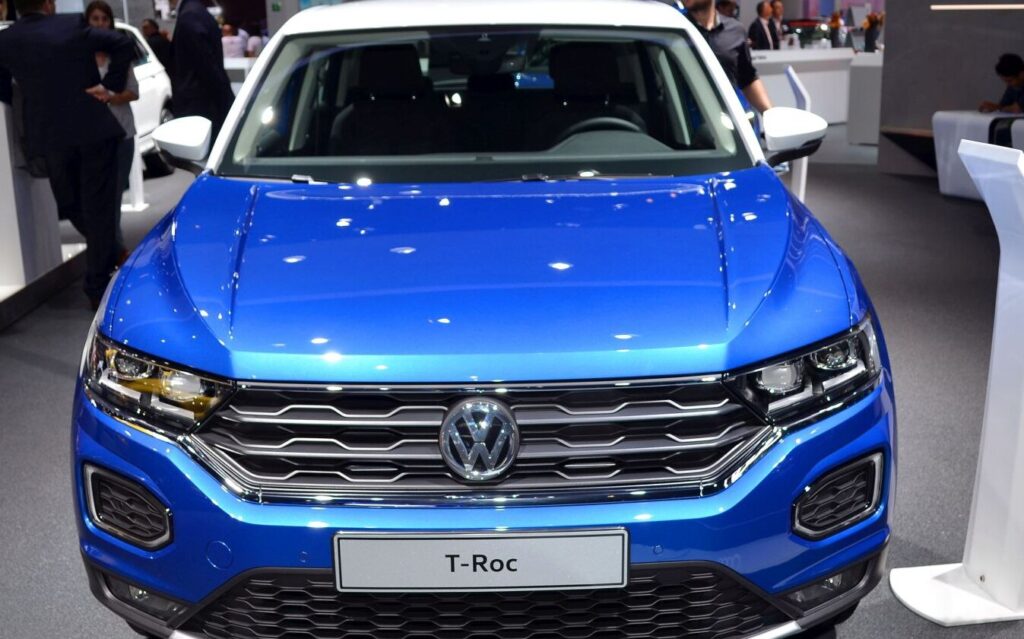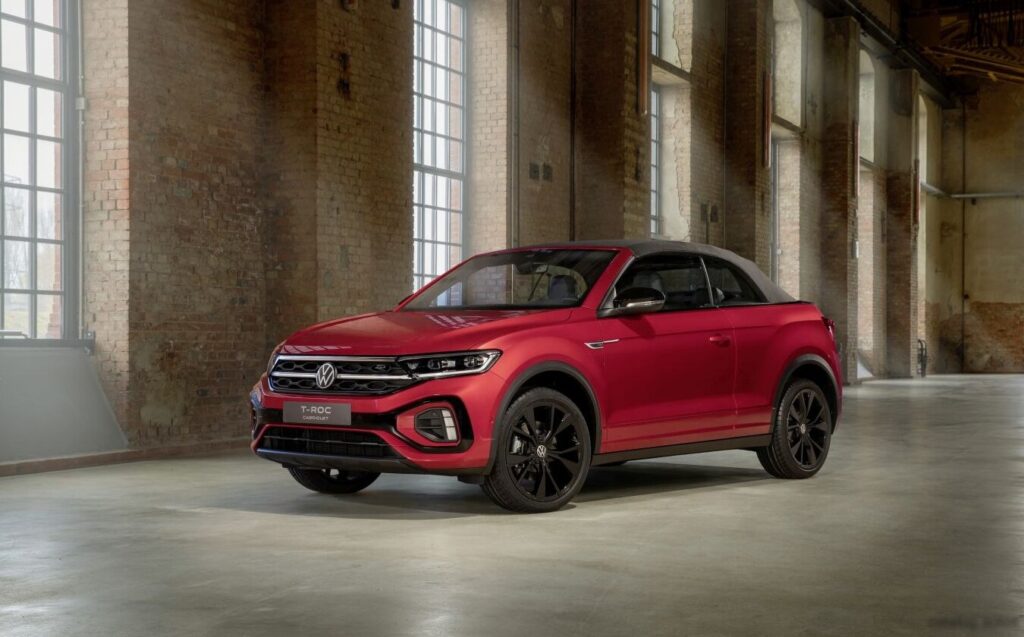
The Volkswagen T-Roc Cabriolet, introduced in 2020, brought open-top motoring to Volkswagen’s popular compact SUV range. The facelifted model, launched in March 2022, refined the design and technology of the original. This article focuses on the 1.5 TSI (150 hp) variant equipped with a 7-speed Dual Clutch Gearbox (DSG), a popular configuration in European markets. Positioned as a mid-range offering, it balanced performance, fuel efficiency, and affordability within the T-Roc Cabriolet lineup. This version aimed to appeal to buyers seeking a stylish and practical convertible SUV with a responsive powertrain.
Technical Specifications
| Brand | Volkswagen |
| Model | T-Roc |
| Generation | T-Roc I Cabriolet (facelift 2022) |
| Type (Engine) | 1.5 TSI (150 Hp) DSG |
| Start of production | March, 2022 |
| Powertrain Architecture | Internal Combustion engine |
| Body type | Cabriolet, SUV |
| Seats | 4 |
| Doors | 2 |
| Fuel consumption at Low speed (WLTP) | 8.2 l/100 km (28.7 US mpg, 34.4 UK mpg, 12.2 km/l) |
| Fuel consumption at Medium speed (WLTP) | 6.2 l/100 km (37.9 US mpg, 45.6 UK mpg, 16.1 km/l) |
| Fuel consumption at high speed (WLTP) | 5.5 l/100 km (42.8 US mpg, 51.4 UK mpg, 18.2 km/l) |
| Fuel consumption at very high speed (WLTP) | 6.6 l/100 km (35.6 US mpg, 42.8 UK mpg, 15.2 km/l) |
| Combined fuel consumption (WLTP) | 6.4 l/100 km (36.8 US mpg, 44.1 UK mpg, 15.6 km/l) |
| CO2 emissions (WLTP) | 144 g/km |
| Fuel consumption (economy) – urban (NEDC) | 6.4 l/100 km (36.8 US mpg, 44.1 UK mpg, 15.6 km/l) |
| Fuel consumption (economy) – extra urban (NEDC) | 4.7 l/100 km (50 US mpg, 60.1 UK mpg, 21.3 km/l) |
| Fuel consumption (economy) – combined (NEDC) | 5.4 l/100 km (43.6 US mpg, 52.3 UK mpg, 18.5 km/l) |
| CO2 emissions (NEDC) | 122 g/km |
| Fuel Type | Petrol (Gasoline) |
| Acceleration 0 – 100 km/h | 9.4 sec |
| Acceleration 0 – 62 mph | 9.4 sec |
| Acceleration 0 – 60 mph | 8.9 sec |
| Maximum speed | 203 km/h (126.14 mph) |
| Emission standard | EURO 6d-ISC FCM |
| Weight-to-power ratio | 10.3 kg/Hp, 97 Hp/tonne |
| Weight-to-torque ratio | 10.3 kg/Nm, 97 Nm/tonne |
| Power | 150 Hp @ 5000-6000 rpm |
| Power per litre | 100.1 Hp/l |
| Torque | 150 Nm @ 1500-3500 rpm (110.63 lb.-ft. @ 1500-3500 rpm) |
| Engine layout | Front, Transverse |
| Engine displacement | 1498 cm3 (91.41 cu. in.) |
| Number of cylinders | 4 |
| Engine configuration | Inline |
| Number of valves per cylinder | 4 |
| Fuel injection system | Direct injection |
| Engine aspiration | Turbocharger, Intercooler |
| Valvetrain | DOHC |
| Engine oil capacity | 4.3 l (4.54 US qt | 3.78 UK qt) |
| Kerb Weight | 1546 kg (3408.35 lbs.) |
| Max. weight | 1910 kg (4210.83 lbs.) |
| Max load | 364 kg (802.48 lbs.) |
| Trunk (boot) space – minimum | 284 l (10.03 cu. ft.) |
| Fuel tank capacity | 50 l (13.21 US gal | 11 UK gal) |
| Permitted trailer load with brakes (8%) | 1700 kg (3747.86 lbs.) |
| Permitted trailer load with brakes (12%) | 1500 kg (3306.93 lbs.) |
| Permitted trailer load without brakes | 750 kg (1653.47 lbs.) |
| Permitted towbar download | 80 kg (176.37 lbs.) |
| Length | 4271-4286 mm (168.15 – 168.74 in.) |
| Width | 1811 mm (71.3 in.) |
| Height | 1527 mm (60.12 in.) |
| Wheelbase | 2630 mm (103.54 in.) |
| Front track | 1538-1548 mm (60.55 – 60.94 in.) |
| Rear (Back) track | 1541-1551 mm (60.67 – 61.06 in.) |
| Minimum turning circle (turning diameter) | 10.9 m (35.76 ft.) |
| Drivetrain Architecture | The Internal combustion engine (ICE) drives the front wheels of the vehicle. |
| Drive wheel | Front wheel drive |
| Number of gears and type of gearbox | 7 gears, automatic transmission DSG |
| Front suspension | Independent, type McPherson with coil spring and anti-roll bar |
| Rear suspension | Semi-dependent beam with stabilizer lateral stability |
| Front brakes | Ventilated discs |
| Rear brakes | Disc |
INTRODUCTION
The Volkswagen T-Roc Cabriolet, launched in 2020, represented Volkswagen’s entry into the increasingly popular compact SUV convertible segment. The 2022 facelift brought styling updates, improved technology, and refinements to the powertrain options. The 1.5 TSI 150 hp DSG variant was a key model in the range, offering a balance between performance and efficiency. Built on the A1 platform, shared with the Audi A1 and Volkswagen Polo, the T-Roc Cabriolet aimed to provide a fun-to-drive experience with the added practicality of a small SUV. It was primarily marketed in Europe, where demand for compact convertibles remained relatively strong.
Powertrain & Engine Architecture
At the heart of the T-Roc Cabriolet 1.5 TSI DSG lies the EA211 family of engines. Specifically, this variant utilizes the 1.5-liter turbocharged four-cylinder petrol engine, often identified by engine codes such as DSU or similar variations depending on specific market regulations. This engine features direct fuel injection, a key technology for maximizing efficiency and power output. The engine employs a Miller cycle for improved thermal efficiency. The turbocharger, coupled with an intercooler, provides a boost in power and torque. The 7-speed DSG (Dual Clutch Gearbox) is a crucial component, offering quick and smooth gear changes. This transmission features two separate clutches, allowing for pre-selection of the next gear, resulting in seamless shifts and improved responsiveness. The engine produces 150 horsepower at 5000-6000 rpm and 150 Nm (110.63 lb-ft) of torque between 1500 and 3500 rpm.
Driving Characteristics
The 1.5 TSI 150 hp DSG powertrain delivers a respectable driving experience for the T-Roc Cabriolet. While not a performance-oriented variant, it provides sufficient power for everyday driving and occasional highway cruising. Acceleration from 0 to 100 km/h (0-62 mph) takes approximately 9.4 seconds. The DSG transmission contributes to a responsive feel, with quick gear changes enhancing acceleration. Compared to the base 1.0 TSI engine, the 1.5 TSI offers noticeably more power and torque, resulting in improved performance in overtaking situations and when carrying a full load. However, it doesn’t match the punch of the more powerful T-Roc models. The gear ratios are tuned for a balance between fuel efficiency and performance, with taller gears for relaxed cruising and shorter gears for quicker acceleration. The front-wheel-drive configuration provides adequate traction in most conditions, but can exhibit some torque steer under hard acceleration.
Equipment & Trim Levels
The 1.5 TSI DSG variant of the T-Roc Cabriolet typically came equipped with a good level of standard features. These included air conditioning, a touchscreen infotainment system with Apple CarPlay and Android Auto compatibility, and a suite of safety features such as automatic emergency braking and lane departure warning. Interior upholstery was generally cloth, with options for leather upgrades. Standard dashboard configuration included a digital instrument cluster. Optional extras available for this trim level included adaptive cruise control, park assist, a premium sound system, and various styling packages. The specific trim level (e.g., Style, R-Line) further influenced the standard equipment and available options.
Chassis & Braking
The T-Roc Cabriolet utilizes a McPherson strut front suspension and a semi-dependent beam rear suspension. This setup provides a good balance between ride comfort and handling. The front suspension incorporates a stabilizer bar to reduce body roll during cornering. The rear suspension is tuned for stability and comfort. Braking duties are handled by ventilated discs at the front and solid discs at the rear. Anti-lock Braking System (ABS) is standard, along with Electronic Stability Control (ESC). The chassis is reinforced to compensate for the lack of a fixed roof, ensuring adequate torsional rigidity. The weight distribution is slightly front-biased due to the engine and drivetrain layout.
Market Reception & Comparison
The T-Roc Cabriolet 1.5 TSI DSG received generally positive reviews from automotive critics. It was praised for its stylish design, comfortable ride, and responsive powertrain. However, some critics noted the limited rear passenger space and the relatively small trunk capacity, typical for a convertible. Compared to other trims in the T-Roc Cabriolet lineup, the 1.5 TSI offered a sweet spot between performance and fuel economy. The 1.0 TSI was more affordable but lacked power, while the higher-output variants came at a premium price. Fuel economy figures were competitive for the segment, with combined WLTP figures around 6.4 l/100 km (36.8 US mpg). Reliability reports have been generally positive, with the EA211 engine proving to be a robust and dependable unit.
Legacy
The Volkswagen T-Roc Cabriolet 1.5 TSI DSG has established itself as a popular choice in the compact SUV convertible market. The EA211 engine, coupled with the DSG transmission, has proven to be a reliable and efficient powertrain. On the used car market, these models hold their value reasonably well, particularly those with low mileage and a full service history. The T-Roc Cabriolet continues to appeal to buyers seeking a stylish and practical open-top vehicle, and the 1.5 TSI variant remains a well-regarded option within the range.