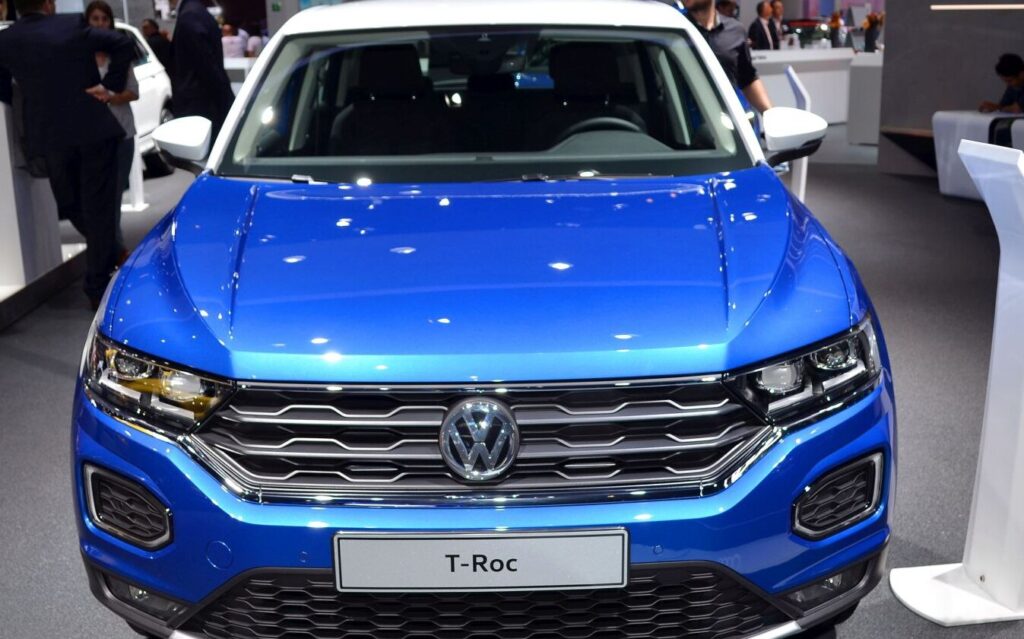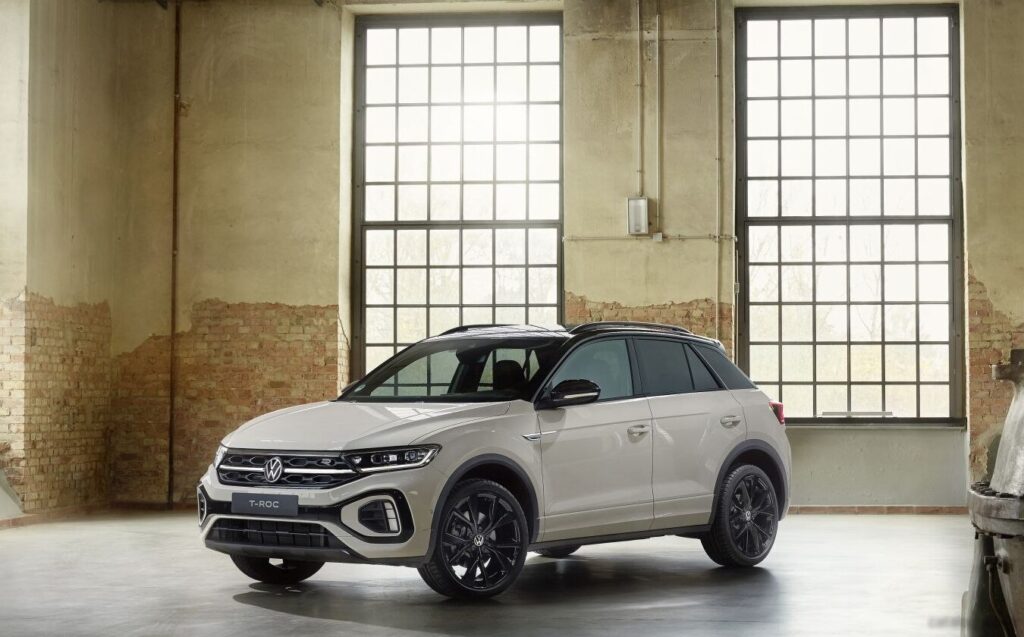
The Volkswagen T-Roc 1.5 TSI (150 hp) DSG, part of the T-Roc I (facelift) generation produced from 2022 to 2025, represents a key offering in Volkswagen’s compact SUV lineup. Positioned as a mid-range trim, it aimed to balance performance, fuel efficiency, and affordability within the broader T-Roc range. This variant was primarily marketed in Europe and other international markets, leveraging the popularity of smaller, more efficient SUVs. The facelift brought styling updates and technological enhancements to the already successful T-Roc platform (A1/1HX0), solidifying its position as a competitive choice in the crowded crossover segment.
Technical Specifications
| Brand | Volkswagen |
| Model | T-Roc |
| Generation | T-Roc I (facelift 2022) |
| Type (Engine) | 1.5 TSI (150 Hp) DSG |
| Start of production | 2022 |
| End of production | 2025 |
| Powertrain Architecture | Internal Combustion engine |
| Body type | SUV |
| Seats | 5 |
| Doors | 5 |
| Fuel consumption at Low speed (WLTP) | 8.1 l/100 km (29 US mpg, 34.9 UK mpg, 12.3 km/l) |
| Fuel consumption at Medium speed (WLTP) | 6 l/100 km (39.2 US mpg, 47.1 UK mpg, 16.7 km/l) |
| Fuel consumption at high speed (WLTP) | 5.3 l/100 km (44.4 US mpg, 53.3 UK mpg, 18.9 km/l) |
| Fuel consumption at very high speed (WLTP) | 6.5 l/100 km (36.2 US mpg, 43.5 UK mpg, 15.4 km/l) |
| Combined fuel consumption (WLTP) | 6.3 l/100 km (37.3 US mpg, 44.8 UK mpg, 15.9 km/l) |
| CO2 emissions (WLTP) | 142 g/km |
| Fuel consumption (economy) – urban (NEDC) | 6.7 l/100 km (35.1 US mpg, 42.2 UK mpg, 14.9 km/l) |
| Fuel consumption (economy) – extra urban (NEDC) | 4.6 l/100 km (51.1 US mpg, 61.4 UK mpg, 21.7 km/l) |
| Fuel consumption (economy) – combined (NEDC) | 5.4 l/100 km (43.6 US mpg, 52.3 UK mpg, 18.5 km/l) |
| CO2 emissions (NEDC) | 123 g/km |
| Fuel Type | Petrol (Gasoline) |
| Acceleration 0 – 100 km/h | 8.6 sec |
| Acceleration 0 – 62 mph | 8.6 sec |
| Acceleration 0 – 60 mph | 8.2 sec |
| Maximum speed | 205 km/h (127.38 mph) |
| Emission standard | Euro 6d-ISC-FCM |
| Weight-to-power ratio | 8.5 kg/Hp, 117.4 Hp/tonne |
| Weight-to-torque ratio | 5.1 kg/Nm, 195.6 Nm/tonne |
| Power | 150 Hp @ 5000 rpm |
| Torque | 250 Nm @ 1500-3500 rpm (184.39 lb.-ft. @ 1500-3500 rpm) |
| Engine layout | Front, Transverse |
| Engine Model/Code | DPCA |
| Engine displacement | 1498 cm3 (91.41 cu. in.) |
| Number of cylinders | 4 |
| Engine configuration | Inline |
| Cylinder Bore | 74.5 mm (2.93 in.) |
| Piston Stroke | 85.9 mm (3.38 in.) |
| Compression ratio | 10.5:1 |
| Number of valves per cylinder | 4 |
| Fuel injection system | Direct injection |
| Engine aspiration | Turbocharger, Intercooler |
| Valvetrain | DOHC |
| Engine oil capacity | 4.3 l (4.54 US qt | 3.78 UK qt) |
| Kerb Weight | 1278 kg (2817.51 lbs.) |
| Max. weight | 1860 kg (4100.6 lbs.) |
| Max load | 582 kg (1283.09 lbs.) |
| Trunk (boot) space – minimum | 445 l (15.72 cu. ft.) |
| Trunk (boot) space – maximum | 1290 l (45.56 cu. ft.) |
| Fuel tank capacity | 50 l (13.21 US gal | 11 UK gal) |
| Max. roof load | 75 kg (165.35 lbs.) |
| Permitted trailer load with brakes (8%) | 1700 kg (3747.86 lbs.) |
| Permitted trailer load with brakes (12%) | 1500 kg (3306.93 lbs.) |
| Permitted trailer load without brakes | 670 kg (1477.1 lbs.) |
| Permitted towbar download | 80 kg (176.37 lbs.) |
| Length | 4236 mm (166.77 in.) |
| Width | 1819 mm (71.61 in.) |
| Width including mirrors | 2012 mm (79.21 in.) |
| Height | 1584 mm (62.36 in.) |
| Wheelbase | 2590 mm (101.97 in.) |
| Front track | 1538-1549 mm (60.55 – 60.98 in.) |
| Rear (Back) track | 1531-1541 mm (60.28 – 60.67 in.) |
| Ride height (ground clearance) | 161 mm (6.34 in.) |
| Minimum turning circle (turning diameter) | 11.1 m (36.42 ft.) |
| Drivetrain Architecture | The Internal combustion engine (ICE) drives the front wheels of the vehicle. |
| Drive wheel | Front wheel drive |
| Number of gears and type of gearbox | 7 gears, automatic transmission DSG |
| Front suspension | Independent type McPherson, Transverse stabilizer |
| Rear suspension | Semi-dependent beam with stabilizer lateral stability |
| Front brakes | Ventilated discs |
| Rear brakes | Disc |
| Assisting systems | ABS (Anti-lock braking system) |
| Steering type | Steering rack and pinion |
| Power steering | Electric Steering |
| Tires size | 205/60 R16; 215/60 R16; 215/55 R17; 215/50 R18 |
| Wheel rims size | 6J x 16; 6.5J x 16; 7J x 17; 7J x 18 |
INTRODUCTION
The Volkswagen T-Roc 1.5 TSI (150 hp) DSG, introduced with the 2022 facelift, is a front-wheel-drive compact SUV built on the MQB platform (specifically the A1/1HX0 variant). This iteration aimed to provide a balance between fuel economy and acceptable performance for everyday driving. It occupied a middle ground in the T-Roc lineup, offering more power and a more sophisticated transmission than the base models, but remaining more accessible than the higher-performance R variants. The facelift brought revised styling, upgraded interior materials, and enhanced technology features, making it a more competitive offering in the increasingly popular compact SUV segment.
Powertrain & Engine Architecture
At the heart of the T-Roc 1.5 TSI DSG lies the DPCA engine, a 1.5-liter turbocharged inline-four cylinder gasoline engine. This engine is part of Volkswagen’s EA211 family, known for its efficiency and relatively compact size. It utilizes direct fuel injection, delivering fuel directly into the combustion chamber for improved combustion efficiency and reduced emissions. The engine employs a Miller cycle for increased thermal efficiency. The turbocharger, coupled with an intercooler, provides a boost in power and torque. The 150 hp output is achieved at 5000 rpm, while the peak torque of 250 Nm (184 lb-ft) is available from 1500 to 3500 rpm. This broad torque curve contributes to good drivability in various conditions. The engine is paired with a 7-speed dual-clutch transmission (DSG), which offers quick and smooth gear changes. The DSG transmission contributes to both performance and fuel efficiency.
Driving Characteristics
The T-Roc 1.5 TSI DSG delivers a comfortable and refined driving experience. The 150 hp engine provides adequate power for everyday driving, with a 0-60 mph acceleration time of around 8.2 seconds. The DSG transmission ensures responsive shifts, and the broad torque band minimizes the need for frequent downshifts. While not a sports SUV, the T-Roc 1.5 TSI offers sufficient performance for overtaking and merging onto highways. Compared to the lower-powered 1.0 TSI variants, the 1.5 TSI provides a noticeable improvement in acceleration and overall responsiveness. However, it doesn’t match the performance of the more powerful T-Roc R, which boasts a significantly more potent engine and all-wheel drive. The front-wheel-drive configuration provides good traction in most conditions, but can struggle in slippery surfaces.
Equipment & Trim Levels
The T-Roc 1.5 TSI DSG typically came equipped with a generous amount of standard features. These included air conditioning, a touchscreen infotainment system with Apple CarPlay and Android Auto compatibility, Bluetooth connectivity, and a suite of safety features such as automatic emergency braking and lane departure warning. Higher trim levels offered additional features such as adaptive cruise control, a larger touchscreen display, a digital instrument cluster, and leather upholstery. Optional extras included a panoramic sunroof, upgraded sound system, and various styling packages. Interior upholstery was typically cloth on the base trims, with leather options available on higher-spec models. The dashboard layout was modern and functional, with a focus on ease of use.
Chassis & Braking
The T-Roc 1.5 TSI DSG utilizes an independent McPherson strut suspension at the front and a semi-independent torsion beam suspension at the rear. This setup provides a good balance between ride comfort and handling. A transverse stabilizer bar is fitted to both the front and rear axles to reduce body roll during cornering. The braking system consists of ventilated discs at the front and solid discs at the rear. Anti-lock braking system (ABS) is standard, along with electronic stability control (ESC). The steering is electrically assisted, providing light and precise steering feel.
Market Reception & Comparison
The Volkswagen T-Roc 1.5 TSI DSG was generally well-received by automotive critics. It was praised for its comfortable ride, refined engine, and efficient DSG transmission. Fuel economy figures were competitive, with combined WLTP figures around 6.3 l/100 km (37.3 US mpg). Compared to the 1.0 TSI variants, the 1.5 TSI offered a significant improvement in performance, making it a more enjoyable driving experience. However, some critics noted that the interior materials could be improved, and the rear passenger space was somewhat limited. Compared to rivals such as the Nissan Qashqai and Peugeot 3008, the T-Roc offered a more premium feel and a more engaging driving experience.
Legacy
The Volkswagen T-Roc 1.5 TSI DSG has proven to be a reliable and durable powertrain. The EA211 engine is known for its longevity, and the DSG transmission, while requiring occasional maintenance, is generally robust. In the used car market, these models hold their value reasonably well, thanks to their reputation for reliability and fuel efficiency. Regular maintenance, including oil changes and DSG fluid changes, is crucial to ensure long-term reliability. The T-Roc 1.5 TSI DSG remains a popular choice for buyers seeking a practical, efficient, and well-equipped compact SUV.