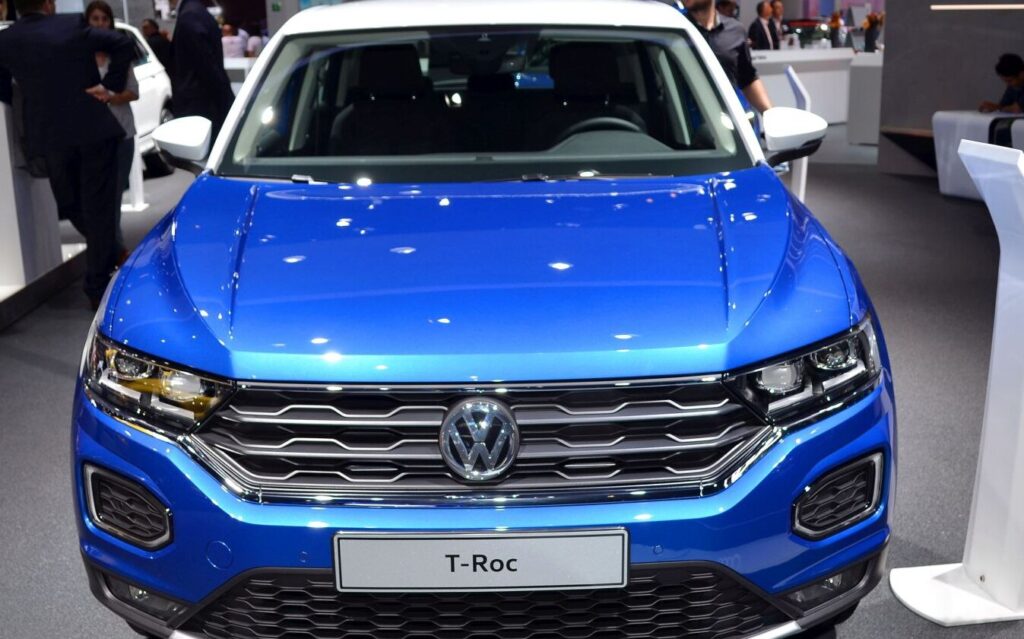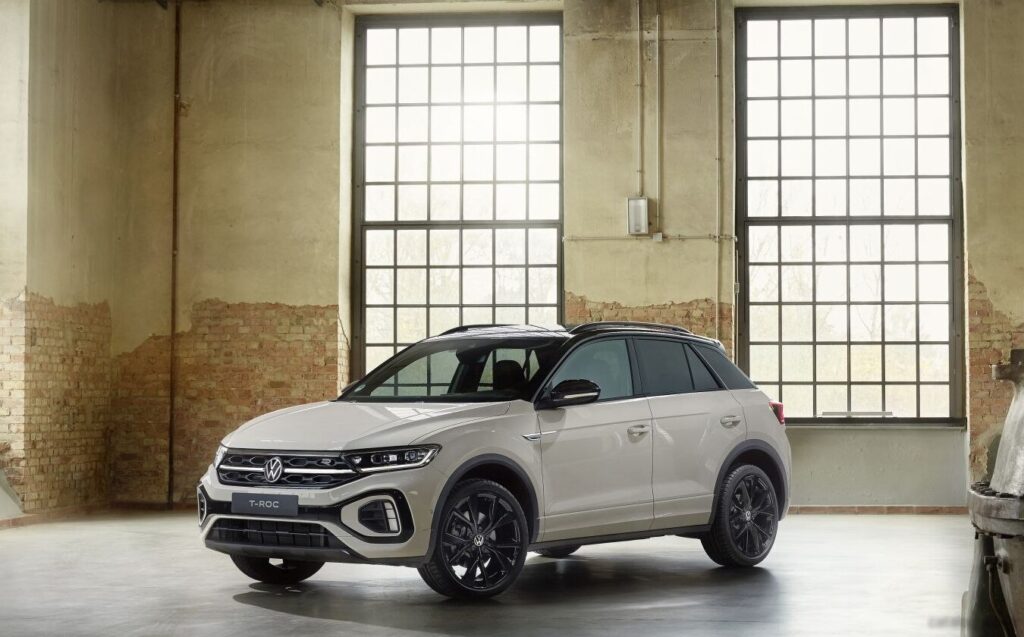
The Volkswagen T-Roc, launched in 2017, represented Volkswagen’s entry into the highly competitive subcompact SUV market. The first generation (T-Roc I) received a significant facelift in 2022, bringing updated styling, enhanced technology, and revised engine options. Among these, the 2.0 TDI variant producing 116 horsepower (Hp) served as a popular choice, particularly in European markets, offering a balance of fuel efficiency and reasonable performance. Production of this specific configuration ran from 2022 to 2025, positioned as a mid-range offering within the T-Roc lineup.
Technical Specifications
| Brand | Volkswagen |
| Model | T-Roc |
| Generation | T-Roc I (facelift 2022) |
| Type (Engine) | 2.0 TDI (116 Hp) |
| Start of production | 2022 |
| End of production | 2025 |
| Powertrain Architecture | Internal Combustion engine |
| Body type | SUV |
| Seats | 5 |
| Doors | 5 |
| Fuel consumption at Low speed (WLTP) | 5.9 l/100 km (39.9 US mpg, 47.9 UK mpg, 16.9 km/l) |
| Fuel consumption at Medium speed (WLTP) | 4.3 l/100 km (54.7 US mpg, 65.7 UK mpg, 23.3 km/l) |
| Fuel consumption at high speed (WLTP) | 3.9 l/100 km (60.3 US mpg, 72.4 UK mpg, 25.6 km/l) |
| Fuel consumption at very high speed (WLTP) | 4.9 l/100 km (48 US mpg, 57.6 UK mpg, 20.4 km/l) |
| Combined fuel consumption (WLTP) | 4.6 l/100 km (51.1 US mpg, 61.4 UK mpg, 21.7 km/l) |
| CO2 emissions (WLTP) | 121 g/km |
| Fuel consumption (economy) – urban (NEDC) | 5.6 l/100 km (42 US mpg, 50.4 UK mpg, 17.9 km/l) |
| Fuel consumption (economy) – extra urban (NEDC) | 3.5 l/100 km (67.2 US mpg, 80.7 UK mpg, 28.6 km/l) |
| Fuel consumption (economy) – combined (NEDC) | 4.3 l/100 km (54.7 US mpg, 65.7 UK mpg, 23.3 km/l) |
| CO2 emissions (NEDC) | 113 g/km |
| Fuel Type | Diesel |
| Acceleration 0 – 100 km/h | 10.4 sec |
| Acceleration 0 – 62 mph | 10.4 sec |
| Acceleration 0 – 60 mph | 9.9 sec |
| Maximum speed | 187 km/h (116.2 mph) |
| Emission standard | Euro 6d-ISC-FCM |
| Weight-to-power ratio | 11.6 kg/Hp, 86.6 Hp/tonne |
| Weight-to-torque ratio | 4.5 kg/Nm, 223.9 Nm/tonne |
| Power | 116 Hp @ 3250 rpm |
| Torque | 300 Nm @ 1600-2500 rpm (221.27 lb.-ft. @ 1600-2500 rpm) |
| Engine layout | Front, Transverse |
| Engine Model/Code | DTRD |
| Engine displacement | 1968 cm3 (120.09 cu. in.) |
| Number of cylinders | 4 |
| Engine configuration | Inline |
| Cylinder Bore | 81 mm (3.19 in.) |
| Piston Stroke | 95.5 mm (3.76 in.) |
| Number of valves per cylinder | 4 |
| Fuel injection system | Diesel Commonrail |
| Engine aspiration | Turbocharger, Intercooler |
| Valvetrain | DOHC |
| Engine oil capacity | 5.5 l (5.81 US qt | 4.84 UK qt) |
| Kerb Weight | 1340 kg (2954.19 lbs.) |
| Max. weight | 1920 kg (4232.88 lbs.) |
| Max load | 580 kg (1278.68 lbs.) |
| Trunk (boot) space – minimum | 445 l (15.72 cu. ft.) |
| Trunk (boot) space – maximum | 1290 l (45.56 cu. ft.) |
| Fuel tank capacity | 50 l (13.21 US gal | 11 UK gal) |
| AdBlue tank | 12 l (3.17 US gal | 2.64 UK gal) |
| Max. roof load | 75 kg (165.35 lbs.) |
| Permitted trailer load with brakes (8%) | 1800 kg (3968.32 lbs.) |
| Permitted trailer load with brakes (12%) | 1500 kg (3306.93 lbs.) |
| Permitted trailer load without brakes | 700 kg (1543.24 lbs.) |
| Permitted towbar download | 80 kg (176.37 lbs.) |
| Length | 4236 mm (166.77 in.) |
| Width | 1819 mm (71.61 in.) |
| Width including mirrors | 2012 mm (79.21 in.) |
| Height | 1584 mm (62.36 in.) |
| Wheelbase | 2590 mm (101.97 in.) |
| Front track | 1538-1549 mm (60.55 – 60.98 in.) |
| Rear (Back) track | 1531-1541 mm (60.28 – 60.67 in.) |
| Ride height (ground clearance) | 161 mm (6.34 in.) |
| Minimum turning circle (turning diameter) | 11.1 m (36.42 ft.) |
| Front suspension | Independent type McPherson, Transverse stabilizer |
| Rear suspension | Semi-dependent beam with stabilizer lateral stability |
| Front brakes | Ventilated discs |
| Rear brakes | Disc |
| Drive wheel | Front wheel drive |
| Number of gears and type of gearbox | 6 gears, manual transmission |
| Tires size | 205/60 R16; 215/60 R16 |
| Wheel rims size | 6J x 16; 6.5J x 16 |
INTRODUCTION
The 2022 facelift of the Volkswagen T-Roc brought a refreshed look and updated technology to the popular subcompact SUV. The 2.0 TDI 116 Hp variant occupied a crucial position in the range, appealing to buyers seeking a balance between fuel economy and everyday usability. Built on the MQB platform (specifically the A1 variant), the T-Roc aimed to provide a more youthful and dynamic alternative to more conservative offerings in the segment. This engine configuration was particularly popular in Europe, where diesel engines remained prevalent due to favorable tax incentives and fuel efficiency.
Powertrain & Engine Architecture
The heart of this T-Roc variant is the DTRD engine, a 2.0-liter four-cylinder turbocharged diesel engine. This engine falls under the Volkswagen Group’s common rail diesel family, utilizing a Bosch injection system capable of delivering highly precise fuel metering. The engine produces 116 horsepower at 3250 rpm and 300 Nm (221 lb-ft) of torque between 1600 and 2500 rpm. The engine features a DOHC (Double Overhead Camshaft) valvetrain and an intercooled turbocharger to enhance performance and efficiency. The 2.0 TDI engine is known for its relatively robust construction and longevity. The engine is transversely mounted, driving the front wheels. While a dual-clutch DSG transmission was available on higher trims, the 116 Hp version was typically paired with a 6-speed manual transmission, contributing to its fuel efficiency and lower cost.
Driving Characteristics
The 2.0 TDI 116 Hp T-Roc offers a comfortable and composed driving experience, prioritizing fuel economy over outright performance. Acceleration from 0-100 km/h (0-62 mph) takes approximately 10.4 seconds, which is adequate for everyday driving but doesn’t provide particularly brisk performance. The engine’s strong low-end torque makes it feel responsive in urban environments and provides sufficient power for overtaking maneuvers on the highway. The 6-speed manual transmission is well-matched to the engine, offering smooth gear changes and a reasonable spread of ratios. Compared to the more powerful 1.5 TSI petrol engine or higher-output TDI variants, the 116 Hp diesel feels less eager to rev, but it compensates with significantly better fuel economy and a more relaxed cruising experience.
Equipment & Trim Levels
The 2.0 TDI 116 Hp T-Roc typically came equipped with a respectable level of standard features. These generally included air conditioning, a touchscreen infotainment system with Apple CarPlay and Android Auto compatibility, alloy wheels, and a suite of safety features such as ABS, ESC (Electronic Stability Control), and multiple airbags. Higher trim levels offered additional features like automatic climate control, a larger touchscreen display, adaptive cruise control, and parking sensors. Interior upholstery was typically cloth, with options for leather or partial leather upgrades. The dashboard layout was modern and functional, with a focus on ease of use.
Chassis & Braking
The T-Roc’s chassis is tuned for comfort and stability. The front suspension utilizes a McPherson strut setup, while the rear employs a semi-independent torsion beam. This configuration provides a good balance between ride quality and handling. The steering is electrically assisted, offering a light and precise feel. Braking duties are handled by ventilated discs at the front and solid discs at the rear. ABS (Anti-lock Braking System) is standard, ensuring safe and controlled stopping power. The suspension setup is generally well-suited to the vehicle’s weight and power output, providing a comfortable and predictable driving experience.
Market Reception & Comparison
The 2.0 TDI 116 Hp T-Roc was generally well-received by automotive critics, who praised its fuel efficiency, comfortable ride, and practical interior. However, some reviewers noted its relatively modest performance compared to competitors. Compared to the petrol-powered T-Roc variants, the diesel offered significantly better fuel economy, making it an attractive option for drivers covering long distances. Against rivals like the Peugeot 2008 and Renault Captur, the T-Roc stood out with its more refined driving experience and higher-quality interior. The diesel engine’s reliability was generally considered good, although diesel particulate filter (DPF) maintenance was a consideration for owners primarily driving short distances.
Legacy
The Volkswagen T-Roc 2.0 TDI 116 Hp has proven to be a reliable and economical choice in the used car market. The 2.0 TDI engine, when properly maintained, is known for its longevity and durability. The relatively simple mechanicals of this variant, compared to more complex petrol-hybrid options, contribute to lower maintenance costs. As of today, these models represent a good value proposition for buyers seeking a practical and fuel-efficient subcompact SUV. The T-Roc’s success helped establish Volkswagen as a key player in the growing subcompact SUV segment, and the 2.0 TDI variant remains a popular choice among those prioritizing fuel economy and reliability.