Technical Specifications
| Brand | Volkswagen |
| Model | T-Roc |
| Generation | T-Roc I (facelift 2022) |
| Type (Engine) | 2.0 TDI (150 Hp) 4MOTION DSG |
| Start of production | 2022 |
| End of production | 2025 |
| Powertrain Architecture | Internal Combustion engine |
| Body type | SUV |
| Seats | 5 |
| Doors | 5 |
| Fuel consumption at Low speed (WLTP) | 7.8 l/100 km (30.2 US mpg, 36.2 UK mpg, 12.8 km/l) |
| Fuel consumption at Medium speed (WLTP) | 5.3 l/100 km (44.4 US mpg, 53.3 UK mpg, 18.9 km/l) |
| Fuel consumption at high speed (WLTP) | 4.7 l/100 km (50 US mpg, 60.1 UK mpg, 21.3 km/l) |
| Fuel consumption at very high speed (WLTP) | 5.7 l/100 km (41.3 US mpg, 49.6 UK mpg, 17.5 km/l) |
| Combined fuel consumption (WLTP) | 5.6 l/100 km (42 US mpg, 50.4 UK mpg, 17.9 km/l) |
| CO2 emissions (WLTP) | 146 g/km |
| Fuel Type | Diesel |
| Acceleration 0 – 100 km/h | 8.6 sec |
| Acceleration 0 – 62 mph | 8.6 sec |
| Acceleration 0 – 60 mph | 8.2 sec |
| Maximum speed | 201 km/h (124.9 mph) |
| Emission standard | Euro 6 EA |
| Weight-to-power ratio | 9.9 kg/Hp, 100.9 Hp/tonne |
| Weight-to-torque ratio | 4.1 kg/Nm, 242.3 Nm/tonne |
| Power | 150 Hp @ 3500 rpm |
| Torque | 360 Nm @ 1600-2750 rpm (265.52 lb.-ft. @ 1600-2750 rpm) |
| Engine layout | Front, Transverse |
| Engine Model/Code | EA288 evo / DTTC |
| Engine displacement | 1968 cm3 (120.09 cu. in.) |
| Number of cylinders | 4 |
| Engine configuration | Inline |
| Cylinder Bore | 81 mm (3.19 in.) |
| Piston Stroke | 95.5 mm (3.76 in.) |
| Number of valves per cylinder | 4 |
| Fuel injection system | Diesel Commonrail |
| Engine aspiration | Turbocharger, Intercooler |
| Valvetrain | DOHC |
| Engine oil capacity | 5.5 l (5.81 US qt, 4.84 UK qt) |
| Kerb Weight | 1486 kg (3276.07 lbs.) |
| Max. weight | 2070 kg (4563.57 lbs.) |
| Max load | 584 kg (1287.5 lbs.) |
| Trunk (boot) space – minimum | 392 l (13.84 cu. ft.) |
| Trunk (boot) space – maximum | 1237 l (43.68 cu. ft.) |
| Fuel tank capacity | 55 l (14.53 US gal, 12.1 UK gal) |
| AdBlue tank | 12 l (3.17 US gal, 2.64 UK gal) |
| Permitted trailer load with brakes (8%) | 1900 kg (4188.78 lbs.) |
| Permitted trailer load with brakes (12%) | 1700 kg (3747.86 lbs.) |
| Permitted trailer load without brakes | 750 kg (1653.47 lbs.) |
| Permitted towbar download | 80 kg (176.37 lbs.) |
| Length | 4236 mm (166.77 in.) |
| Width | 1819 mm (71.61 in.) |
| Width including mirrors | 2012 mm (79.21 in.) |
| Height | 1582 mm (62.28 in.) |
| Wheelbase | 2594 mm (102.13 in.) |
| Front track | 1537-1547 mm (60.51 – 60.91 in.) |
| Rear (Back) track | 1542-1552 mm (60.71 – 61.1 in.) |
| Minimum turning circle | 11 m (36.09 ft.) |
| Drivetrain Architecture | All wheel drive (4×4). ICE drives front wheels, rear driven via clutch. |
| Number of gears and type of gearbox | 7 gears, automatic transmission DSG |
| Front brakes | Ventilated discs |
| Rear brakes | Disc |
| Tires size | 215/55 R17; 215/50 R18; 225/40 R19 |
| Wheel rims size | 7J x 17; 7J x 18; 8J x 19 |
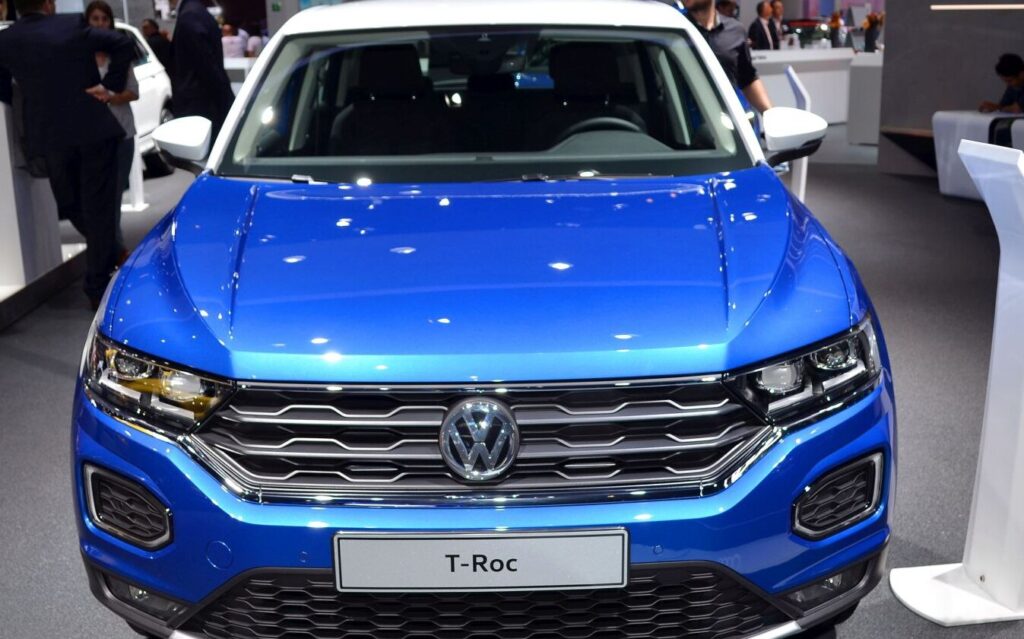
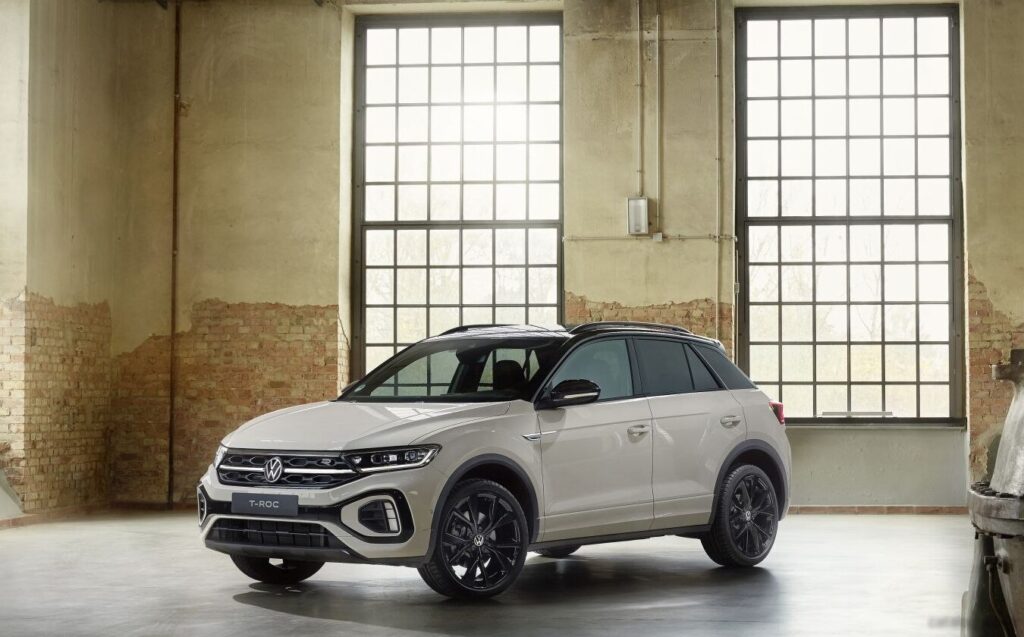
The Volkswagen T-Roc 2.0 TDI 4MOTION DSG, part of the first generation (A1) T-Roc lineup, arrived with the 2022 facelift. Built on the MQB platform (specifically the A1 variant, also used for the Audi A3 and SEAT Leon), it aimed to provide a more sophisticated and capable option within the increasingly competitive compact SUV market. This variant distinguished itself through its combination of a fuel-efficient diesel engine, the security of all-wheel drive, and the convenience of a seven-speed dual-clutch transmission. It occupied a sweet spot in the T-Roc range, appealing to buyers who needed practicality, performance, and all-weather confidence without opting for the more expensive and sporty R trim.
Powertrain & Engine Architecture
At the heart of the T-Roc 2.0 TDI 4MOTION DSG lies the EA288 evo series diesel engine, specifically the DTTC code. This 1968cc inline-four cylinder engine utilizes a common rail direct injection system, delivering fuel at extremely high pressures for optimized combustion. The engine features a turbocharger with an intercooler, boosting power output to 150 horsepower at 3500 rpm and a substantial 360 Nm (265.52 lb-ft) of torque available from 1600 to 2750 rpm. The DOHC valvetrain with four valves per cylinder further enhances breathing and efficiency. The seven-speed DSG (Direct-Shift Gearbox) is a crucial component, offering rapid and seamless gear changes. This transmission utilizes two separate clutches for pre-selecting the next gear, resulting in quicker acceleration and improved fuel economy compared to a traditional automatic. The 4MOTION system is a sophisticated all-wheel-drive setup, typically employing a Haldex multi-plate clutch to distribute torque between the front and rear axles as needed, providing enhanced traction in slippery conditions.
Driving Characteristics
The 2.0 TDI 4MOTION DSG delivers a refined and capable driving experience. The readily available torque from the diesel engine provides strong acceleration, particularly in the mid-range, making overtaking and merging onto highways effortless. While not a sports car, the 8.6-second 0-62 mph acceleration is respectable for a compact SUV. The DSG transmission contributes to smooth and quick gear changes, enhancing responsiveness. The 4MOTION system provides excellent grip and stability, especially on loose surfaces or in inclement weather. Compared to the lower-powered 1.0 TSI variants, the 2.0 TDI offers a more relaxed and confident driving experience, particularly when fully loaded or towing. Compared to the petrol engines, the diesel provides superior fuel economy, but lacks the immediate responsiveness of the TSI units. The gear ratios in the DSG are tuned for a balance of performance and efficiency, prioritizing fuel savings at cruising speeds.
Equipment & Trim Levels
The 2.0 TDI 4MOTION DSG trim typically included a generous level of standard equipment. Features commonly included automatic climate control, an 8-inch touchscreen infotainment system with Apple CarPlay and Android Auto compatibility, a digital instrument cluster, and a suite of safety features such as automatic emergency braking, lane departure warning, and adaptive cruise control. Interior upholstery was typically cloth or a combination of cloth and leatherette. Optional extras included a panoramic sunroof, upgraded sound system, navigation system, and various driver assistance packages. The overall interior design was modern and functional, with a focus on user-friendliness.
Chassis & Braking
The T-Roc’s chassis is tuned for a comfortable ride while maintaining decent handling characteristics. The front suspension utilizes MacPherson struts, while the rear suspension employs a multi-link setup. Stabilizer bars are fitted to both axles to reduce body roll during cornering. Braking duties are handled by ventilated discs at the front and solid discs at the rear. The braking system is assisted by ABS (Anti-lock Braking System) and electronic stability control. The 4MOTION system adds to the vehicle’s stability and control, particularly during braking on uneven surfaces.
Market Reception & Comparison
The T-Roc 2.0 TDI 4MOTION DSG was generally well-received by automotive critics. It was praised for its refined engine, comfortable ride, and all-weather capability. The fuel economy was also a strong point, particularly compared to petrol-powered rivals. However, some critics noted that the interior, while well-built, could feel a bit basic compared to some competitors. Compared to the 1.5 TSI Evo variants, the TDI offered better fuel economy and more torque, but lacked the same level of responsiveness. The 2.0 TDI also provided a more premium feel than the entry-level 1.0 TSI models. Reliability reports have been generally positive, with the EA288 engine proving to be a durable and long-lasting unit.
Legacy
The Volkswagen T-Roc 2.0 TDI 4MOTION DSG has established itself as a reliable and practical choice in the used car market. The EA288 engine, when properly maintained, is known for its longevity. The DSG transmission, while requiring occasional servicing, is generally robust. The 4MOTION system adds to the vehicle’s appeal, particularly in regions with harsh winters or challenging road conditions. As a result, well-maintained examples of this variant continue to hold their value and remain a popular choice for buyers seeking a versatile and capable compact SUV.