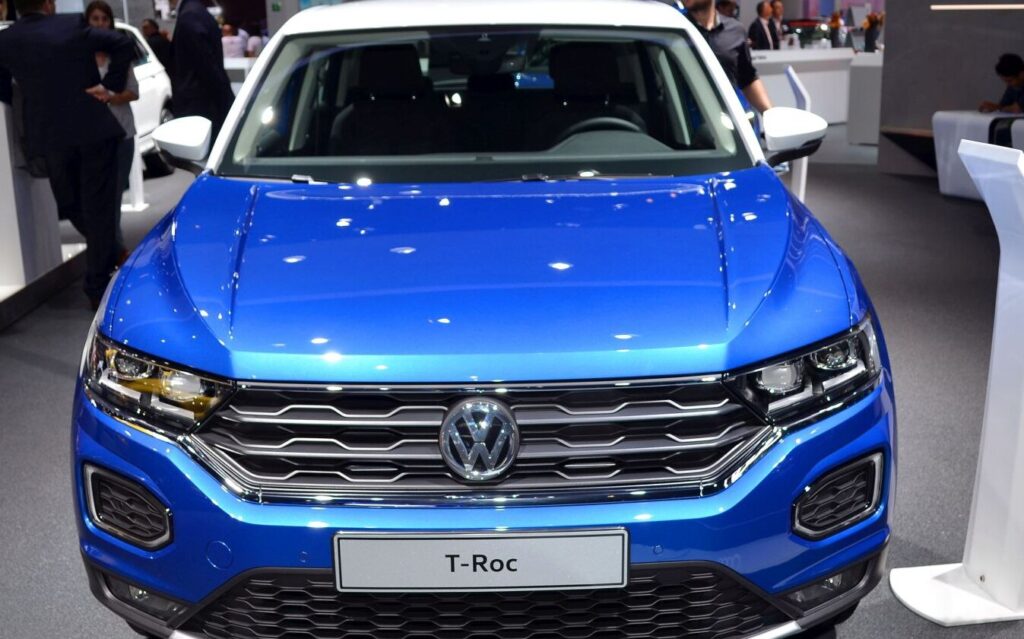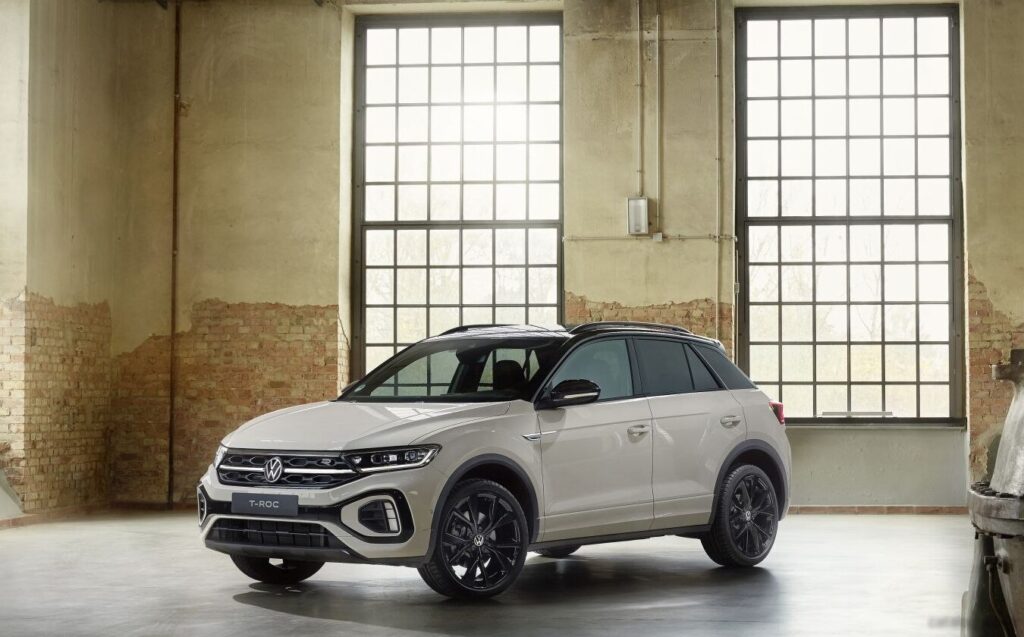
The Volkswagen T-Roc, launched in 2017, represented Volkswagen’s entry into the highly competitive subcompact SUV segment. The first generation (T-Roc I), and particularly the facelifted version introduced in 2022, aimed to broaden the model’s appeal with updated styling and refined powertrain options. Among these, the 2.0 TDI variant with 150 horsepower and a 7-speed Dual Clutch Gearbox (DSG) transmission was a significant offering, primarily targeted at European markets where diesel engines remained popular. Production of this specific configuration ran from 2022 to 2025.
Technical Specifications
| Brand | Volkswagen |
| Model | T-Roc |
| Generation | T-Roc I (facelift 2022) |
| Type (Engine) | 2.0 TDI (150 Hp) DSG |
| Start of production | 2022 |
| End of production | 2025 |
| Powertrain Architecture | Internal Combustion engine |
| Body type | SUV |
| Seats | 5 |
| Doors | 5 |
| Fuel consumption at Low speed (WLTP) | 6.6 l/100 km (35.6 US mpg, 42.8 UK mpg, 15.2 km/l) |
| Fuel consumption at Medium speed (WLTP) | 4.6 l/100 km (51.1 US mpg, 61.4 UK mpg, 21.7 km/l) |
| Fuel consumption at high speed (WLTP) | 4.1 l/100 km (57.4 US mpg, 68.9 UK mpg, 24.4 km/l) |
| Fuel consumption at very high speed (WLTP) | 5.1 l/100 km (46.1 US mpg, 55.4 UK mpg, 19.6 km/l) |
| Combined fuel consumption (WLTP) | 4.9 l/100 km (48 US mpg, 57.6 UK mpg, 20.4 km/l) |
| CO2 emissions (WLTP) | 128 g/km |
| Fuel consumption (economy) – urban (NEDC) | 4.9 l/100 km (48 US mpg, 57.6 UK mpg, 20.4 km/l) |
| Fuel consumption (economy) – extra urban (NEDC) | 3.8 l/100 km (61.9 US mpg, 74.3 UK mpg, 26.3 km/l) |
| Fuel consumption (economy) – combined (NEDC) | 4.2 l/100 km (56 US mpg, 67.3 UK mpg, 23.8 km/l) |
| CO2 emissions (NEDC) | 110 g/km |
| Fuel Type | Diesel |
| Acceleration 0 – 100 km/h | 8.6 sec |
| Acceleration 0 – 62 mph | 8.6 sec |
| Acceleration 0 – 60 mph | 8.2 sec |
| Maximum speed | 205 km/h (127.38 mph) |
| Emission standard | Euro 6d-ISC-FCM |
| Weight-to-power ratio | 9.2 kg/Hp, 108.7 Hp/tonne |
| Weight-to-torque ratio | 4.6 kg/Nm, 217.4 Nm/tonne |
| Power | 150 Hp @ 3500 rpm |
| Torque | 300 Nm @ 1600-2750 rpm (221.27 lb.-ft. @ 1600-2750 rpm) |
| Engine layout | Front, Transverse |
| Engine Model/Code | DTTC |
| Engine displacement | 1968 cm3 (120.09 cu. in.) |
| Number of cylinders | 4 |
| Engine configuration | Inline |
| Cylinder Bore | 81 mm (3.19 in.) |
| Piston Stroke | 95.5 mm (3.76 in.) |
| Number of valves per cylinder | 4 |
| Fuel injection system | Diesel Commonrail |
| Engine aspiration | Turbocharger, Intercooler |
| Valvetrain | DOHC |
| Engine oil capacity | 5.5 l (5.81 US qt | 4.84 UK qt) |
| Kerb Weight | 1380 kg (3042.38 lbs.) |
| Max. weight | 1960 kg (4321.06 lbs.) |
| Max load | 580 kg (1278.68 lbs.) |
| Trunk (boot) space – minimum | 445 l (15.72 cu. ft.) |
| Trunk (boot) space – maximum | 1290 l (45.56 cu. ft.) |
| Fuel tank capacity | 50 l (13.21 US gal | 11 UK gal) |
| AdBlue tank | 12 l (3.17 US gal | 2.64 UK gal) |
| Max. roof load | 75 kg (165.35 lbs.) |
| Permitted trailer load with brakes (8%) | 1800 kg (3968.32 lbs.) |
| Permitted trailer load with brakes (12%) | 1600 kg (3527.4 lbs.) |
| Permitted trailer load without brakes | 720 kg (1587.33 lbs.) |
| Permitted towbar download | 80 kg (176.37 lbs.) |
| Length | 4236 mm (166.77 in.) |
| Width | 1819 mm (71.61 in.) |
| Width including mirrors | 2012 mm (79.21 in.) |
| Height | 1584 mm (62.36 in.) |
| Wheelbase | 2590 mm (101.97 in.) |
| Front track | 1538-1549 mm (60.55 – 60.98 in.) |
| Rear (Back) track | 1531-1541 mm (60.28 – 60.67 in.) |
| Ride height (ground clearance) | 161 mm (6.34 in.) |
| Minimum turning circle (turning diameter) | 11.1 m (36.42 ft.) |
| Drivetrain Architecture | The Internal combustion engine (ICE) drives the front wheels of the vehicle. |
| Drive wheel | Front wheel drive |
| Number of gears and type of gearbox | 7 gears, automatic transmission DSG |
| Front suspension | Independent type McPherson, Transverse stabilizer |
| Rear suspension | Semi-dependent beam with stabilizer lateral stability |
| Front brakes | Ventilated discs |
| Rear brakes | Disc |
| Tires size | 205/60 R16; 215/60 R16; 215/55 R17; 215/50 R18 |
| Wheel rims size | 6J x 16; 6.5J x 16; 7J x 17; 7J x 18 |
INTRODUCTION
The 2022 facelift of the Volkswagen T-Roc I brought a refreshed look and updated technology to the popular subcompact SUV. The 2.0 TDI 150 hp DSG model occupied a middle ground in the T-Roc lineup, offering a balance between fuel efficiency, performance, and price. Positioned above the entry-level 1.0 TSI petrol engine and below the more powerful (and often more expensive) 2.0 TSI variants, it catered to buyers prioritizing economy and torque for everyday driving and occasional longer journeys. This variant was particularly popular in Europe, where diesel engines continued to hold a significant market share due to their fuel efficiency and lower running costs.
Powertrain & Engine Architecture
The heart of this T-Roc variant is the DTTC engine, a 2.0-liter four-cylinder turbocharged diesel engine. This engine is part of Volkswagen’s modular engine family and utilizes a common rail direct injection system, delivering fuel directly into the combustion chamber at extremely high pressure. The engine employs a variable geometry turbocharger (VGT) and an intercooler to optimize performance and efficiency. The DOHC (Double Overhead Camshaft) valvetrain, with four valves per cylinder, further enhances breathing and power output. The engine produces 150 horsepower at 3500 rpm and a substantial 300 Nm (221 lb-ft) of torque between 1600 and 2750 rpm. This broad torque curve provides strong acceleration and effortless cruising. Paired with the engine is a 7-speed Dual Clutch Gearbox (DSG). This transmission offers quick, smooth shifts and contributes to improved fuel economy compared to a traditional automatic transmission. The DSG features both a wet clutch design for durability and paddle shifters for manual control.
Driving Characteristics
The 2.0 TDI 150 hp DSG T-Roc delivers a composed and refined driving experience. While not overtly sporty, the engine’s ample torque provides brisk acceleration, with a 0-60 mph time of around 8.2 seconds. The DSG transmission shifts quickly and seamlessly, making for a comfortable ride in most conditions. The gear ratios are tuned for a balance of fuel efficiency and responsiveness. Compared to the lower-powered 1.0 TSI petrol engine, the TDI offers significantly more torque, resulting in easier overtaking and a more relaxed driving experience, especially when fully loaded or on inclines. However, it lacks the outright punch of the 2.0 TSI models. The front-wheel-drive configuration provides adequate traction for most everyday driving scenarios, although it can struggle for grip in slippery conditions.
Equipment & Trim Levels
The 2.0 TDI 150 hp DSG T-Roc typically came equipped with a generous level of standard features. These included air conditioning, a touchscreen infotainment system with Apple CarPlay and Android Auto compatibility, Bluetooth connectivity, and a suite of safety features such as automatic emergency braking and lane departure warning. Interior upholstery was typically cloth, with options for leather upgrades. Higher trim levels offered additional features such as a larger touchscreen display, navigation system, adaptive cruise control, and a panoramic sunroof. Optional extras included LED headlights, parking sensors, and a premium sound system.
Chassis & Braking
The T-Roc’s chassis is based on the MQB platform, providing a solid and well-balanced foundation. The front suspension utilizes an independent McPherson strut setup, while the rear employs a semi-independent torsion beam. This configuration strikes a good balance between ride comfort and handling. The 2.0 TDI models typically featured ventilated front disc brakes and solid rear disc brakes, providing adequate stopping power for the vehicle’s weight and performance. Anti-lock Braking System (ABS) and Electronic Stability Control (ESC) were standard safety features.
Market Reception & Comparison
The 2.0 TDI 150 hp DSG T-Roc was generally well-received by automotive critics. It was praised for its fuel efficiency, comfortable ride, and refined powertrain. However, some reviewers noted that the interior materials could feel a bit basic in lower trim levels. Compared to the petrol-powered T-Roc variants, the TDI offered superior fuel economy and torque, making it a more practical choice for drivers covering long distances. Compared to competitors like the Nissan Juke and Renault Captur, the T-Roc offered a more sophisticated driving experience and a more spacious interior.
Legacy
The 2.0 TDI engine, in various iterations, has proven to be a reliable and durable powertrain within the Volkswagen Group. While diesel engines have faced increased scrutiny in recent years due to emissions concerns, the DTTC engine, when properly maintained, is generally considered to be a robust unit. On the used car market, the 2022-2025 T-Roc 2.0 TDI 150 hp DSG models hold their value reasonably well, particularly those with a full service history and low mileage. Potential buyers should be aware of the importance of regular servicing, including AdBlue refills and diesel particulate filter (DPF) maintenance, to ensure long-term reliability.