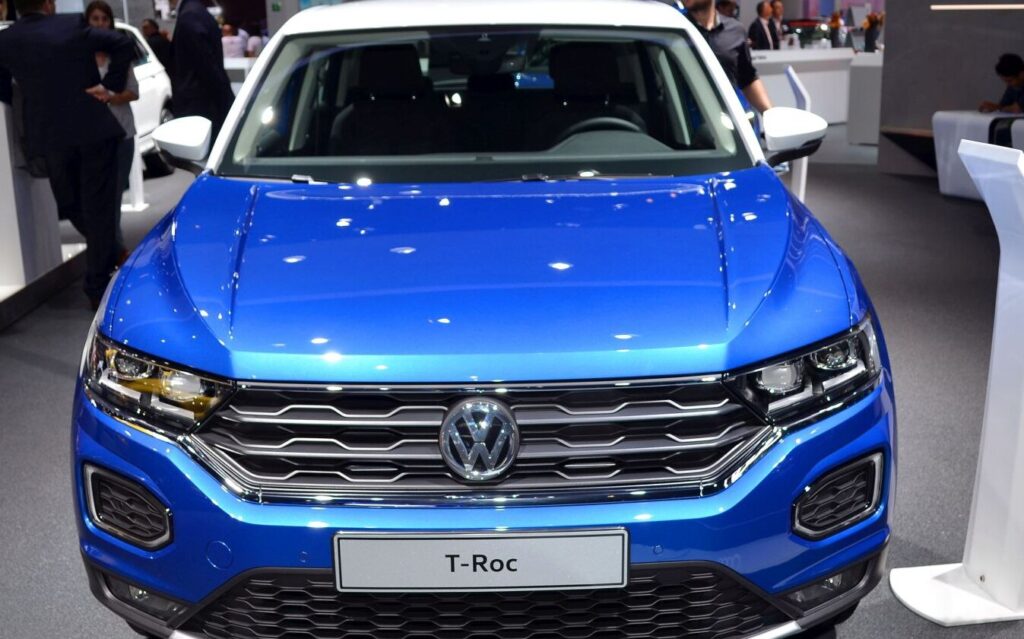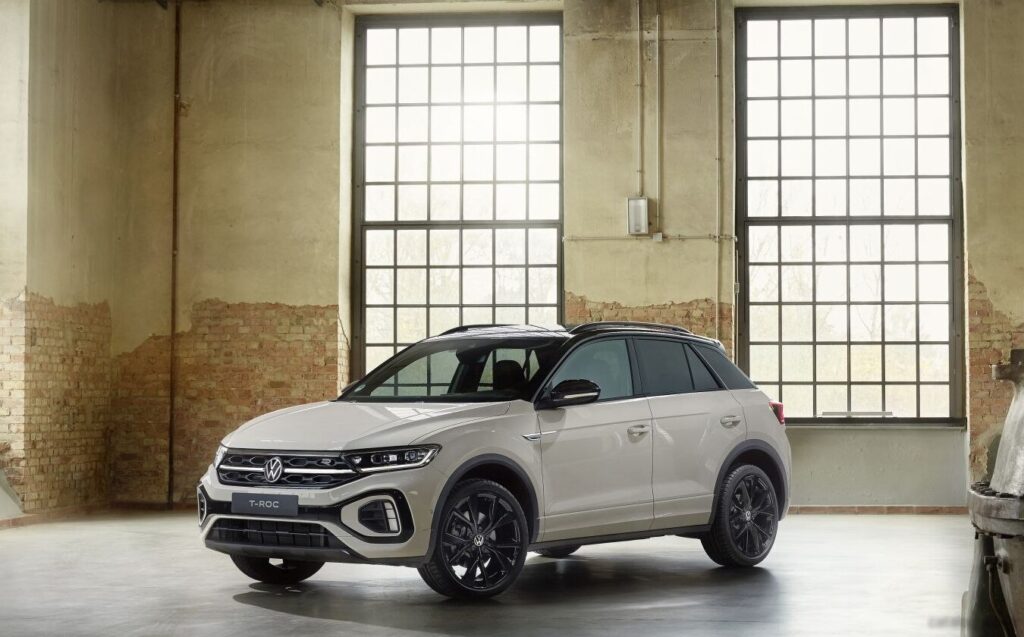
The Volkswagen T-Roc, launched in 2017, represents Volkswagen’s entry into the highly competitive subcompact SUV market. The first generation (T-Roc I), and particularly the facelifted version introduced in 2022, aimed to blend practicality, style, and technology. The 2.0 TSI 190 hp 4MOTION DSG variant, produced from 2022 to 2025, occupied the upper-mid range of the T-Roc lineup, offering a performance-oriented option with all-wheel drive capability. This model was primarily marketed in Europe and other international markets, offering a more engaging driving experience than the base engine options while remaining more accessible than the full-performance R trim.
Technical Specifications
| Brand | Volkswagen |
| Model | T-Roc |
| Generation | T-Roc I (facelift 2022) |
| Type (Engine) | 2.0 TSI (190 Hp) 4MOTION DSG |
| Start of production | 2022 |
| End of production | 2025 |
| Powertrain Architecture | Internal Combustion engine |
| Body type | SUV |
| Seats | 5 |
| Doors | 5 |
| Fuel consumption at Low speed (WLTP) | 9.8 l/100 km (24 US mpg, 28.8 UK mpg, 10.2 km/l) |
| Fuel consumption at Medium speed (WLTP) | 7.4 l/100 km (31.8 US mpg, 38.2 UK mpg, 13.5 km/l) |
| Fuel consumption at high speed (WLTP) | 6.3 l/100 km (37.3 US mpg, 44.8 UK mpg, 15.9 km/l) |
| Fuel consumption at very high speed (WLTP) | 7.2 l/100 km (32.7 US mpg, 39.2 UK mpg, 13.9 km/l) |
| Combined fuel consumption (WLTP) | 7.3 l/100 km (32.2 US mpg, 38.7 UK mpg, 13.7 km/l) |
| CO2 emissions (WLTP) | 166 g/km |
| Fuel consumption (economy) – urban (NEDC) | 7.5 l/100 km (31.4 US mpg, 37.7 UK mpg, 13.3 km/l) |
| Fuel consumption (economy) – extra urban (NEDC) | 5.7 l/100 km (41.3 US mpg, 49.6 UK mpg, 17.5 km/l) |
| Fuel consumption (economy) – combined (NEDC) | 6.3 l/100 km (37.3 US mpg, 44.8 UK mpg, 15.9 km/l) |
| CO2 emissions (NEDC) | 145 g/km |
| Fuel Type | Petrol (Gasoline) |
| Acceleration 0 – 100 km/h | 6.8 sec |
| Acceleration 0 – 62 mph | 6.8 sec |
| Acceleration 0 – 60 mph | 6.5 sec |
| Maximum speed | 218 km/h (135.46 mph) |
| Emission standard | Euro 6 EA |
| Weight-to-power ratio | 7.7 kg/Hp, 130.5 Hp/tonne |
| Weight-to-torque ratio | 4.6 kg/Nm, 219.8 Nm/tonne |
| Power | 190 Hp @ 4200-6000 rpm |
| Torque | 320 Nm @ 1500-4100 rpm (236.02 lb.-ft. @ 1500-4100 rpm) |
| Engine layout | Front, Transverse |
| Engine Model/Code | EA888 evo4 / DNNA |
| Engine displacement | 1984 cm3 (121.07 cu. in.) |
| Number of cylinders | 4 |
| Engine configuration | Inline |
| Cylinder Bore | 82.5 mm (3.25 in.) |
| Piston Stroke | 92.8 mm (3.65 in.) |
| Compression ratio | 12.2:1 |
| Number of valves per cylinder | 4 |
| Fuel injection system | Direct injection |
| Engine aspiration | Turbocharger, Intercooler |
| Valvetrain | DOHC |
| Engine oil capacity | 5.7 l (6.02 US qt | 5.02 UK qt) |
| Kerb Weight | 1456 kg (3209.93 lbs.) |
| Max. weight | 2040 kg (4497.43 lbs.) |
| Max load | 584 kg (1287.5 lbs.) |
| Trunk (boot) space – minimum | 392 l (13.84 cu. ft.) |
| Trunk (boot) space – maximum | 1237 l (43.68 cu. ft.) |
| Fuel tank capacity | 55 l (14.53 US gal | 12.1 UK gal) |
| Max. roof load | 75 kg (165.35 lbs.) |
| Permitted trailer load with brakes (8%) | 1900 kg (4188.78 lbs.) |
| Permitted trailer load with brakes (12%) | 1700 kg (3747.86 lbs.) |
| Permitted trailer load without brakes | 750 kg (1653.47 lbs.) |
| Permitted towbar download | 80 kg (176.37 lbs.) |
| Length | 4236 mm (166.77 in.) |
| Width | 1819 mm (71.61 in.) |
| Width including mirrors | 2012 mm (79.21 in.) |
| Height | 1582 mm (62.28 in.) |
| Wheelbase | 2594 mm (102.13 in.) |
| Front track | 1537-1547 mm (60.51 – 60.91 in.) |
| Rear (Back) track | 1542-1552 mm (60.71 – 61.1 in.) |
| Ride height (ground clearance) | 158 mm (6.22 in.) |
| Minimum turning circle (turning diameter) | 11.1 m (36.42 ft.) |
| Drivetrain Architecture | All wheel drive (4×4). Internal Combustion engine. |
| Number of gears and type of gearbox | 7 gears, automatic transmission DSG |
INTRODUCTION
The 2022-2025 Volkswagen T-Roc 2.0 TSI 4MOTION DSG represents a significant step up in performance and capability within the T-Roc range. Built on the MQB platform (specifically the A1 variant, also used for the Audi A3 and VW Golf), this variant aimed to provide a more dynamic driving experience while retaining the practicality and compact dimensions that made the T-Roc popular. The facelift introduced in 2022 brought styling updates, enhanced technology, and refinements to the engine lineup, solidifying the T-Roc’s position as a key player in the competitive European small SUV segment. This particular configuration was not widely available in the North American market, where Volkswagen focused on larger SUV offerings.
Powertrain & Engine Architecture
At the heart of the T-Roc 2.0 TSI 4MOTION DSG lies the EA888 evo4 engine, a 1.984-liter turbocharged inline-four cylinder gasoline engine. This engine, bearing the code DNNA, is a sophisticated unit featuring direct fuel injection, a variable valve timing system (DOHC), and an integrated intercooler. The turbocharger provides significant boost, contributing to the engine’s 190 horsepower output at 4200-6000 rpm and 320 Nm (236 lb-ft) of torque available from a low 1500 rpm to 4100 rpm. The engine utilizes a relatively high compression ratio of 12.2:1, optimizing combustion efficiency. Paired with this engine is the 7-speed dual-clutch transmission (DSG), known for its quick and smooth gear changes. The 4MOTION all-wheel-drive system is a sophisticated setup that proactively distributes torque between the front and rear axles, enhancing traction and stability, particularly in adverse weather conditions. The system typically operates with a front-wheel-drive bias, engaging the rear wheels when slip is detected or during more aggressive driving.
Driving Characteristics
The 2.0 TSI 4MOTION DSG variant of the T-Roc delivers a noticeably more engaging driving experience compared to the lower-powered engine options. Acceleration from 0-100 km/h (0-62 mph) takes approximately 6.8 seconds, making it a relatively quick vehicle in its class. The DSG transmission contributes to this performance, providing rapid shifts and keeping the engine within its optimal power band. The 4MOTION system provides excellent grip and stability, inspiring confidence in various driving conditions. While not a dedicated sports SUV, the T-Roc 2.0 TSI offers a balanced blend of performance and comfort. The gear ratios in the DSG are tuned for both acceleration and fuel efficiency, providing a responsive feel in everyday driving. Compared to a manual transmission equipped T-Roc, the DSG offers convenience and quicker acceleration, but some enthusiasts might miss the direct engagement of a manual gearbox.
Equipment & Trim Levels
The 2.0 TSI 4MOTION DSG trim typically came well-equipped, positioning it as a mid-to-high range offering within the T-Roc lineup. Standard features often included automatic climate control, a touchscreen infotainment system with smartphone integration (Apple CarPlay and Android Auto), and a suite of driver-assistance systems such as lane-keeping assist, adaptive cruise control, and automatic emergency braking. Interior upholstery was typically a combination of cloth and leatherette, with options for full leather available. Optional extras could include a panoramic sunroof, upgraded sound system, and various styling packages. The dashboard layout was modern and functional, with a focus on ease of use.
Chassis & Braking
The T-Roc’s chassis features an independent suspension setup at both the front (McPherson strut) and rear (multi-link). This configuration provides a good balance between ride comfort and handling precision. Stabilizer bars are fitted to both axles to reduce body roll during cornering. Braking duties are handled by ventilated discs at the front and solid discs at the rear, providing adequate stopping power. The electronic stability control (ESC) system works in conjunction with the ABS (Anti-lock Braking System) to enhance safety and control. The 4MOTION system also contributes to improved braking performance by distributing braking force optimally between the axles.
Market Reception & Comparison
The T-Roc 2.0 TSI 4MOTION DSG was generally well-received by automotive critics. It was praised for its responsive engine, capable handling, and comfortable ride. The 4MOTION system was highlighted as a significant advantage, particularly in regions with inclement weather. Compared to other trims in the T-Roc lineup, the 2.0 TSI offered a noticeable performance upgrade, but at a higher price point. Fuel economy was respectable, but not class-leading, given the engine’s output and the all-wheel-drive system. Competitors in this segment included the Nissan Qashqai, Peugeot 3008, and Kia Sportage, each offering a different blend of features and performance.
Legacy
The EA888 evo4 engine, in various iterations, has proven to be a reliable and durable powerplant. The DSG transmission, while requiring periodic maintenance (fluid changes), is generally considered robust. The T-Roc 2.0 TSI 4MOTION DSG holds its value reasonably well in the used car market, particularly examples with a well-maintained service history. Its combination of performance, practicality, and all-wheel-drive capability continues to appeal to buyers seeking a versatile and engaging small SUV. While not a collector’s item, it represents a well-engineered and enjoyable vehicle from Volkswagen’s modern lineup.