Technical Specifications
| Brand | Volkswagen |
| Model | T-Roc |
| Generation | T-Roc I (facelift 2022) |
| Type (Engine) | R 2.0 TSI (300 Hp) OPF 4MOTION DSG |
| Start of production | January, 2022 |
| End of production | 2025 |
| Powertrain Architecture | Internal Combustion engine |
| Body type | SUV |
| Seats | 5 |
| Doors | 5 |
| Fuel consumption at Low speed (WLTP) | 11.9 l/100 km (19.8 US mpg, 23.7 UK mpg, 8.4 km/l) |
| Fuel consumption at Medium speed (WLTP) | 8.3 l/100 km (28.3 US mpg, 34 UK mpg, 12 km/l) |
| Fuel consumption at high speed (WLTP) | 7.3 l/100 km (32.2 US mpg, 38.7 UK mpg, 13.7 km/l) |
| Fuel consumption at very high speed (WLTP) | 8.5 l/100 km (27.7 US mpg, 33.2 UK mpg, 11.8 km/l) |
| Combined fuel consumption (WLTP) | 8.5 l/100 km (27.7 US mpg, 33.2 UK mpg, 11.8 km/l) |
| CO2 emissions (WLTP) | 194 g/km |
| Fuel consumption (economy) – urban (NEDC) | 9.3 l/100 km (25.3 US mpg, 30.4 UK mpg, 10.8 km/l) |
| Fuel consumption (economy) – extra urban (NEDC) | 6.8 l/100 km (34.6 US mpg, 41.5 UK mpg, 14.7 km/l) |
| Fuel consumption (economy) – combined (NEDC) | 7.8 l/100 km (30.2 US mpg, 36.2 UK mpg, 12.8 km/l) |
| CO2 emissions (NEDC) | 177 g/km |
| Fuel Type | Petrol (Gasoline) |
| Acceleration 0 – 100 km/h | 4.9 sec |
| Acceleration 0 – 62 mph | 4.9 sec |
| Acceleration 0 – 60 mph | 4.7 sec |
| Maximum speed | 250 km/h (155.34 mph), Electronically limited |
| Emission standard | Euro 6d-ISC-FCM |
| Weight-to-power ratio | 5.3 kg/Hp, 190.1 Hp/tonne |
| Weight-to-torque ratio | 3.9 kg/Nm, 253.5 Nm/tonne |
| Power | 300 Hp @ 5300-6500 rpm |
| Power per litre | 151.2 Hp/l |
| Torque | 400 Nm @ 2000-5200 rpm (295.02 lb.-ft. @ 2000-5200 rpm) |
| Engine layout | Front, Transverse |
| Engine displacement | 1984 cm3 (121.07 cu. in.) |
| Number of cylinders | 4 |
| Engine configuration | Inline |
| Number of valves per cylinder | 4 |
| Fuel injection system | Direct injection |
| Engine aspiration | Turbocharger, Intercooler |
| Valvetrain | DOHC |
| Kerb Weight | 1578 kg (3478.89 lbs.) |
| Max. weight | 2060 kg (4541.52 lbs.) |
| Max load | 482 kg (1062.63 lbs.) |
| Trunk (boot) space – minimum | 392 l (13.84 cu. ft.) |
| Fuel tank capacity | 55 l (14.53 US gal | 12.1 UK gal) |
| Max. roof load | 75 kg (165.35 lbs.) |
| Permitted trailer load with brakes (8%) | 1900 kg (4188.78 lbs.) |
| Permitted trailer load with brakes (12%) | 1700 kg (3747.86 lbs.) |
| Permitted trailer load without brakes | 750 kg (1653.47 lbs.) |
| Permitted towbar download | 80 kg (176.37 lbs.) |
| Length | 4236 mm (166.77 in.) |
| Width | 1819 mm (71.61 in.) |
| Width including mirrors | 2012 mm (79.21 in.) |
| Height | 1568 mm (61.73 in.) |
| Wheelbase | 2594 mm (102.13 in.) |
| Front track | 1541-1549 mm (60.67 – 60.98 in.) |
| Rear (Back) track | 1550-1558 mm (61.02 – 61.34 in.) |
| Approach angle | 17.5° |
| Departure angle | 19.5° |
| Ramp-over (brakeover) angle | 13.5° |
| Drivetrain Architecture | The Internal combustion engine (ICE) drives the front wheels permanently, and the rear wheels are driven through an electrically or mechanically operated clutch if necessary. |
| Drive wheel | All wheel drive (4×4) |
| Number of gears and type of gearbox | 7 gears, automatic transmission DSG |
| Front suspension | Independent, type McPherson with coil spring and anti-roll bar |
| Rear suspension | Independent multi-link spring suspension with stabilizer |
| Front brakes | Ventilated discs |
| Rear brakes | Ventilated discs |
| Assisting systems | ABS (Anti-lock braking system) |
| Steering type | Steering rack and pinion |
| Power steering | Electric Steering |
| Tires size | 215/50 R18 |
| Wheel rims size | 7J x 18 |
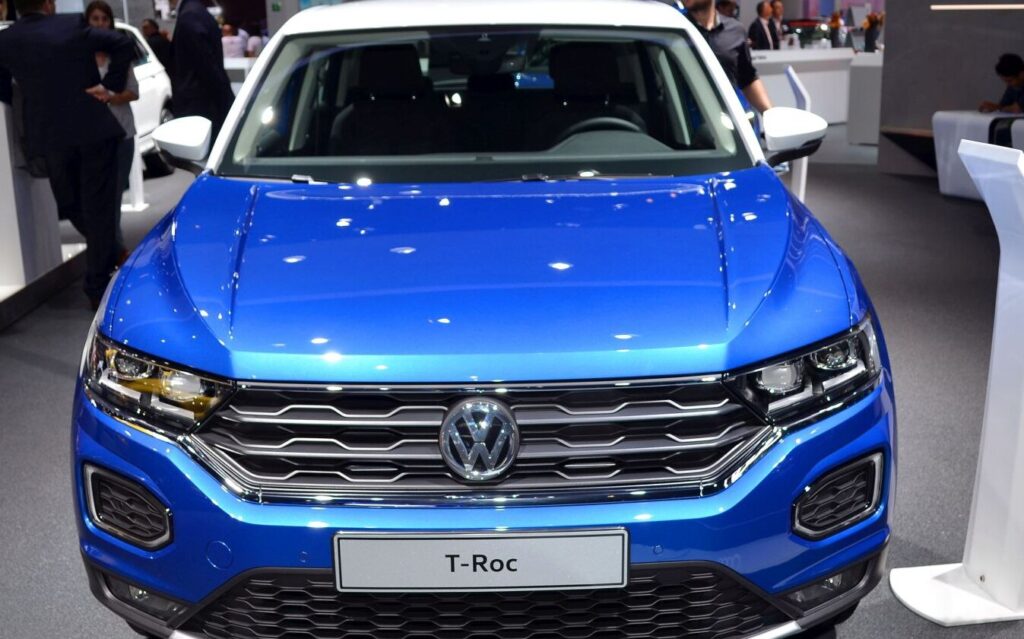
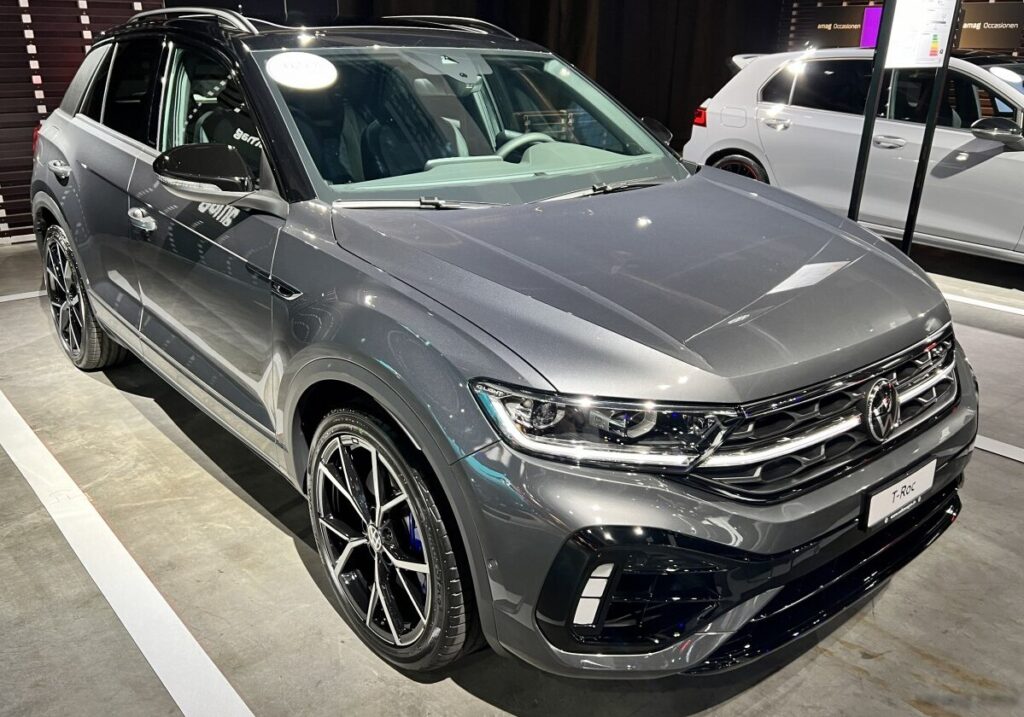
The Volkswagen T-Roc R 2.0 TSI (300 hp) OPF 4MOTION DSG represents the high-performance pinnacle of the first-generation T-Roc, introduced with the 2022 facelift. Production spanned from January 2022 to 2025. Positioned as the flagship model within the T-Roc range, it aimed to deliver a compelling blend of everyday usability and sporty driving dynamics in the increasingly popular compact SUV segment. The T-Roc itself was Volkswagen’s response to the growing demand for subcompact SUVs, designed to attract a younger demographic seeking a vehicle that was both stylish and practical. The “R” designation signifies Volkswagen’s performance division, analogous to AMG for Mercedes-Benz or M for BMW.
Powertrain & Engine Architecture
The core of the T-Roc R is the EA888 2.0-liter turbocharged four-cylinder engine. This engine, in its 300 horsepower configuration, is a widely utilized powerplant throughout the Volkswagen Group, also found in models like the Golf R and Audi S3. The engine code typically corresponds to later iterations of the EA888 family. It features direct fuel injection, a sophisticated seven-speed dual-clutch transmission (DSG), and an integrated exhaust manifold designed to improve turbocharger responsiveness. The turbocharger is a twin-scroll unit, further enhancing this responsiveness. The engine employs a double overhead camshaft (DOHC) valvetrain with four valves per cylinder, optimizing airflow for increased power output. A particulate filter (OPF) is included to comply with stringent Euro 6d emissions regulations. The seven-speed DSG transmission provides quick and precise gear changes, contributing to the car’s sporty character. The 4MOTION all-wheel-drive system utilizes a Haldex system, proactively distributing torque between the front and rear axles based on driving conditions.
Driving Characteristics
The T-Roc R delivers a noticeably more engaging driving experience compared to lower-powered T-Roc variants. Acceleration from 0 to 60 mph is achieved in approximately 4.7 seconds, making it one of the quicker vehicles in its class. The DSG transmission is well-tuned, offering both automatic convenience and the ability to manually shift gears via paddle shifters. The 4MOTION system provides excellent traction, particularly in inclement weather. While the suspension is firmer than on standard T-Rocs, it remains compliant enough for everyday driving. The steering is precise and well-weighted, providing good feedback to the driver. The engine delivers a broad torque curve, providing strong acceleration throughout the rev range. Compared to a T-Roc equipped with a manual transmission, the DSG offers quicker shifts but may lack the direct engagement preferred by some driving enthusiasts.
Equipment & Trim Levels
The T-Roc R came generously equipped as standard. Key features included sport seats upholstered in fabric and Alcantara, a digital cockpit display, a large touchscreen infotainment system with navigation, and a premium sound system. Exterior styling cues included unique front and rear bumpers, a rear spoiler, and quad exhaust outlets. Optional extras included leather upholstery, adaptive cruise control, a panoramic sunroof, and various driver assistance systems. The interior generally featured a dark color scheme with contrasting stitching and “R” badging throughout.
Chassis & Braking
The T-Roc R features a sport-tuned suspension with stiffer springs and dampers compared to other T-Roc models. It also benefits from a larger stabilizer bar, reducing body roll during cornering. Braking is handled by ventilated disc brakes on all four wheels, providing ample stopping power. The ABS (Anti-lock Braking System) is standard, along with electronic stability control. The suspension geometry is optimized for handling and stability, providing a balanced ride.
Market Reception & Comparison
The T-Roc R was generally well-received by automotive critics, who praised its performance, handling, and practicality. It was often compared to rivals such as the Audi SQ2 and the BMW X2 M35i. While the T-Roc R offered a compelling performance package, its fuel economy was somewhat lower than that of some competitors. However, its more affordable price point and spacious interior made it an attractive option for buyers seeking a sporty and practical SUV. Compared to the standard T-Roc 1.5 TSI, the R offered a significant performance upgrade but came at a higher price and with increased running costs.
Legacy
The EA888 engine, in its various iterations, has proven to be a robust and reliable powerplant. The DSG transmission, while requiring periodic maintenance, is generally considered durable. The T-Roc R has established itself as a desirable used car, particularly among enthusiasts seeking a high-performance compact SUV. Its combination of performance, practicality, and style has ensured its continued popularity in the used car market. Regular maintenance, including oil changes and DSG fluid services, is crucial for ensuring the long-term reliability of this vehicle.