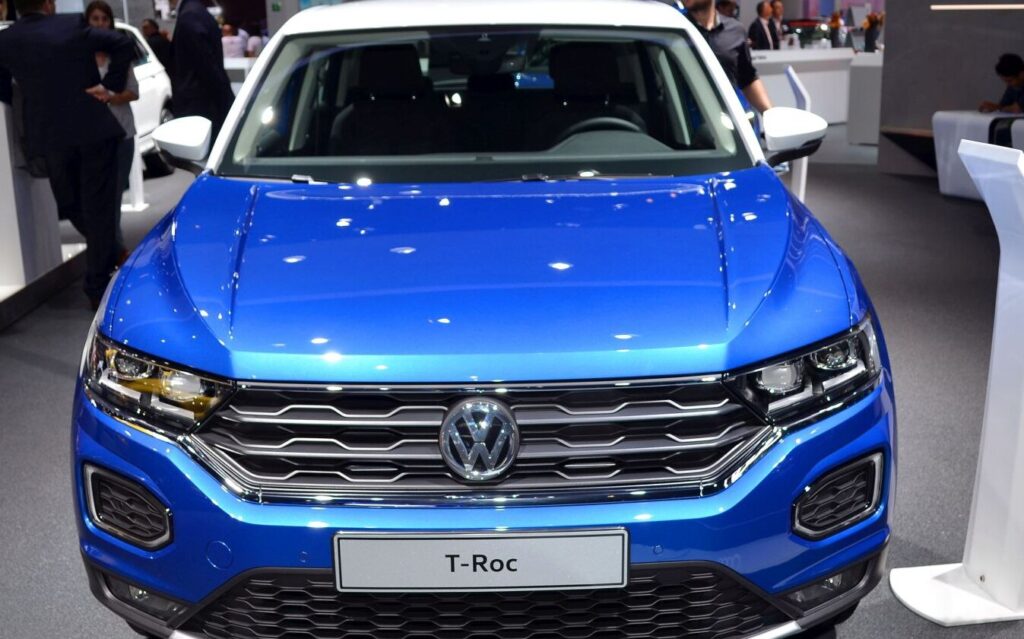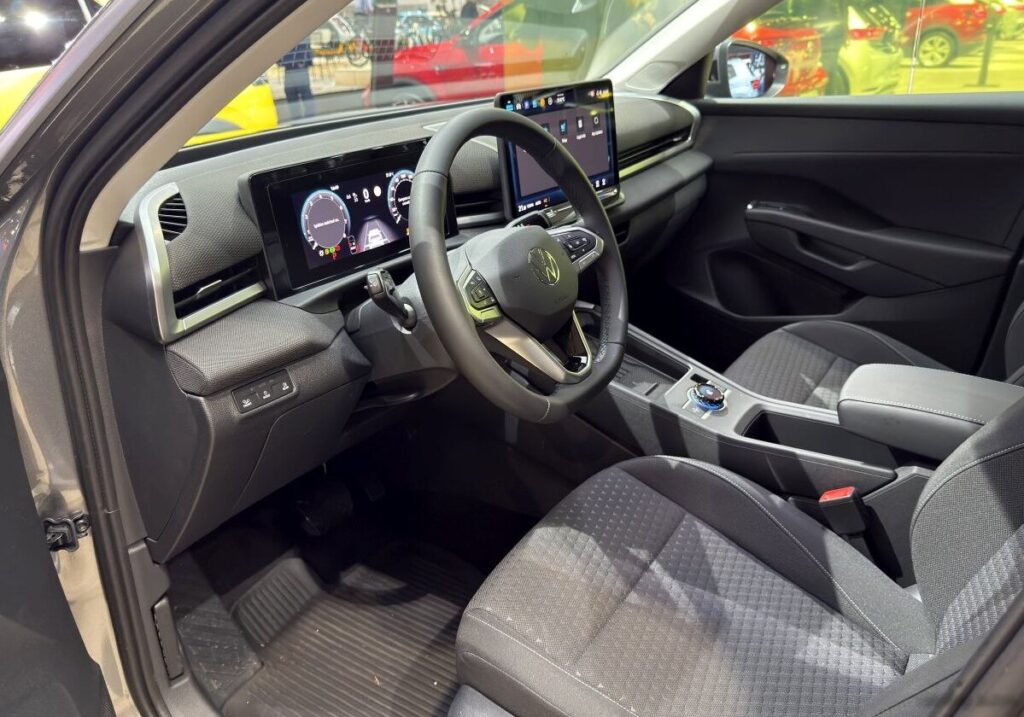
The Volkswagen T-Roc II 1.5 eTSI (116 Hp) Mild Hybrid DSG represents a key variant within the second generation of Volkswagen’s popular subcompact SUV, the T-Roc. Introduced in August 2025, this model combines a gasoline-powered 1.5-liter turbocharged engine with a 48-volt mild hybrid system and a 7-speed dual-clutch transmission (DSG). Positioned as a mid-range offering, it aims to balance fuel efficiency, performance, and affordability within the T-Roc II lineup, which also includes more powerful gasoline engines and diesel options. The T-Roc II builds upon the success of the first-generation T-Roc, continuing Volkswagen’s strategy of offering a versatile and modern SUV for the European and increasingly global markets.
Technical Specifications
| Brand | Volkswagen |
| Model | T-Roc |
| Generation | T-Roc II |
| Type (Engine) | 1.5 eTSI (116 Hp) Mild Hybrid DSG |
| Start of production | August, 2025 |
| Powertrain Architecture | MHEV (Mild Hybrid Electric Vehicle) |
| Body type | SUV |
| Seats | 5 |
| Doors | 5 |
| Fuel consumption at Low speed (WLTP) | 7 l/100 km (33.6 US mpg, 40.4 UK mpg, 14.3 km/l) |
| Fuel consumption at Medium speed (WLTP) | 5.1-5.2 l/100 km (46.1 – 45.2 US mpg, 55.4 – 54.3 UK mpg, 19.6 – 19.2 km/l) |
| Fuel consumption at high speed (WLTP) | 4.7-4.8 l/100 km (50 – 49 US mpg, 60.1 – 58.9 UK mpg, 21.3 – 20.8 km/l) |
| Fuel consumption at very high speed (WLTP) | 5.9-6.1 l/100 km (39.9 – 38.6 US mpg, 47.9 – 46.3 UK mpg, 16.9 – 16.4 km/l) |
| Combined fuel consumption (WLTP) | 5.5-5.7 l/100 km (42.8 – 41.3 US mpg, 51.4 – 49.6 UK mpg, 18.2 – 17.5 km/l) |
| CO2 emissions (WLTP) | 126-129 g/km |
| Fuel Type | Petrol (Gasoline) |
| Acceleration 0 – 100 km/h | 10.6 sec |
| Acceleration 0 – 62 mph | 10.6 sec |
| Acceleration 0 – 60 mph | 10.1 sec |
| Maximum speed | 196 km/h (121.79 mph) |
| Emission standard | Euro 6e |
| Weight-to-power ratio | 12 kg/Hp, 83.5 Hp/tonne |
| Weight-to-torque ratio | 6.3 kg/Nm, 158.3 Nm/tonne |
| Battery voltage | 48 V |
| Battery technology | Lithium-ion (Li-Ion) |
| Electric motor power | 19 Hp |
| Electric motor Torque | 56 Nm (41.3 lb.-ft.) |
| Electric motor location | Front, Transverse |
| Power | 116 Hp @ 5000 rpm |
| Torque | 220 Nm @ 1500-3000 rpm (162.26 lb.-ft. @ 1500-3000 rpm) |
| Engine layout | Front, Transverse |
| Engine Model/Code | EA211 evo2 |
| Engine displacement | 1498 cm3 (91.41 cu. in.) |
| Number of cylinders | 4 |
| Engine configuration | Inline |
| Cylinder Bore | 74.5 mm (2.93 in.) |
| Piston Stroke | 85.9 mm (3.38 in.) |
| Number of valves per cylinder | 4 |
| Fuel injection system | Direct injection |
| Engine aspiration | Turbocharger, Intercooler |
| Valvetrain | DOHC |
| Engine systems | Start & Stop System, Cylinder deactivation system, Particulate filter |
| Kerb Weight | 1390 kg (3064.43 lbs.) |
| Max. weight | 1980 kg (4365.15 lbs.) |
| Max load | 590 kg (1300.73 lbs.) |
| Trunk (boot) space – minimum | 475 l (16.77 cu. ft.) |
| Trunk (boot) space – maximum | 1350 l (47.67 cu. ft.) |
| Fuel tank capacity | 50 l (13.21 US gal | 11 UK gal) |
| Permitted trailer load with brakes (8%) | 1500 kg (3306.93 lbs.) |
| Permitted trailer load with brakes (12%) | 1300 kg (2866.01 lbs.) |
| Permitted trailer load without brakes | 730 kg (1609.37 lbs.) |
| Permitted towbar download | 80 kg (176.37 lbs.) |
| Length | 4372 mm (172.13 in.) |
| Width | 1828 mm (71.97 in.) |
| Width including mirrors | 2044 mm (80.47 in.) |
| Height | 1573 mm (61.93 in.) |
| Wheelbase | 2629 mm (103.5 in.) |
| Front track | 1572-1574 mm (61.89 – 61.97 in.) |
| Rear (Back) track | 1546-1548 mm (60.87 – 60.94 in.) |
| Drag coefficient (Cd) | 0.29 |
| Minimum turning circle (turning diameter) | 11.1 m (36.42 ft.) |
| Approach angle | 16.2° |
| Departure angle | 18.7° |
| Ramp-over (brakeover) angle | 14° |
| Drivetrain Architecture | ICE and electric motor drive the front wheels, mixed mode operation. |
| Drive wheel | Front wheel drive |
| Number of gears and type of gearbox | 7 gears, automatic transmission DSG |
| Front suspension | Independent, type McPherson with coil spring and anti-roll bar |
| Front brakes | Ventilated discs |
| Assisting systems | ABS (Anti-lock braking system) |
| Steering type | Steering rack and pinion |
| Power steering | Electric Steering |
| Tires size | 205/60 R16; 215/60 R16; 225/60 R16; 215/55 R17; 225/55 R17; 225/50 R18 |
| Wheel rims size | 6.5J x 16; 7J x 16; 7J x 17; 7J x 18 |
Powertrain & Engine Architecture
At the heart of the T-Roc II 1.5 eTSI lies the EA211 evo2 1.5-liter inline-four cylinder gasoline engine. This engine utilizes direct fuel injection and a single turbocharger with intercooling to produce 116 horsepower at 5000 rpm and 220 Nm (162.26 lb-ft) of torque between 1500 and 3000 rpm. The ‘eTSI’ designation indicates the inclusion of a 48-volt mild hybrid system. This system comprises a belt-integrated starter generator (BSG) and a small lithium-ion battery. The BSG allows for extended start-stop functionality, regenerative braking to recoup energy during deceleration, and a limited amount of electric assistance during acceleration. The 7-speed dual-clutch transmission (DSG) is standard, offering quick and smooth gear changes. The DSG’s programming is tuned to prioritize fuel efficiency and comfort, rather than outright performance.
Driving Characteristics
The 1.5 eTSI with the DSG transmission delivers a comfortable and refined driving experience. Acceleration from 0-100 km/h (0-62 mph) takes 10.6 seconds, which is adequate for everyday driving but not particularly sporty. The mild hybrid system provides a subtle boost during acceleration, but the overall performance is noticeably less spirited than higher-powered T-Roc variants. The DSG transmission generally shifts smoothly, although some drivers may notice a slight hesitation at lower speeds. The gear ratios are optimized for fuel economy, resulting in a relatively relaxed cruising experience. Compared to a manual transmission version (if offered), the DSG prioritizes convenience and ease of use over driver engagement.
Equipment & Trim Levels
The T-Roc II 1.5 eTSI typically comes equipped with a respectable level of standard features. These generally include air conditioning, a touchscreen infotainment system with smartphone integration (Apple CarPlay and Android Auto), LED headlights, and a suite of driver-assistance systems such as automatic emergency braking and lane-keeping assist. Interior upholstery is typically cloth, with options for leather or partial leather upgrades. Higher trim levels may add features like a larger touchscreen, a digital instrument cluster, adaptive cruise control, and a panoramic sunroof. Optional extras often include metallic paint, upgraded audio systems, and parking sensors.
Chassis & Braking
The T-Roc II utilizes a McPherson strut front suspension and a multi-link rear suspension, providing a good balance between ride comfort and handling. The suspension is tuned to be relatively compliant, absorbing bumps and imperfections in the road surface effectively. Braking duties are handled by ventilated discs at the front and solid discs at the rear. Anti-lock braking system (ABS) is standard, along with electronic stability control. The steering is electrically assisted, providing a light and precise feel.
Market Reception & Comparison
The T-Roc II 1.5 eTSI has been generally well-received by automotive critics as a practical and efficient choice within the subcompact SUV segment. Its fuel economy figures of 5.5-5.7 l/100 km (42.8 – 41.3 US mpg) are competitive, particularly considering its size and versatility. Compared to the more powerful gasoline engines in the T-Roc II lineup, the 1.5 eTSI offers lower running costs but sacrifices some performance. The diesel variants provide even better fuel economy, but may be subject to stricter emissions regulations in some markets. The mild hybrid system adds a layer of efficiency without significantly increasing the vehicle’s price.
Legacy
The EA211 engine family, including the 1.5 TSI variant, has proven to be relatively reliable in numerous Volkswagen Group vehicles. The addition of the mild hybrid system is expected to further enhance its longevity by reducing stress on the engine during start-stop cycles. However, as with any modern vehicle, regular maintenance is crucial to ensure long-term reliability. The DSG transmission, while generally robust, requires periodic servicing to maintain optimal performance. On the used car market, the T-Roc II 1.5 eTSI is likely to appeal to buyers seeking a fuel-efficient, well-equipped, and relatively affordable subcompact SUV.