
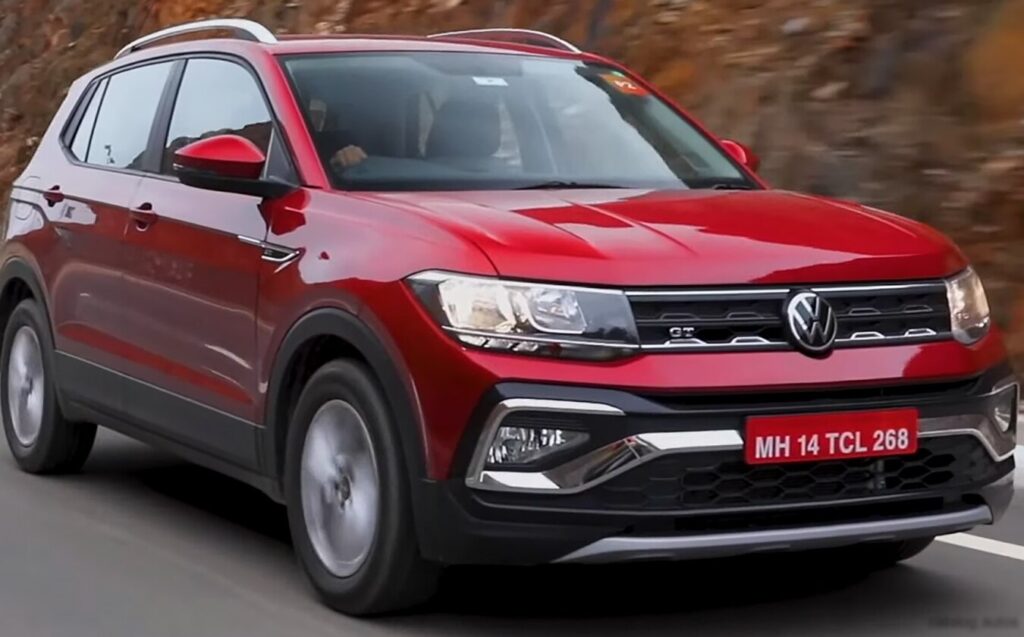
The Volkswagen Taigun 1.0 TSI (115 hp) represents Volkswagen’s entry into the subcompact SUV market, specifically tailored for regions like India and South America. Introduced in 2021, the Taigun is built on the MQB-A0-IN platform, a localized version of the global Modular Transverse Matrix. This variant, powered by the 1.0-liter TSI engine, occupies the lower end of the Taigun lineup, offering a balance of fuel efficiency and affordability. It’s positioned as an alternative to larger, more expensive SUVs, and competes with models like the Hyundai Venue and Kia Sonet.
Technical Specifications
| Brand | Volkswagen |
| Model | Taigun |
| Generation | Taigun |
| Type (Engine) | 1.0 TSI (115 Hp) |
| Start of production | 2021 |
| Powertrain Architecture | Internal Combustion engine |
| Body type | SUV |
| Seats | 5 |
| Doors | 5 |
| Fuel consumption (combined) | 5.5 l/100 km (42.8 US mpg, 51.4 UK mpg, 18.2 km/l) |
| Fuel Type | Petrol (Gasoline) |
| Weight-to-power ratio | 10.4 kg/Hp, 96.2 Hp/tonne |
| Weight-to-torque ratio | 6.7 kg/Nm, 149 Nm/tonne |
| Power | 115 Hp @ 5000-5500 rpm |
| Power per litre | 115.1 Hp/l |
| Torque | 178 Nm @ 1750-4500 rpm (131.29 lb.-ft. @ 1750-4500 rpm) |
| Engine layout | Front, Transverse |
| Engine Model/Code | EA211 |
| Engine displacement | 999 cm3 (60.96 cu. in.) |
| Number of cylinders | 3 |
| Engine configuration | Inline |
| Cylinder Bore | 74.5 mm (2.93 in.) |
| Piston Stroke | 76.4 mm (3.01 in.) |
| Compression ratio | 10.5:1 |
| Number of valves per cylinder | 4 |
| Fuel injection system | Multi-port manifold injection |
| Engine aspiration | Turbocharger, Intercooler |
| Valvetrain | DOHC |
| Engine oil capacity | 4 l (4.23 US qt | 3.52 UK qt) |
| Kerb Weight | 1195-1240 kg (2634.52 – 2733.73 lbs.) |
| Max. weight | 1650 kg (3637.63 lbs.) |
| Max load | 410-455 kg (903.9 – 1003.1 lbs.) |
| Trunk (boot) space – minimum | 385 l (13.6 cu. ft.) |
| Trunk (boot) space – maximum | 1405 l (49.62 cu. ft.) |
| Fuel tank capacity | 50 l (13.21 US gal | 11 UK gal) |
| Length | 4221 mm (166.18 in.) |
| Width | 1760 mm (69.29 in.) |
| Height | 1612 mm (63.46 in.) |
| Wheelbase | 2651 mm (104.37 in.) |
| Front track | 1531 mm (60.28 in.) |
| Rear (Back) track | 1516 mm (59.69 in.) |
| Ride height (ground clearance) | 188 mm (7.4 in.) |
| Minimum turning circle | 10.1 m (33.14 ft.) |
| Drivetrain Architecture | Front wheel drive |
| Number of gears and type of gearbox | 6 gears, manual transmission |
| Front suspension | Independent, type McPherson with coil spring and anti-roll bar |
| Rear suspension | Threaded twist beam |
| Front brakes | Disc |
| Rear brakes | Drum |
| Assisting systems | ABS (Anti-lock braking system) |
| Steering type | Steering rack and pinion |
| Power steering | Electric Steering |
| Tires size | 205/60 R16; 205/55 R17 |
INTRODUCTION
The Volkswagen Taigun 1.0 TSI, launched in 2021, is a compact SUV designed primarily for the Indian and South American markets. It represents Volkswagen’s commitment to offering locally relevant vehicles, built on the MQB-A0-IN platform. This platform is a cost-optimized version of the MQB architecture, allowing for competitive pricing. The 1.0 TSI variant serves as the entry point to the Taigun range, appealing to buyers seeking a fuel-efficient and practical urban SUV. It’s a five-seater, five-door vehicle intended to provide a comfortable and modern driving experience within its segment.
Powertrain & Engine Architecture
At the heart of the Taigun 1.0 TSI lies the EA211 engine, a three-cylinder, 1.0-liter turbocharged gasoline engine. This engine is part of Volkswagen’s modular engine family, known for its efficiency and compact design. The engine utilizes multi-point fuel injection and a single turbocharger with an intercooler to deliver a balance of power and fuel economy. The engine produces 115 horsepower at 5000-5500 rpm and 178 Nm (131.29 lb-ft) of torque between 1750 and 4500 rpm. The engine features a double overhead camshaft (DOHC) valvetrain with four valves per cylinder. The Taigun 1.0 TSI is paired with a 6-speed manual transmission, optimized for delivering smooth shifts and maximizing fuel efficiency. The engine’s transverse mounting and front-wheel-drive configuration contribute to its compact footprint.
Driving Characteristics
The Taigun 1.0 TSI offers a comfortable and predictable driving experience, geared towards urban commuting. While not a performance-oriented vehicle, the turbocharger provides adequate power for everyday driving situations. Acceleration is linear, with the peak torque available from a relatively low 1750 rpm, making it responsive in city traffic. The 6-speed manual transmission allows for driver engagement, but the gear ratios are tuned for fuel efficiency rather than outright speed. Compared to higher-spec Taigun variants with the 1.5-liter TSI engine, the 1.0 TSI feels less powerful, particularly when fully loaded or tackling steep inclines. However, its lighter weight and efficient engine contribute to better fuel economy. The steering is light and precise, making it easy to maneuver in tight spaces.
Equipment & Trim Levels
The Taigun 1.0 TSI typically comes with a decent level of standard equipment, though features vary depending on the specific trim level. Base models generally include air conditioning, power windows, power-adjustable side mirrors, and a basic audio system. Higher trims add features like a touchscreen infotainment system with Apple CarPlay and Android Auto, automatic climate control, rear parking sensors, and alloy wheels. Safety features typically include dual airbags, ABS, and electronic stability control. Optional extras may include a sunroof, rear camera, and upgraded upholstery. Interior upholstery is typically cloth, with a focus on durability and practicality. The dashboard layout is modern and functional, with a clear instrument cluster and intuitive controls.
Chassis & Braking
The Taigun 1.0 TSI utilizes a McPherson strut suspension setup at the front, providing a comfortable ride and good handling characteristics. The rear suspension employs a threaded twist beam, which is a cost-effective and space-saving solution. The braking system consists of disc brakes at the front and drum brakes at the rear. ABS (Anti-lock Braking System) is standard, enhancing safety during emergency braking situations. The chassis is designed to provide a balance of stability and agility, with a focus on absorbing bumps and minimizing body roll. The relatively lightweight construction of the 1.0 TSI variant contributes to its nimble handling.
Market Reception & Comparison
The Volkswagen Taigun 1.0 TSI has been generally well-received in its target markets, particularly for its fuel efficiency and value proposition. Critics have praised its comfortable ride, modern interior, and decent features list. However, some have noted that the 1.0-liter engine can feel underpowered in certain situations. Compared to the 1.5-liter TSI variants, the 1.0 TSI offers significantly better fuel economy but sacrifices some performance. It competes directly with other subcompact SUVs like the Hyundai Venue, Kia Sonet, and Tata Nexon, offering a compelling alternative with Volkswagen’s reputation for build quality and reliability. Fuel economy figures of around 5.5 l/100 km (42.8 US mpg) are competitive within its class.
Legacy
The Volkswagen Taigun 1.0 TSI represents a significant step for Volkswagen in catering to the growing demand for affordable and fuel-efficient SUVs in emerging markets. The EA211 engine has proven to be a reliable and durable powertrain, and its widespread use across the Volkswagen Group suggests long-term parts availability. While it’s still relatively early to assess its long-term reliability definitively, the Taigun 1.0 TSI is expected to hold its value reasonably well in the used car market, particularly among buyers seeking a practical and economical urban SUV. Its success will likely influence Volkswagen’s future product strategy in these regions, potentially leading to further localized models and powertrain options.
