
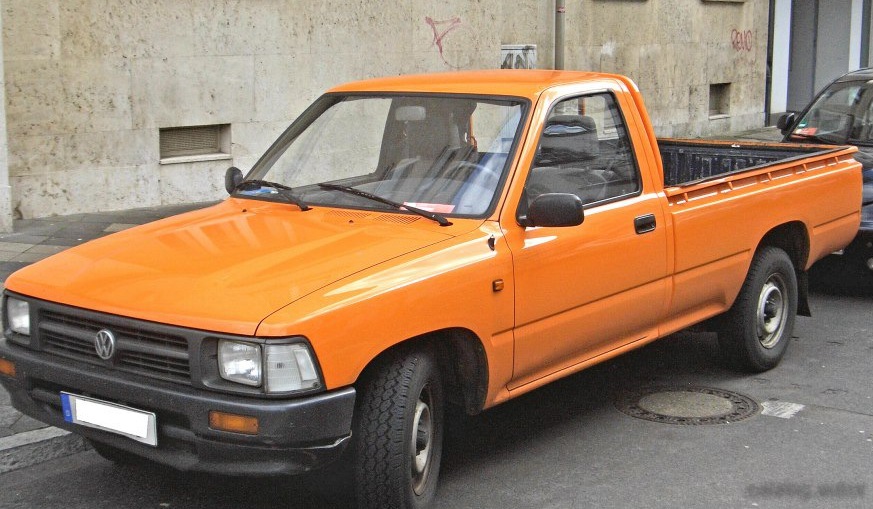
Technical Specifications
| Brand | Volkswagen |
| Model | Taro |
| Generation | Taro |
| Type (Engine) | 1.8 (83 Hp) |
| Start of production | 1989 year |
| End of production | 1994 year |
| Powertrain Architecture | Internal Combustion engine |
| Body type | Pick-up |
| Seats | 2 |
| Doors | 2 |
| Fuel consumption (extra urban) | 7.4 l/100 km (31.8 US mpg, 38.2 UK mpg, 13.5 km/l) |
| Fuel Type | Petrol (Gasoline) |
| Maximum speed | 145 km/h (90.1 mph) |
| Power | 83 Hp @ 4800 rpm |
| Power per litre | 45.8 Hp/l |
| Torque | 140 Nm @ 2400 rpm (103.26 lb.-ft. @ 2400 rpm) |
| Engine layout | Front, Longitudinal |
| Engine Model/Code | 2Y |
| Engine displacement | 1812 cm3 (110.58 cu. in.) |
| Number of cylinders | 4 |
| Engine configuration | Inline |
| Cylinder Bore | 86 mm (3.39 in.) |
| Piston Stroke | 78 mm (3.07 in.) |
| Compression ratio | 8.8:1 |
| Number of valves per cylinder | 2 |
| Fuel injection system | Carburettor |
| Engine aspiration | Naturally aspirated engine |
| Engine oil capacity | 3.5 l (3.7 US qt | 3.08 UK qt) |
| Fuel tank capacity | 56 l (14.79 US gal | 12.32 UK gal) |
| Length | 4725 mm (186.02 in.) |
| Width | 1650 mm (64.96 in.) |
| Height | 1550 mm (61.02 in.) |
| Wheelbase | 2850 mm (112.2 in.) |
| Front track | 1355 mm (53.35 in.) |
| Rear track | 1370 mm (53.94 in.) |
| Minimum turning circle | 12.6 m (41.34 ft.) |
| Drivetrain Architecture | The Internal combustion engine (ICE) drives the rear wheels of the vehicle. |
| Drive wheel | Rear wheel drive |
| Number of gears and type of gearbox | 5 gears, manual transmission |
| Front suspension | Double wishbone |
| Rear suspension | Leaf spring |
| Front brakes | Ventilated discs |
| Rear brakes | Drum |
| Steering type | Cone worm with recirculation balls |
| Wheel rims size | 5.5J x 14 |
The Volkswagen Taro 1.8, producing 83 horsepower, was a compact pickup truck manufactured between 1989 and 1994. It represented Volkswagen’s foray into the small pickup segment, primarily targeted at the European and Asian markets. The Taro was fundamentally a rebadged version of the Toyota Hilux, a direct result of a collaborative agreement between the two automotive giants. This partnership allowed Volkswagen to enter the commercially viable pickup truck market without incurring the substantial development costs associated with creating a completely new platform. The 1.8-liter variant occupied the entry-level position in the Taro lineup, positioned as a more affordable and fuel-efficient option, though potential diesel offerings never came to fruition. It was designed for light-duty applications, appealing to small business owners, farmers, and individuals needing a practical vehicle for occasional hauling tasks.
Powertrain & Engine Architecture
The Volkswagen Taro 1.8 was powered by a 1.8-liter inline four-cylinder engine, internally designated with the Toyota 2Y engine code. While originating from Toyota, the engine was adapted for use within the Volkswagen Taro. It employed a carbureted fuel injection system, a relatively simple and cost-effective technology prevalent during that era. The engine featured an overhead valve (OHV) valvetrain configuration with two valves per cylinder. This design prioritized simplicity and reliability over achieving peak performance. The engine’s 8.8:1 compression ratio represented a compromise between maximizing efficiency and accommodating the varying fuel quality standards found in different markets. The 1.8-liter engine generated 83 horsepower at 4800 rpm and 140 Nm (103.26 lb.-ft.) of torque at 2400 rpm. The Taro utilized a robust 5-speed manual transmission, transmitting power to the rear wheels. This transmission was selected for its durability and suitability for light commercial applications.
Driving Characteristics
The 1.8-liter Taro delivered modest, but adequate, performance. Acceleration was sufficient for typical daily driving scenarios, but the vehicle wasn’t engineered for rapid acceleration or consistently carrying heavy loads. The carbureted engine provided a relatively linear power delivery, making it predictable and easy to modulate. Compared to potential diesel-powered versions, the 1.8 offered a quieter and more responsive driving experience, although at the expense of fuel economy and low-end pulling power. The 5-speed manual transmission allowed drivers to optimize engine speed for varying driving conditions. The gear ratios were carefully spaced to strike a balance between acceleration and fuel efficiency. While not a particularly sporty vehicle, the Taro provided a comfortable and functional driving experience well-suited to its intended purpose.
Equipment & Trim Levels
The Volkswagen Taro 1.8 was generally offered with a basic level of standard equipment, reflecting its positioning as a work-oriented vehicle. Standard features typically included a durable vinyl interior, basic instrumentation, and a functional heating system. Power steering was not usually included as standard equipment, and air conditioning was a rare option. The dashboard layout was functional and straightforward, prioritizing practicality over aesthetic appeal. Optional extras were limited, but could include upgraded interior trim materials, a radio, and potentially a limited-slip differential to enhance traction in challenging conditions. The Taro’s interior was designed to withstand the demands of commercial use, utilizing durable materials and a focus on ease of cleaning.
Chassis & Braking
The Taro’s chassis was based on the proven Toyota Hilux platform, providing a solid and durable foundation. The front suspension utilized a double wishbone setup, offering a reasonable level of ride comfort and handling characteristics. The rear suspension employed traditional leaf springs, a design renowned for its load-carrying capacity and long-term durability. The braking system consisted of ventilated discs at the front and drum brakes at the rear. This configuration was deemed adequate for the vehicle’s weight and intended use. Steering was accomplished through a cone worm and recirculation balls system, providing a direct but somewhat firm steering feel. The Taro’s 5.5J x 14 inch steel wheels were fitted with tires designed to provide acceptable performance both on and off paved surfaces.
Market Reception & Comparison
The Volkswagen Taro 1.8 received a mixed reception from automotive critics. Praise was generally directed towards its build quality and overall reliability, benefiting from the underlying Toyota Hilux engineering. However, the 1.8-liter engine was frequently criticized as being underpowered, particularly when compared to diesel-powered competitors. Fuel economy was considered reasonable, but not exceptional. The Taro’s relatively higher price point compared to some other small pickup trucks also drew some criticism. In comparison to a hypothetical diesel version, the 1.8 offered a smoother and quieter driving experience, but lacked the diesel’s superior torque output and fuel efficiency. The Taro’s primary appeal rested on its Volkswagen badge and the associated perception of quality associated with the brand.
Legacy
The Volkswagen Taro, while not a resounding commercial success, has become a relatively sought-after vehicle among collectors and enthusiasts. Its simplicity, durability, and the connection to both Volkswagen and Toyota contribute to its enduring appeal. The 1.8-liter engine, while not exceptionally powerful, is known for its inherent reliability and relatively straightforward maintenance requirements. Parts availability can sometimes be a challenge, as many components are specific to the Toyota Hilux. However, the Taro’s robust construction and the widespread availability of Toyota parts ensure that a significant number of examples remain operational today. In the current used car market, the Taro 1.8 represents a unique and practical alternative to more commonly found small pickup trucks.
