
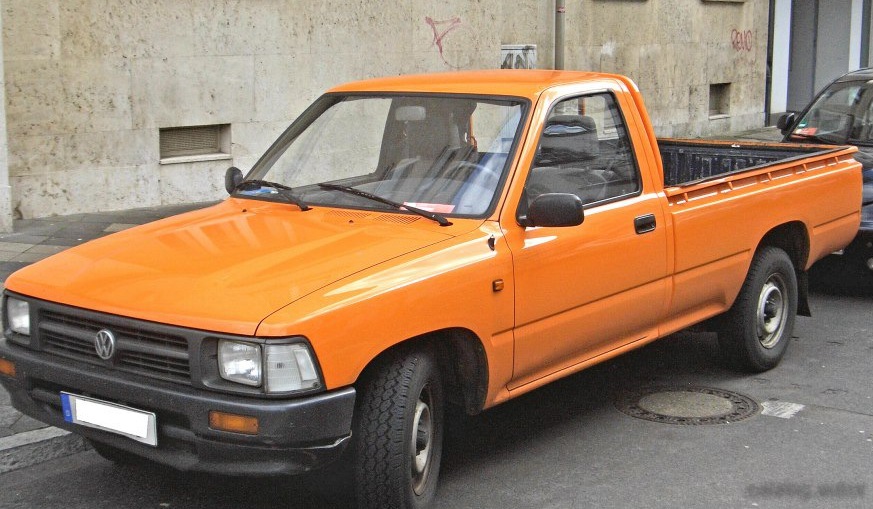
The Volkswagen Taro 2.4 D (83 hp) 4WD was a compact pickup truck produced between 1989 and 1991. It represented Volkswagen’s entry into the small pickup segment, primarily aimed at markets where such vehicles were popular for commercial and light-duty applications. The Taro was essentially a rebadged Toyota Hilux, a result of a collaborative agreement between the two manufacturers. This partnership allowed Volkswagen to offer a robust and reliable pickup without the extensive development costs. Within the Taro lineup, the 2.4 D 4WD variant occupied a position geared towards practicality and durability, prioritizing functionality over outright performance. It served as a workhorse option, appealing to buyers needing a capable four-wheel-drive vehicle for hauling and navigating challenging terrain.
Technical Specifications
| Brand | Volkswagen |
| Model | Taro |
| Generation | Taro |
| Type (Engine) | 2.4 D (83 Hp) 4WD |
| Start of production | 1989 year |
| End of production | 1991 year |
| Powertrain Architecture | Internal Combustion engine |
| Body type | Pick-up |
| Seats | 2 |
| Doors | 2 |
| Fuel consumption (extra urban) | 9.8 l/100 km (24 US mpg, 28.8 UK mpg, 10.2 km/l) |
| Fuel Type | Diesel |
| Maximum speed | 130 km/h (80.78 mph) |
| Weight-to-power ratio | 18.5 kg/Hp, 54.2 Hp/tonne |
| Weight-to-torque ratio | 9.3 kg/Nm, 107.7 Nm/tonne |
| Power | 83 Hp @ 4200 rpm |
| Power per litre | 33.9 Hp/l |
| Torque | 165 Nm @ 2400 rpm (121.7 lb.-ft. @ 2400 rpm) |
| Maximum engine speed | 4800 rpm |
| Engine layout | Front, Longitudinal |
| Engine Model/Code | 2L |
| Engine displacement | 2446 cm3 (149.26 cu. in.) |
| Number of cylinders | 4 |
| Engine configuration | Inline |
| Cylinder Bore | 92 mm (3.62 in.) |
| Piston Stroke | 92 mm (3.62 in.) |
| Compression ratio | 22.2:1 |
| Number of valves per cylinder | 2 |
| Fuel injection system | Precombustion chamber injection |
| Engine aspiration | Naturally aspirated engine |
| Valvetrain | SOHC |
| Engine oil capacity | 5.8 l (6.13 US qt | 5.1 UK qt) |
| Kerb Weight | 1532 kg (3377.48 lbs.) |
| Max. weight | 2460 kg (5423.37 lbs.) |
| Max load | 928 kg (2045.89 lbs.) |
| Fuel tank capacity | 56 l (14.79 US gal | 12.32 UK gal) |
| Permitted trailer load with brakes (12%) | 1500 kg (3306.93 lbs.) |
| Permitted trailer load without brakes | 600 kg (1322.77 lbs.) |
| Permitted towbar download | 75 kg (165.35 lbs.) |
| Length | 4725 mm (186.02 in.) |
| Width | 1690 mm (66.54 in.) |
| Height | 1745 mm (68.7 in.) |
| Wheelbase | 2850 mm (112.2 in.) |
| Front track | 1420 mm (55.91 in.) |
| Rear (Back) track | 1400 mm (55.12 in.) |
| Minimum turning circle | 13.6 m (44.62 ft.) |
| Drivetrain Architecture | The Internal combustion engine (ICE) drives permanently the four wheels of the vehicle. |
| Drive wheel | All wheel drive (4×4) |
| Number of gears and type of gearbox | 5 gears, manual transmission |
| Front suspension | Rigid axle suspension, Leaf spring |
| Rear suspension | Leaf spring |
| Front brakes | Ventilated discs |
| Rear brakes | Drum |
| Steering type | Cone worm with recirculation balls |
| Wheel rims size | 6J x 16 |
Powertrain & Engine Architecture
The Volkswagen Taro 2.4 D was powered by a naturally aspirated, inline-four cylinder diesel engine. This engine, designated the 2L, was sourced directly from Toyota and was a common powerplant in the Hilux range. It featured a precombustion chamber injection system, a design prevalent in diesel engines of the era, which aided in cold starting and smoother combustion. The engine produced 83 horsepower at 4200 rpm and 165 Nm (121.7 lb-ft) of torque at 2400 rpm. The engine’s robust construction and relatively simple design contributed to its durability and reliability. The Taro utilized a five-speed manual transmission, delivering power to all four wheels via a permanent four-wheel-drive system. This system, while providing enhanced traction, lacked a low-range gear, limiting its off-road capability compared to some other 4×4 pickups.
Driving Characteristics
The 2.4 D engine in the Taro, coupled with the five-speed manual transmission, provided adequate, though not exhilarating, performance. Acceleration was modest, and the engine required frequent shifting to maintain momentum, especially when loaded. The gear ratios were geared towards maximizing fuel economy and providing sufficient torque for hauling and towing. Compared to potential gasoline-powered alternatives or even higher-output diesel versions of the Hilux, the Taro 2.4 D felt somewhat underpowered. However, its strength lay in its ability to consistently deliver torque at low engine speeds, making it well-suited for demanding tasks. The four-wheel-drive system provided enhanced stability and traction on slippery surfaces, but the lack of a low-range gear limited its ability to tackle extremely challenging off-road conditions.
Equipment & Trim Levels
The Volkswagen Taro 2.4 D 4WD was generally sparsely equipped, reflecting its utilitarian purpose. Standard features typically included a basic dashboard with essential gauges, vinyl upholstery, and a robust heating system. Power steering was not standard, requiring more effort at low speeds. Options were limited, often including upgraded audio systems or minor cosmetic enhancements. The interior was functional and durable, designed to withstand the rigors of commercial use. The focus was on providing a practical and reliable work vehicle rather than luxury or comfort.
Chassis & Braking
The Taro’s chassis was a ladder-frame construction, providing a solid and durable foundation for the vehicle. The front suspension utilized a rigid axle with leaf springs, while the rear suspension also employed leaf springs. This setup prioritized load-carrying capacity and durability over ride comfort. The braking system consisted of ventilated discs on the front wheels and drum brakes on the rear. While adequate for normal driving conditions, the braking performance was not particularly sophisticated. The steering system was a cone worm with recirculation balls, offering a direct but somewhat heavy feel.
Market Reception & Comparison
The Volkswagen Taro, and specifically the 2.4 D 4WD variant, received mixed reviews. Critics generally praised its reliability and durability, attributes inherited from the Toyota Hilux. However, its relatively low power output and basic equipment levels were often criticized. Compared to other pickups available in Europe at the time, the Taro offered a competitive price point but lacked the refinement and features of some rivals. Fuel economy was reasonable for a diesel pickup of its era. The Taro’s main advantage lay in its reputation for dependability and its association with the well-regarded Toyota Hilux.
Legacy
The Volkswagen Taro, despite its short production run, remains a relatively sought-after vehicle among enthusiasts and collectors. Its simplicity, durability, and association with the Toyota Hilux contribute to its appeal. The 2.4 D engine, while not particularly powerful, is known for its longevity and relatively straightforward maintenance. Today, well-maintained examples of the Taro 2.4 D 4WD can command a premium in the used car market, particularly among those seeking a classic and reliable pickup truck. The Taro serves as a reminder of Volkswagen’s brief foray into the compact pickup segment and its collaboration with Toyota.
